Spring Awakening: The Marmots’ Joyful Show at the Vanoise Park
Share
The Spring Awakening of the Marmots: An Enchanting Spectacle in the Vanoise National Park
Every year, between March and April, the Vanoise National Park slowly awakens from its winter slumber. Among the most eagerly awaited events for nature lovers is the awakening of the marmots , these adorable rodents emblematic of the Alps, who finally emerge from their long hibernation.
This magical moment offers a playful and touching spectacle: the marmots, thin after several months without food, cautiously explore their territory, warm themselves in the spring sunshine, and gradually resume their social activities. For photographers and hikers, it's the perfect opportunity to observe these mountain animals in their natural habitat.
The Alpine Marmot: Portrait of an Emblematic Animal
Features and Lifestyle
The Alpine marmot (Marmota marmota) is the largest rodent in Europe after the beaver. Weighing between 4 and 8 kg, it measures approximately 50 to 60 cm in length. Its brownish-grey fur, small round ears, and stocky build make it instantly recognizable.
These animals live in family colonies in complex burrows dug in alpine pastures, generally between 1,500 and 3,000 meters in altitude. Their social organization is fascinating: a dominant pair, their young of the year, and sometimes young from previous years coexist in the same burrow.
Hibernation: A 6-Month Sleep
From late September to March-April, marmots enter a deep hibernation . Snuggled in their carefully insulated burrow with hay, they considerably slow down their metabolism: their body temperature drops from 37°C to around 5°C, and their heart rate goes from 130 to only 15 beats per minute.
During these six months, they lose approximately 30% of their weight, living solely on their fat reserves accumulated during the summer and autumn.
The Spring Awakening: A Crucial Moment
When do the marmots come out in the spring?
The marmots in the Vanoise National Park usually emerge between late March and mid-April , depending on altitude and snow cover. Adult males come out first, followed a few days later by females and young.
The first few days are critical: weakened by hibernation, the marmots must quickly find food while vegetation is still scarce. They feed on the first green shoots, roots and buds.
Observable Behaviors in Spring
Spring is the ideal season to observe the social behaviors of marmots :
- Sunbathing : Marmots spend long hours lying on rocks to warm up and conserve their energy
- Mutual grooming : Members of the colony groom each other, strengthening social bonds.
- Youth Games : The previous year's children play and bicker, developing their social skills
- Alarm calls : The famous shrill whistle that alerts the entire colony in case of danger (eagle, fox)
- Searching for food : Frenzied activity to replenish fat reserves
Where to Observe Marmots in the Vanoise National Park?
The Best Observation Spots
The Vanoise National Park offers many sites suitable for observing marmots:
1. Pralognan-la-Vanoise
- Vanoise Pass Trail: numerous colonies between the Péclet-Polset refuge and the pass
- Chavière Valley: Marmots visible from 1,800 m altitude
2. Champagny-en-Vanoise Valley
- Ascent to the Plan du Lac refuge: easy observation along the path
- Plan Sec Plateau: colonies accustomed to human presence
3. Tignes and Val d'Isère area
- Tignes : Col de la Leisse, Lavachet sector
- Val d'Isère : Sachette Valley, ascent to the Prariond refuge
Tips for Successful Observation
Best time of day: Early morning (7am-10am) and late afternoon (4pm-7pm), when the marmots are most active.
Recommended equipment:
- Binoculars (8×42 or 10×42)
- Telephoto lens (300 mm minimum for the photo)
- Discreet clothing (avoid bright colors)
- Patience and silence
Rules of good conduct:
- Keep your distance (minimum 20-30 meters)
- Never feed the marmots
- Avoid sudden movements
- Respect the peace and quiet of the animals
Photographing Marmots: Technical Tips
Recommended Photo Settings
To capture the playful spectacle of the marmots , a few technical adjustments are necessary:
- Shutter priority mode : 1/500s minimum to freeze motion
- Aperture : f/5.6 to f/8 for good depth of field
- ISO : 400-800 depending on the brightness
- Focus : Continuous (AF-C) on the animal's eyes
- Burst : Continuous mode so you don't miss the action
Interesting Compositions
The most successful marmot photos play on several elements:
- Close-up portrait : Focus on the eyes and facial expressions
- Scenes from daily life : Interactions between individuals, grooming, games
- Landscape context : Marmot in its alpine environment
- Backlighting : Silhouette of a marmot standing on its hind legs
- Golden light : Sunrise or sunset illuminating the coat
Marmots in Decoration: Bringing Alpine Life into Your Home
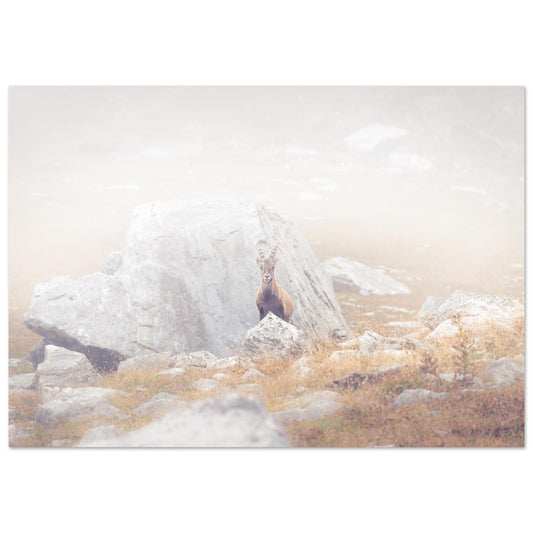
Photos of marmots bring a touch of life and tenderness to your mountain decor. Unlike majestic landscapes, they create an immediate emotional connection thanks to their endearing and expressive nature.
Where to include photos of marmots?
Children's room: Marmots are particularly popular with children. A photo print creates a soft and reassuring atmosphere.
Office or workspace: A marmot standing on its hind legs, vigilant, symbolizes attentiveness and quick thinking.
Living room or reading corner: A scene of marmot life brings an authentic and soothing touch of nature.
Hallway or entrance: A portrait of a marmot welcomes your visitors with originality and friendliness.
Recommended Formats and Media
To enhance your photos of Alpine marmots , we recommend matte Dibond aluminum :
- Detail rendering : The fur, whiskers, and eyes are rendered with exceptional sharpness.
- Depth of color : The brown, grey and green tones of the alpine environment are faithfully reproduced.
- Portrait format : 40×60 cm or 50×70 cm to showcase the standing marmots
- Landscape format : 60×40 cm for group scenes or scenes with a landscape background
Conservation and Ecological Challenges
The Role of the Vanoise National Park
Created in 1963, the Vanoise National Park protects a territory of 53,500 hectares where alpine wildlife can roam undisturbed. Marmots benefit from a preserved habitat and protection against poaching.
Threats and Challenges
Despite this protection, marmots face several challenges:
- Climate change : Alteration of vegetation and snow cover cycles
- Predation : Golden eagle, fox, stray dogs
- Human disturbance : Overcrowding in certain areas
- Diseases : Parasites and infections can decimate colonies
Plan Your Marmot Watching Trip
Best Time
April to June: Spring awakening, intense activity, young birds from the previous year still present
July-August: Birth of the baby marmots, heartwarming family scenes
September: Preparing for hibernation, the marmots are nice and plump.
Recommended Hikes
Easy: Pralognan - Péclet-Polset Refuge (3 hours one way, 600m elevation gain)
Average: Champagny - Refuge du Plan du Lac (2h30 one way, 550m elevation gain)
Sporty hike: Pralognan - Col de la Vanoise (4 hours one way, 1000m elevation gain)
Capture Your Encounter with the Marmots
Whether you are a wildlife photographer, a passionate hiker or simply a lover of alpine nature, the marmots of the Alps offer an unforgettable spectacle in spring.
Our marmot photo prints , printed on Dibond aluminum and made in France, allow you to extend this experience into your own home. Each image captures the liveliness, tenderness, and authenticity of these iconic animals of the Vanoise National Park .
Bring alpine life into your home and let the charm of marmots brighten your everyday life.