Où photographier La Meije depuis La Grave et le Lautaret ? - Tableaux photo Alpes | Alu Art Mountains

Where to photograph La Meije from La Grave and the Lautaret?

Updated on July 8, 2026

La Meije is one of the most powerful peaks to photograph in the Écrins massif. From La Grave, Villar-d'Arêne, Le Chazelet, or the Col du Lautaret, it commands an immediately recognizable presence: dark ridges, hanging glaciers, autumn larches, the Romanche valley, low-angle light, and a wild high-mountain atmosphere.

This page is a detailed photo guide to preparing an outing around La Meije from La Grave and Lautaret. The goal is not just to find a viewpoint, but to understand how to build a strong image: when to use a telephoto lens, how to integrate larches or hamlets, where to look for autumn light, how to photograph glaciers, and how to prevent the north face of La Meije from becoming a mere dark mass in the frame.

As a mountain photographer since 2017, I find this area essential in the Écrins because it combines alpine power, valley heritage, glacial graphics, and very changing light. You can find part of this work in my collection of La Meije and La Grave aluminum photo prints, printed on Dibond aluminum.

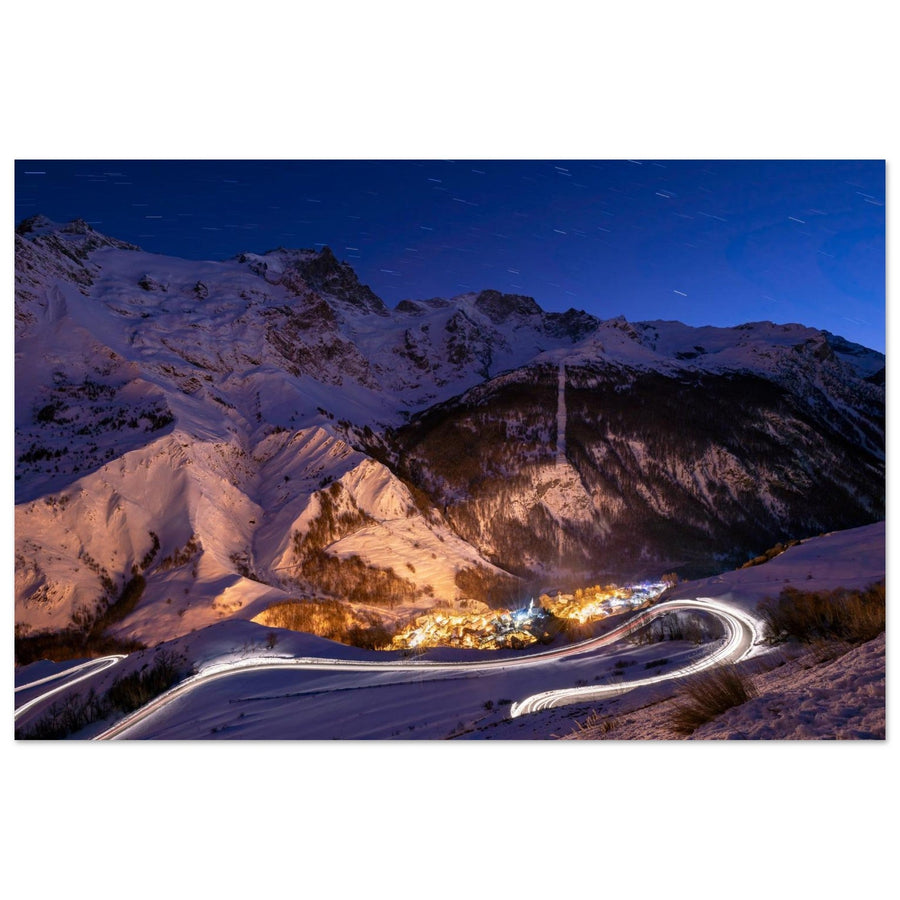
Sunset over La Meije from La Grave in the Écrins massif
From La Grave, La Meije becomes spectacular at sunset: glaciers, rocky ridges, deep shadows, and warm light on the summits.

The essential in 30 seconds

  • Main subject: La Meije, its north face, its glaciers, its ridges, and its late-day lights.
  • Best photo areas: La Grave, Le Chazelet, Villar-d'Arêne, Col du Lautaret, Belvédère de l'Homme, and views towards Le Goléon.
  • Best atmosphere: Autumn with golden larches, sunset, changing sky, fresh snow, or clouds clinging to glaciers.
  • Best focal length: 70–200 mm to isolate La Meije and its glaciers, 24–70 mm to keep the valley and foregrounds.
  • Best season: Autumn for larches, summer for access, early winter for snow on the terrain.
  • Key tip: Give structure to the north face: larches, hamlet, ridge, lake, cloud, or valley line should guide the eye towards La Meije.

Table of Contents

Why photograph La Meije?

La Meije is a major subject in the Écrins because it combines everything that makes high mountains powerful in photography: an identifiable silhouette, hanging glaciers, sharply defined ridges, a dark north face, balcony hamlets, larches, alpine pastures, high-altitude lakes, and often spectacular light.

Unlike some peaks that require a long hike to be visible, La Meije can be photographed from several accessible areas: La Grave, Le Chazelet, Villar-d'Arêne, Lautaret, the balconies above the Romanche, or the routes to Le Goléon. This allows for varied intentions: dramatic alpine image, autumn tableau, glacial detail, lake reflection, valley panorama, or a more minimalist composition.

The risk is to create an overly frontal image. The north face is powerful, but it can become heavy if it occupies the entire frame without breathing space. For a photo of La Meije to work, it needs a counterpoint: a foreground of larches, a hamlet, a ridge, a cloud, light on a glacier, a lake, a path, or a silhouette.

Practical summary of photo spots

Area Photo interest Best light Useful focal lengths To prioritize
La Grave North face, glaciers, village, raw alpine atmosphere Sunset, late afternoon, changing sky 24–70 mm, 70–200 mm Compression, village + summit, alpenglow
Le Chazelet Balcony view of La Meije, hamlet, alpine pastures, wide view Morning, late afternoon, autumn 24–70 mm, 70–200 mm Larches, hamlets, human foregrounds
Villar-d'Arêne Softer valley interpretation, access to Lautaret and Romanche Morning, overcast sky, side light 24–70 mm Valley, road lines, alpine pastures, relief
Col du Lautaret View of La Meije, glaciers, alpine pastures, wide aperture Clear morning, late afternoon, after disturbance 24–70 mm, 70–200 mm Viewpoints, ridges, wide shots
Belvédère de l'Homme Easy viewpoint towards La Meije, glaciers and Romanche Morning, late afternoon 24–70 mm, 70–200 mm Educational reading, clean panorama
Lac du Goléon Reflection of La Meije, high-altitude lake atmosphere, symmetry Dawn, calm morning, blue hour 16–35 mm, 24–70 mm Reflection, mirror, horizontal composition

Access from La Grave, Villar-d'Arêne, and Lautaret

The La Meije area can be accessed from several points. La Grave is the main base: village, Romanche valley, direct views of the north face, and immediate proximity to routes to Le Chazelet, Le Goléon, or Villar-d'Arêne. For a photographer, it's the most logical base if the goal is to capture various lighting conditions over several days.

Col du Lautaret offers a more open and simpler approach. The views towards La Meije and the glaciers are wide, accessible, and work well if you're looking for a short photo outing without significant commitment. The Belvédère de l'Homme, for example, offers a clear view of the glaciers and terrain, while remaining reasonable in terms of duration and difficulty.

The areas of Le Chazelet, Pic du Mas de la Grave, Le Goléon, or the Refuge de l'Aigle require more anticipation. Some are accessible hikes, others become much more challenging. The idea is not to turn a photo outing into an mountaineering ascent: choose the area based on your skill level, the desired light, and the day's conditions.

Useful official links before your outing

Photographing La Meije from La Grave

From La Grave, La Meije is photographed very directly. The north face dominates the valley, with a massive and sometimes almost intimidating presence. It's one of the best areas for sunset, storm, glowing glacier, or raw alpine atmosphere images.

The challenge is not to overwhelm the composition. If you frame only the face, the image can become too dense. Integrating a valley element — village, slope, road, tree, shadow line — helps to give scale and breathing room. A telephoto lens is then very useful for isolating the glaciers and ridges.

Photo tips from La Grave

  • Use the village or slopes as a scale, but without letting them dominate the image.
  • Work with a telephoto lens to give more presence to the hanging glaciers.
  • Wait for late afternoons: La Meije can take on a very brief warm light.
  • In cloudy skies, look for breaks in the light on the ridges and seracs.
  • Avoid overly tight framing if the face becomes confusing: allow for breathing space in the sky or valley.
La Meije from La Grave with autumn larches and glaciers in the Écrins massif
Facing La Grave, La Meije takes on a very graphic dimension when autumn larches complement the glaciers and dark rock faces.

Photographing La Meije from Le Chazelet

Le Chazelet offers a more inhabited interpretation of La Meije. The summit remains monumental, but the image can integrate hamlets, alpine pastures, slope lines, paths, and heritage elements. It's an excellent area if you're looking for a less frontal and more narrative photograph.

From the high points around Le Chazelet, you can build a composition with multiple planes: an alpine pasture foreground, a hamlet or oratory, the valley, then La Meije in the background. This depth often results in a more complete image than a simple portrait of the summit.

Photo tips from Le Chazelet

  • Use hamlets or the oratory as a human anchor point.
  • Compose with the curves of the alpine pastures to guide the eye towards La Meije.
  • In autumn, look for golden larches to warm up the foreground.
  • Don't overload the image: a hamlet, a slope line, and the summit can be enough.
  • With a telephoto lens, isolate the relationships between houses, ridges, and glaciers.

My field tip

La Meije works best when it's not alone. Such a strong summit needs a visual counterpoint: an alpine pasture line, a group of larches, a hamlet, a cloud, or a patch of light. That's what transforms a nice view into a real photograph.

Photographing La Meije from Col du Lautaret

Col du Lautaret is interesting because it offers a more open approach to the massif. La Meije is not necessarily as overwhelming as from La Grave, but it is part of a wider landscape: alpine pastures, ridges, the Romanche, high-altitude light, and views towards the glaciers.

For a short photo outing, Lautaret is one of the most effective areas. It allows for clean images without necessarily embarking on a long hike. The Belvédère de l'Homme, for example, offers a clear view of the glaciers and terrain, while remaining reasonable in terms of duration and difficulty.

Photo tips from Lautaret

  • Prefer morning or late afternoon to avoid overly flat light.
  • Use the lines of the alpine pastures and paths to structure wide compositions.
  • With a 70–200 mm lens, isolate La Meije and the glaciers to avoid an overly dispersed panorama.
  • After bad weather, clinging clouds can add a lot of relief.
  • If the sky is empty, reduce its space and give more importance to the valley planes.

Photographing La Meije's glaciers and ridges

La Meije's glaciers are one of the most graphic subjects in the area. They allow you to move beyond simple wide landscapes to create a more mineral image: ice tongues, seracs, couloirs, ridges, rock/snow contrasts, and high-mountain details.

A telephoto lens is crucial here. A tight crop can transform La Meije into an almost abstract image: dark shapes, bright ice, diagonal lines, simple sky. This is particularly effective when side lighting reveals the volumes.

Detail of La Meije glacier from La Grave in the Écrins massif
The detail of La Meije glacier works very well with a telephoto lens: black ridges, ice tongues, snow, and a simple sky create a very graphic image.

Photo tips for glaciers

  • Use a long focal length to isolate seracs, couloirs, and ridges.
  • Wait for side lighting to reveal the relief of the ice.
  • Avoid overly cluttered skies if the main subject is already complex.
  • In black and white, enhance the contrasts between rock / snow / ice.
  • Keep a simple composition: a ridge, an ice tongue, a sky.

Photographing autumn larches

Autumn is probably the most interesting season to photograph La Meije from La Grave. The golden larches bring a visual warmth that balances the coldness of the glaciers. This opposition is very strong in an image: yellow, brown, gray, white, overcast sky, dark summit.

Larches also help to give scale to the landscape. Without them, La Meije can become a very harsh mineral mass. With them, the image becomes more habitable, warmer, sometimes more decorative, while retaining a true alpine power.

Autumn photo tips

  • Look for larches as a foreground or natural frame.
  • Avoid excessively saturated colors: the contrast should remain elegant.
  • Use a medium focal length to balance forest, valley, and summit.
  • In overcast skies, work with textures and softness rather than harsh contrast.
  • After the first snowfalls, the mix of golden larches + glaciers becomes very strong.
La Meije from La Grave with autumn larches and Ecrins glaciers
Autumn gives a warmer interpretation of La Meije: golden larches, cold glaciers, dark rock faces, and a veiled sky create a very balanced scene.

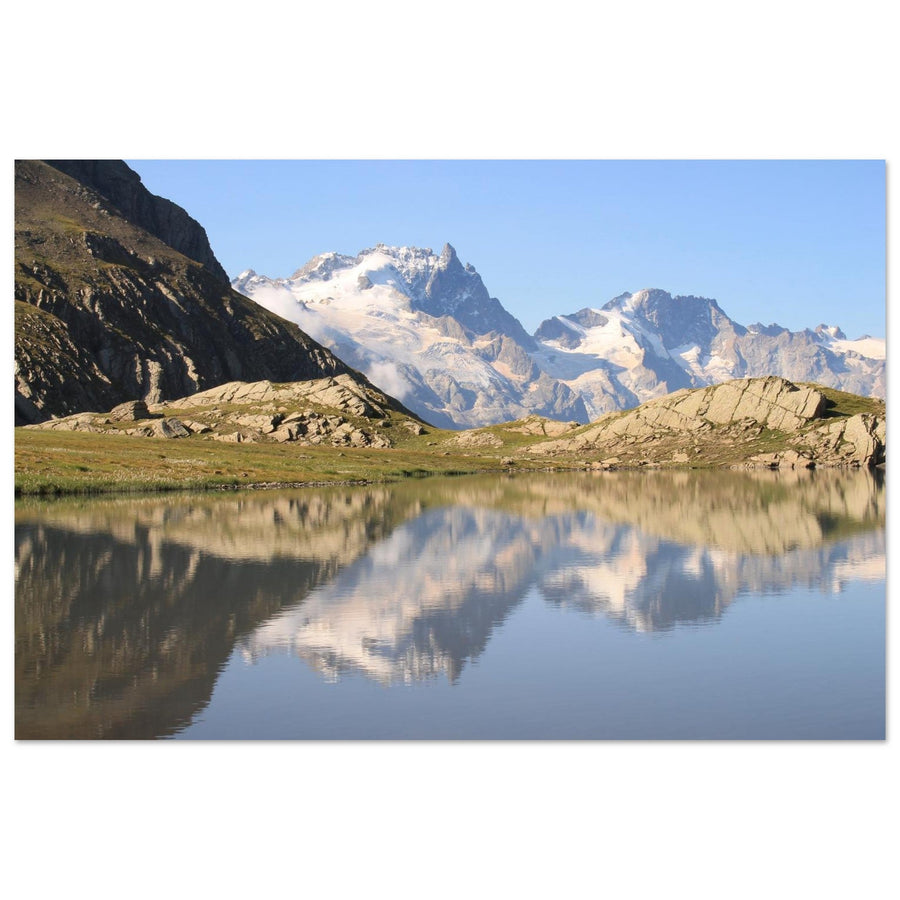
Lake Goléon: Reflection of La Meije

Lake Goléon deserves a mention in this guide, even though it could be a complete subject in itself. It offers one of the most iconic interpretations of La Meije: summit and glaciers reflected in calm water, with a horizontal, softer, and more contemplative composition.

The best time is dawn or early morning, when the wind is light. The reflection requires patience: sometimes a slight breeze is enough to break the symmetry. It’s a very different approach from La Grave or Lautaret: less dramatic, quieter, more graphic.

Reflection of La Meije in Lake Goléon from La Grave in the Écrins
At Lake Goléon, La Meije completely changes its ambiance: mirror reflection, soft light, calm water, and a more serene interpretation of the massif.

For an even more detailed approach to reflections and high-altitude lakes, you can also consult the guide dedicated to the Emparis plateau, Lake Lérié, and Lake Noir.

Best times to photograph La Meije

Morning

Morning works well for views from Lautaret, the Belvédère de l’Homme, or open areas. The light is cooler, contrasts are less harsh, and glacier details often remain legible.

Late afternoon

Late afternoon is the most spectacular time from La Grave. The last light can touch the glaciers and ridges, creating a very strong alpenglow ambiance. You need to be ready: the best light can last only a few minutes.

Blue Hour

Blue hour is interesting if you are close to your return point. Glaciers become colder, contrasts simplify, and the mountain takes on a quieter presence. A headlamp and good organization are essential.

Autumn

Autumn is probably the most aesthetic season: golden larches, low light, clearer air, possible first snows. It is the most consistent season for producing an image that is both alpine, warm, and decorative.

After bad weather

After a disturbance, clouds clinging to La Meije, clearings, and contrasts between rock, snow, and sky can produce the best images. It's often more striking than a uniform blue sky.

Ideas for photo compositions

1. Village + Meije

From La Grave, incorporate the village or a valley line to give scale to the summit. La Meije should remain dominant, but not isolated without structure.

2. Larches + glaciers

In autumn, use larches as a warm foreground against cold glaciers. This is one of the strongest contrasts in the area.

3. North Face with telephoto lens

Frame tightly on the glaciers, ridges, and couloirs. The image becomes more mineral, more graphic, almost abstract.

4. Chazelet balcony view

Use hamlets, slopes, and alpine pastures as successive planes. This composition tells more about the territory than a simple summit.

5. Lautaret open landscape

From Lautaret, work on the lines of alpine pastures and ridges to avoid a too dispersed image. The summit should remain the focal point of the gaze.

6. Reflection at Goléon

At dawn, look for symmetry. Keep the composition horizontal, simple, and calm. A partial reflection may suffice if the water is not perfectly smooth.

7. Glacial Black and White

When color adds nothing, switch to black and white: rock, ice, ridges, and clouds lend themselves very well to a graphic interpretation.

What photo equipment to bring?

  • 16–35 mm: useful for lakes, reflections, wide landscapes, and alpine pasture foregrounds.
  • 24–70 mm: the most versatile focal length for La Grave, Chazelet, and Lautaret.
  • 70–200 mm: essential for isolating La Meije, glaciers, ridges, hamlets, and light effects.
  • Tripod: recommended for dawn, blue hour, Goléon reflections, or very precise compositions.
  • Polarizing filter: useful with caution for certain skies and reflections, but beware of irregular wide-angle renderings.
  • Weather protection: important: wind, cold, rain, snow, and fog can arrive quickly in this area.
  • Extra batteries: useful in cold weather or during long waits at sunset.
  • Headlamp: essential for early morning starts or returns after blue hour.
  • Appropriate mountain equipment: serious shoes, warm clothes, water, map, weather forecast, and equipment according to the chosen itinerary.

Regulations and safety

The La Meije area can range from a very accessible outing to Lautaret to serious mountaineering routes such as the Refuge de l'Aigle. It is therefore important to distinguish between photography from viewpoints, balcony hikes, high-altitude lakes, and more committing approaches.

Before you go, check official information: weather, snow conditions, trail status, road access, opening hours, regulations of the Écrins National Park, rules on dogs, drones, bivouacking, waste, fauna, and flora.

Drones and dogs are prohibited in the core zone of the Écrins National Park. Some areas around La Grave and Lautaret may be outside the core zone, others not: it is therefore necessary to precisely check the itinerary and the zone in which you are located.

The good photography reflex: prepare the shot, but accept to give up. A light on La Meije can be magnificent, but it does not justify a dangerous return, a doubtful crossing of a snowfield, exposure to a storm, or an outing beyond one's skill level.

Photo prints related to La Meije, La Grave and the Écrins

La Meije is one of the strongest subjects for alpine wall decor: iconic summit, glaciers, larches, sunsets, reflections, mineral ridges, and a wild atmosphere. The photographs below directly extend the ambiance of this outing.

See in the gallery

You can also explore:

Continue your exploration of the Écrins

To prepare for other photo outings in the massif, you can continue with the other guides in the Écrins mini-cluster:

FAQ — Photographing La Meije from La Grave and Lautaret

Where to photograph La Meije from La Grave?

The best areas are La Grave, Chazelet, the balconies above the Romanche, Villar-d'Arêne, the Col du Lautaret, and certain routes towards Goléon. Each area offers a different interpretation of La Meije: north face, glaciers, hamlets, larches, alpine pastures, or reflections.

What is the best time to photograph La Meije?

Late afternoon is often the most spectacular time from La Grave, especially when the glaciers and ridges catch the warm light. Morning works very well from Lautaret or for reflections at Lake Goléon.

What focal length to use to photograph La Meije?

A 70–200 mm is very useful for isolating La Meije, its glaciers, and its ridges. A 24–70 mm allows for a wider composition with La Grave, the hamlets, alpine pastures, or larches.

Is La Meije interesting in autumn?

Yes. Autumn is one of the best seasons to photograph La Meije, thanks to the golden larches, low light, possible first snows, and the contrast between warm forest and cold glaciers.

Can you photograph La Meije from the Col du Lautaret?

Yes. The Col du Lautaret and the Belvédère de l'Homme offer interesting views towards La Meije, the glaciers, and the Romanche valley, with a more accessible approach than a long hike.

Where to photograph La Meije's reflection?

Lake Goléon is one of the best-known places to photograph La Meije's reflection. The best conditions are often at dawn, when the water is calm and the wind does not break the symmetry.

Are drones allowed around La Meije?

In the core zone of the Écrins National Park, drones are prohibited. Around La Grave and Lautaret, it is necessary to check the specific area being crossed, as some areas may be outside the core zone and others subject to strict regulations.

Does this page replace the guide on the Emparis plateau?

No. This page focuses on La Meije from La Grave, Villar-d'Arêne, and Lautaret. The Emparis plateau, Lake Lérié, and Lake Noir will be the subject of a separate detailed guide, more oriented towards reflections, high-altitude lakes, and panoramic compositions.

Back to blog

Tableaux photo des Écrins et des Alpes du Sud

Une sélection de photographies prises dans le massif des Écrins et les Alpes du Sud : Pré de Madame Carle, Glacier Blanc, Barre des Écrins, La Meije, plateau d’Emparis, Valgaudemar, Sirac et Rouies, imprimées sur aluminium Dibond en France.