Where can you see ibex in the Alps?
Updated July 27, 2026
The Alpine ibex (Capra ibex) is one of the most emblematic animals of the Alpine massifs. Its massive silhouette, long ringed horns, and ease on rocky faces make it a fascinating subject to observe and photograph.
However, it's not enough to just reach a well-known summit to encounter one. Ibex move according to the season, snow cover, grass availability, heat, and human presence. No location guarantees an observation, even in an area where the species is well established.
This guide presents the main massifs of the French Alps where you can hope to see ibex, the most favorable periods, and good practices for photographing them without disturbing their behavior. The areas remain deliberately broad: the goal is to prepare a responsible outing, not to turn a wild habitat into a meeting point.

The essentials in 30 seconds
- Reference massif: Vanoise, historical territory of the ibex in the French Alps.
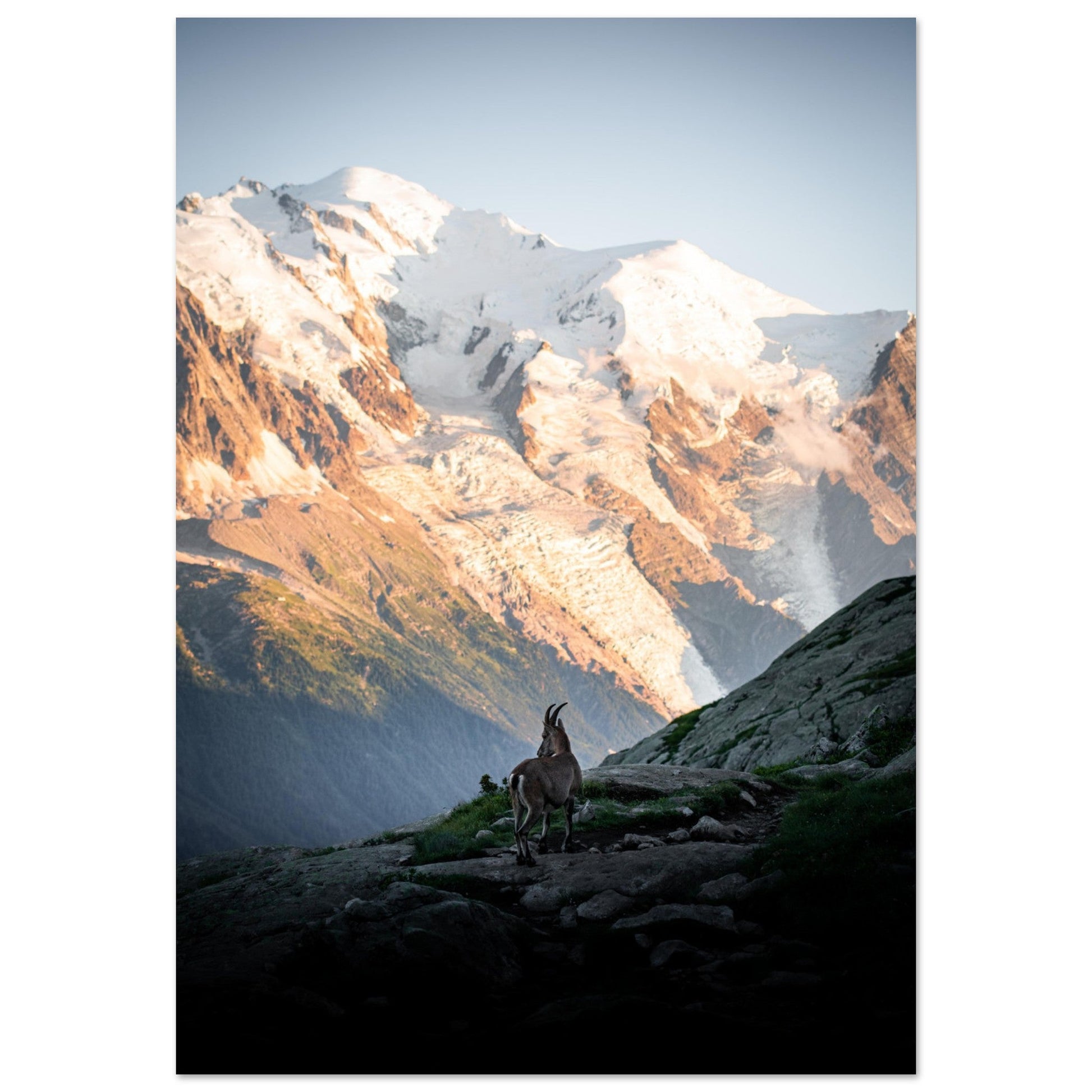
- Best high-mountain setting: the Aiguilles Rouges, with the Mont-Blanc massif in the background.
- Best mineral ambiance: Vercors and the limestone ridges around the Hauts-Plateaux.
- Best areas in the Southern Alps: Mercantour, particularly in the Vésubie and certain rocky valleys in the east of the massif.
- Favorable periods: spring on lower slopes, summer at high altitude, autumn for light, and early winter for rutting season.
- Best times: early morning and late afternoon, when animals feed more and the light is softer.
- Key tip: binoculars and a telephoto lens allow you to keep your distance. A successful observation is one where the animal maintains natural behavior.
Contents
- Where to see ibex in the French Alps?
- Which massif to choose?
- Comparative table of main areas
- Ibex in Vanoise
- Ibex in Écrins
- Ibex in Aiguilles Rouges
- Ibex in Vercors
- Ibex in Mercantour
- Other massifs to know
- Which season and time to choose?
- Ibex or chamois: how to differentiate them?
- How to photograph an ibex?
- Observe without disturbing
- What equipment to bring?
- Mistakes to avoid
- Discover our ibex photo prints
- Continue with the massif guides
- FAQ
Where to see ibex in the French Alps?
The ibex primarily seeks rocky terrain: cliffs, ledges, mineral bars, ridges, and quickly snow-free slopes. It generally remains close to a natural rock shelter, with accessible lawns or grassy areas for feeding.
In the French Alps, the species is now present in many massifs thanks to its protection and reintroduction programs. The most well-known core populations are found in Vanoise, Écrins, Haute-Savoie, Vercors, and Mercantour.
The presence of a population in a massif does not mean that an animal will be visible on every outing. Ibex can be much higher in summer, gather on exposed slopes in winter, or temporarily leave a frequented area. Therefore, one must read the terrain, take the time to scan the slopes, and accept returning without a photograph.
Quickly choose your observation area
- If you are looking for the historical massif of the ibex: prioritize Vanoise.
- If you want to combine wildlife and large glacial summits: look towards Écrins.
- If you are looking for an ibex facing Mont-Blanc: the Aiguilles Rouges offer the most spectacular scenery.
- If you love limestone cliffs and silhouettes on ridges: Vercors is particularly photogenic.
- If you are planning an outing in the Alpes-Maritimes: Mercantour has several well-established populations.
- If you are new to wildlife observation: choose a marked trail, bring binoculars, and never plan your outing around an overly precise location found on social media.
Comparative table of main areas
| Massif | General areas | Dominant terrain | Favorable periods | Photographic interest |
|---|---|---|---|---|
| Vanoise | Pralognan, Haute Maurienne and rocky valleys of the massif | Cliffs, alpine pastures, refuges and high mountains | Spring, summer and autumn | Historical population, family scenes and very alpine landscapes |
| Écrins | Champsaur, Champoléon, Valbonnais and peripheral rocky sectors | Steep valleys, cliffs, moraines and high peaks | Spring, summer and early autumn | Wild atmosphere, powerful relief and long focal lengths |
| Aiguilles Rouges | Nature reserves and slopes overlooking the Chamonix valley | Slabs, scree, alpine lakes and ridges | Summer and autumn, depending on access | Ibex with the Mont-Blanc massif in the background |
| Vercors | Hauts-Plateaux, Grand Veymont and eastern edges of the massif | Limestone cliffs, ridges, lapies and alpine pastures | Spring, summer and autumn | Graphic silhouettes, emptiness and large mineral lines |
| Mercantour | Vésubie, Gordolasque, Boréon, Fontanalba and high-altitude rocky massifs | Mineral valleys, alpine pastures, lakes and cliffs of the Southern Alps | Spring, summer and autumn | Southern light, open landscapes and family groups |
Where to see ibex in Vanoise?
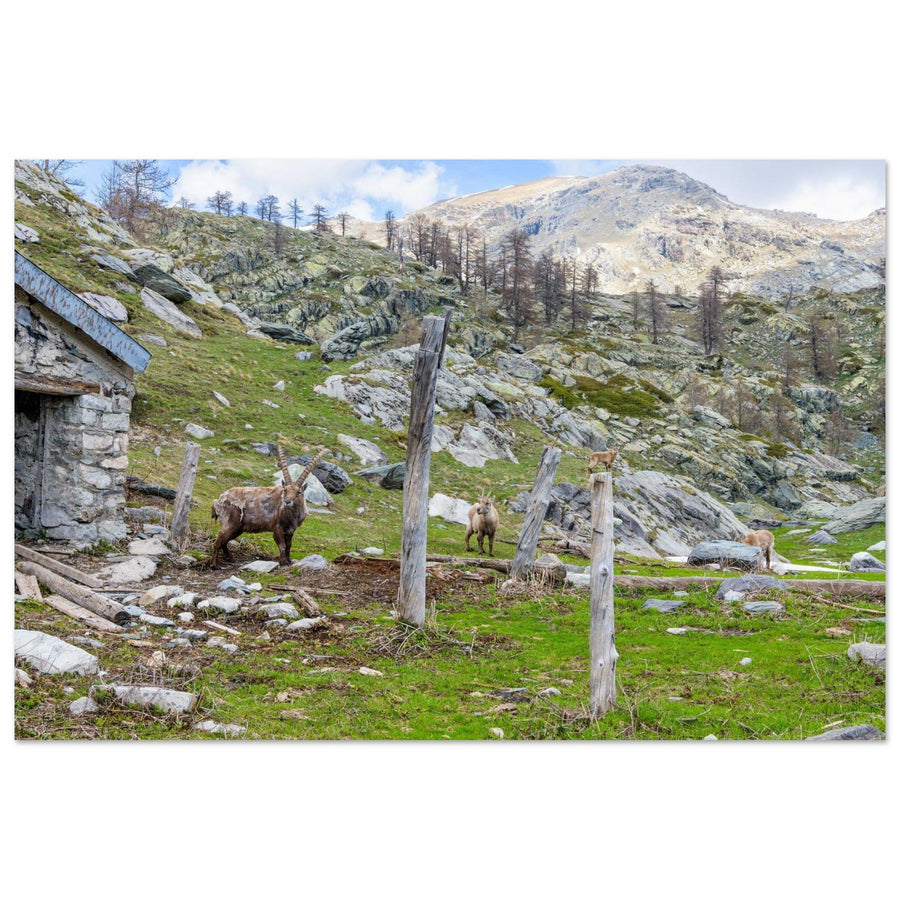
Vanoise holds a special place in the history of the ibex in France. The massif maintained a population even as the species had almost disappeared from the rest of the French Alps, and then played a major role in reintroduction operations carried out in other territories.
Observations are possible on several slopes of the massif, particularly around Pralognan-la-Vanoise, in certain valleys of Haute Maurienne, and on rocky areas near alpine meadows. In spring, animals may descend to lower slopes to find the first shoots of grass. In summer, they generally return to higher altitude areas.
Vanoise is interesting for photographing ibex in a complete environment: rocky bars, meadows, refuges, domes, and summits. Females and young often form distinct groups from large males outside the rutting season. It is therefore possible to encounter very different scenes depending on the area and season.
To better prepare for the landscapes and access around the massif, consult our guide: where to photograph Vanoise?
Also discover the Vanoise photo prints.
Where to see ibex in Écrins?
In the Écrins, reintroduced populations have developed particularly in Champsaur, around Champoléon, as well as in Valbonnais. The massif offers particularly suitable terrain: rocky valleys, sunny slopes, cliffs, moraines, and vast, sparsely wooded areas at high altitude.
The relief often makes observation more demanding than in Vanoise. Animals can be very far away, settled on a ledge or on a slope that is barely distinguishable to the naked eye. A pair of binoculars then becomes more useful than an additional journey. The telephoto lens then allows you to compose an image without trying to reduce the distance.
The great photographic interest of the Écrins is the power of the scenery. An ibex can appear tiny against the cliffs, scree, or high peaks of the massif. You shouldn't always aim for a tight portrait: a wider composition often better tells the story of the animal's life in its environment.
Prepare for the massif's landscapes with our guide: where to photograph the Écrins?
See the Écrins massif photo prints.
Where to see ibex in the Aiguilles Rouges?
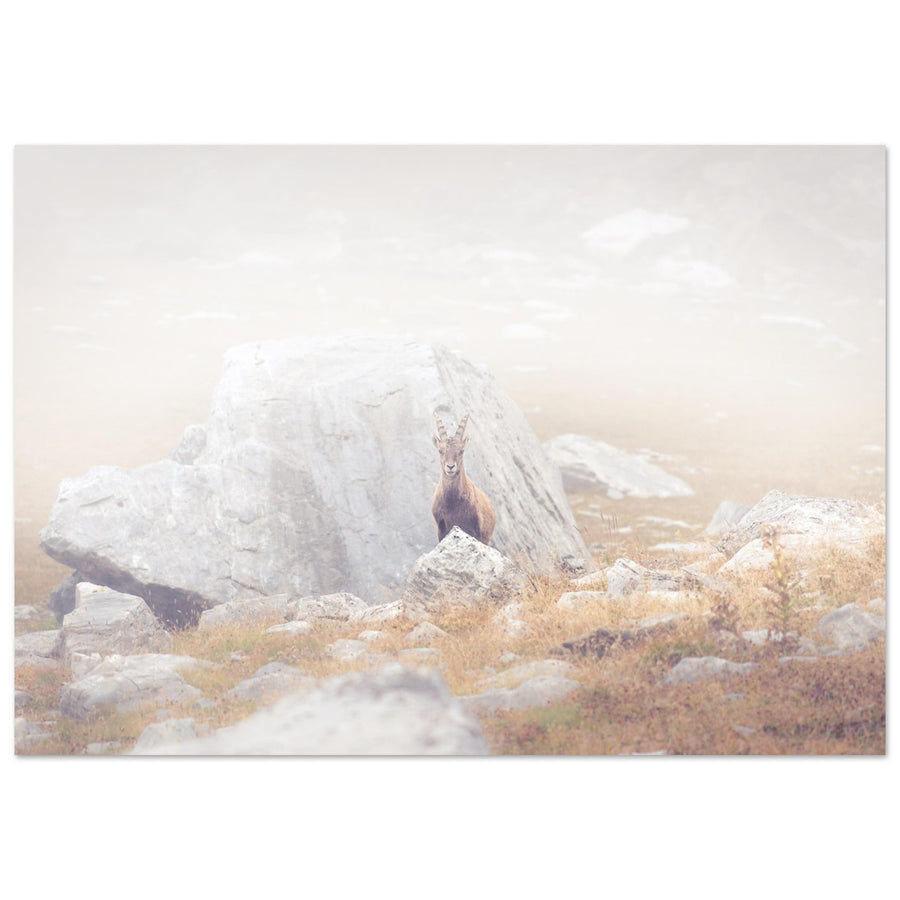
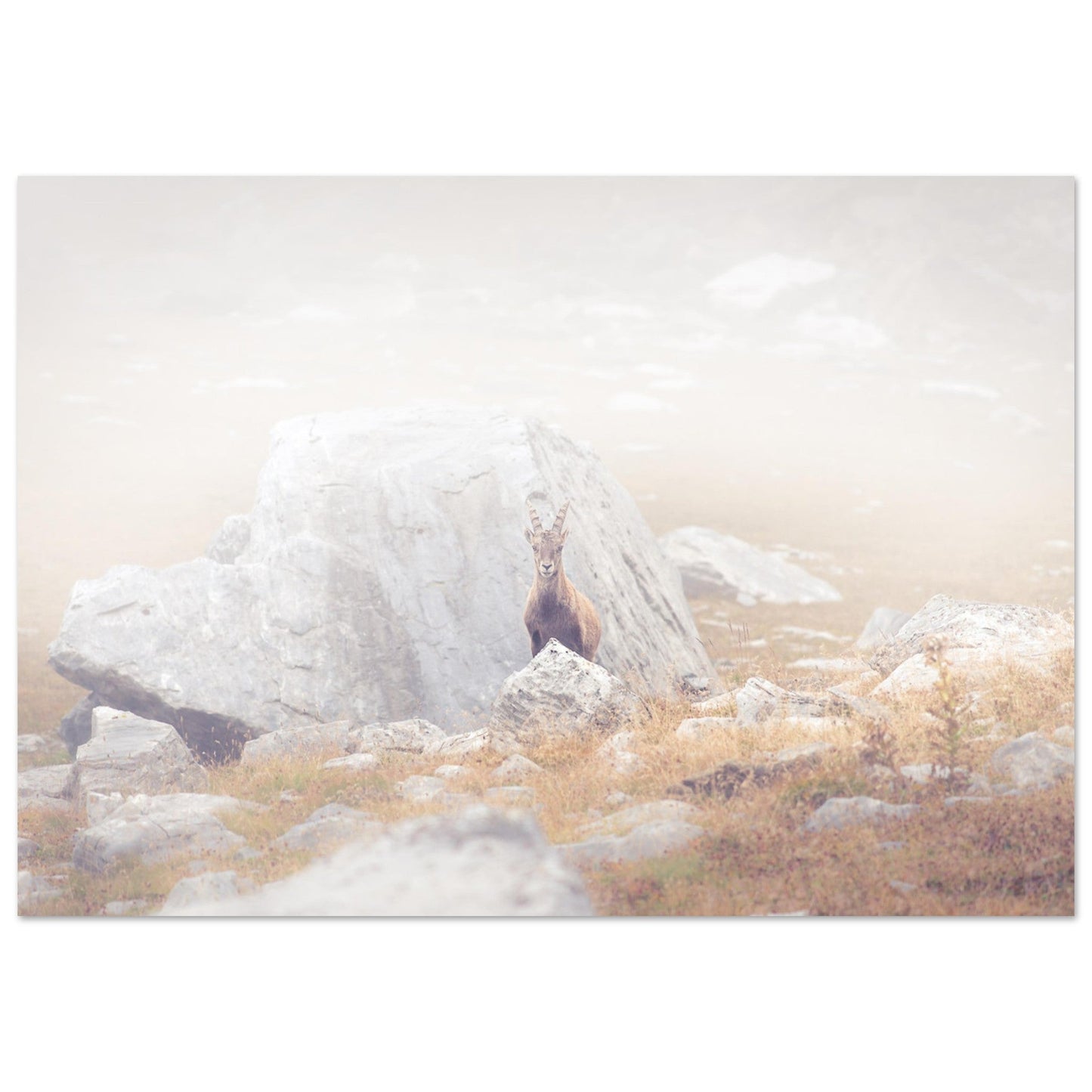
The Aiguilles Rouges are one of the most spectacular areas to combine wildlife observation and landscape photography. The rock slabs, scree slopes, and ridges of the massif face the glaciers and peaks of Mont-Blanc, allowing for images where the ibex is fully integrated into the mountain environment.
The natural reserves in the area protect rich wildlife, but they are also very frequented during peak season. The best approach is to start early, stay on authorized trails, and observe the rocky ledges for a long time rather than following an animal spotted in the distance.
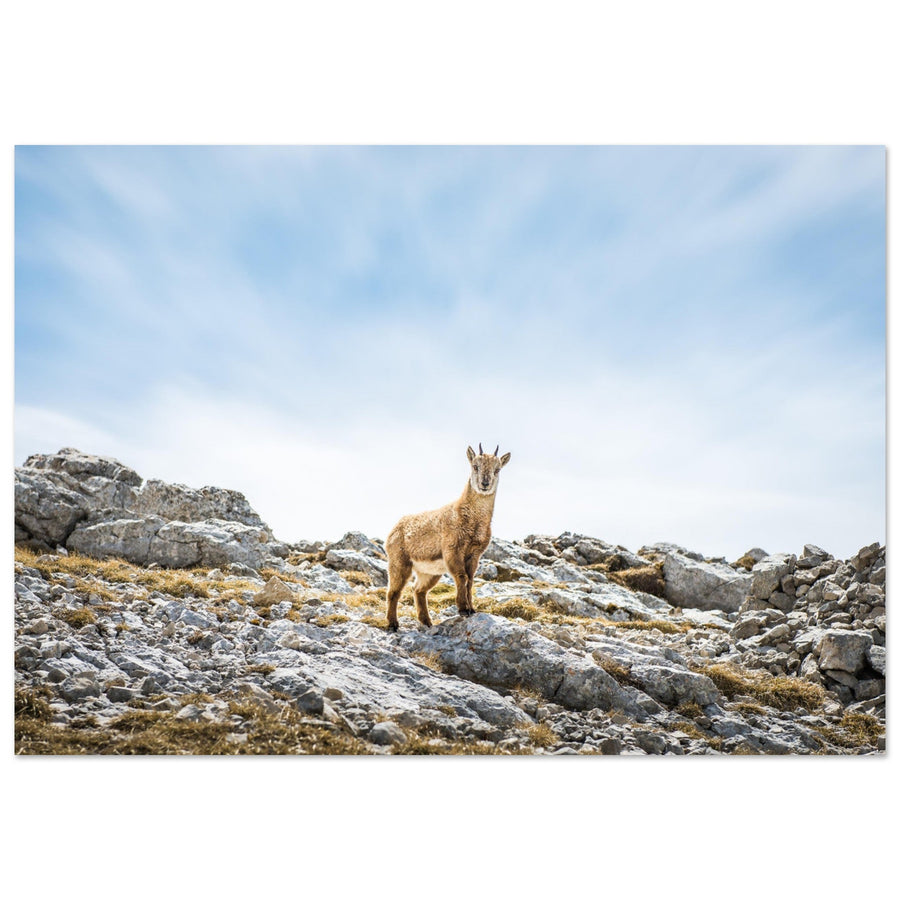
A female ibex can easily be mistaken for a chamois at a distance. The horns, silhouette, and absence of a distinct facial mask help differentiate them. Groups of females and kids offer endearing scenes, but they require even more discretion, especially in early summer.
Prepare your outing with the guide where to photograph the Aiguilles Rouges?
Discover the Aiguilles Rouges photo prints.
Where to see ibex in Vercors?
The ibex was reintroduced into the Vercors in the late 1980s. Today, it frequents the rocky areas of the Hauts-Plateaux, the eastern cliffs, and the surroundings of Grand Veymont, where the limestone creates a very different backdrop from the large glacial massifs.
The Vercors is particularly strong for silhouettes. An ibex perched on a ridge can stand out against the sky, above a rocky bar or facing a very open horizon. A 70–200 mm lens is often sufficient to maintain the relief in the frame; a longer focal length allows for focusing on the gaze, horns, and fur texture.
However, the terrain requires caution. Some ridges are exposed, fog can roll in quickly, and the Hauts-Plateaux Nature Reserve has specific regulations. You should never leave a safe passage to try to position yourself below or in front of an animal.
Prepare for the massif with our guide: where to photograph the Vercors?
See the Vercors photo prints.

Where to see ibex in Mercantour?
Mercantour hosts several ibex populations in its high-mountain rocky massifs. In the Vésubie valley, the Boréon and Gordolasque sectors are regularly monitored. Further east, the Roya and Fontanalba valleys also offer favorable habitats.
The landscape is different from that of the Northern Alps: drier light, colored rocks, Mediterranean vegetation, and strong contrasts between alpine pastures and cliffs. In spring, animals can take advantage of the first snow-free areas. In summer, they move up to the ridges and cooler areas.
The ibex can sometimes be less timid in Mercantour. This apparent closeness should not be interpreted as an invitation to approach. A motionless animal may be assessing your presence. Maintain a comfortable distance, stay on the trail, and always leave a clear path to the rocks.
Discover the Mercantour photo prints.

Other massifs where ibex are present
Cerces Massif
The Cerces massif, in the north of the Hautes-Alpes, is among the territories where the ibex has been reintroduced. Its large mineral slopes and rocky passages can offer observations, but the animals remain mobile and often distant.
Queyras
The ibex has recolonized certain areas of Queyras from neighboring populations. Its presence is real, but observation remains less predictable than in the large historical core areas. The massif should primarily be chosen for its landscapes and itineraries, with the animal remaining a possible encounter rather than a guaranteed objective.
Haute-Savoie and other Prealps
Ibex are present in several areas of Haute-Savoie and the Prealps. Some populations are subject to sanitary monitoring or specific management measures. Before planning an outing focused on wildlife, check local information and avoid quiet zones, breeding areas, or scientific monitoring areas.
What season and time of day should you choose to see ibex?
In Spring
Spring is often a good time for observation. Ibex look for the first blades of grass on snow-free slopes and can be found at lower altitudes than in summer. However, access remains variable depending on snow conditions, and slopes can be unstable.
In Summer
In summer, animals often move up to ridges, high-altitude pastures, and cooler areas. The best sightings generally occur early in the morning or late in the day. In hot weather, ibex may remain lying on promontories, in the shade of a rock face, or in an area difficult to see from the trail.
In Autumn
Autumn offers softer light, gentler colors, and often fewer visitors. Their coats gradually thicken, and the first snows can simplify compositions. This is an excellent time to integrate more of the landscape around the animal.
In Early Winter
The rut usually takes place from late November to mid-January. Males then join female groups and may fight. These behaviors are impressive, but winter is an energetically challenging period: observations must be made from a great distance, without causing unnecessary displacement.
Morning or Evening?
The early hours of the day and late afternoon are the most interesting times. Animals feed more, contrasts are softer, and the low light highlights horns and relief. Midday observation is still possible, especially in spring or on cloudy days.
Ibex or Chamois: How to Tell Them Apart?
| Criterion | Ibex | Chamois |
|---|---|---|
| Silhouette | Massive body, robust legs, heavier build | Slenderer body, lighter and more agile |
| Horns | Thick, ridged, and curved backward; very developed in males | Thin, dark, and ending in a hook |
| Head | Fairly uniform face, small visible beard in some males | Very distinct dark bands between eyes and muzzle |
| Terrain | Cliffs, slabs, ledges, and open rocky slopes | More varied environments, including forest edges, forests, and grassy slopes |
| Behavior | Often calm and not very shy, without being domesticated | Generally more vigilant and quicker to distance itself |
The confusion mainly concerns female ibex, whose horns are shorter than those of males. From a distance, first look at the shape of the horns and the presence or absence of the chamois' facial mask.
How to photograph an ibex without disturbing it?
The main goal is not to fill the frame at all costs. Good wildlife photography relies on distance, anticipation, and reading behavior. When the ibex remains calm, continues to feed, ruminates, or moves normally, your presence is likely tolerated. If it stares at you for a long time, stops eating, stands up abruptly, or tries to move away, back off.
Use a long focal length
A 100–400mm or 200–600mm lens allows you to work without approaching the animal. A 70–200mm lens remains very interesting when the ibex is naturally quite close to the trail or when you want to show the surrounding mountain scenery.
Choose a sufficient shutter speed
For a stationary animal, a speed around 1/500s already secures most handheld situations. For walking, fighting, or fast movement, increase to 1/1000s or more. Auto ISO allows you to react to changes in light without losing time.
Work with continuous autofocus
Use continuous autofocus and a zone flexible enough to track the head or eye. Animal detection can be useful, but it is not always reliable amidst horns, rocks, and shadows. Regularly check focus.
Integrate the landscape
A tight portrait shows the horns and gaze. A wider shot tells the story of the ibex in its habitat: a ridge, a rock face, Mont-Blanc in the background, or the cliffs of Vercors. Alternate between the two approaches without changing your position too often.
Be careful with snow
On a snowy background, the camera may underexpose the scene, making the snow appear gray. A slight positive exposure compensation helps restore a natural white, while keeping an eye on highlights.
Observing ibex without disturbing their behavior
- Stay on the trail: Going off-trail sometimes unnecessarily brings the observer closer and can degrade high-altitude environments.
- Use binoculars: They help confirm a presence before taking out camera equipment.
- Never feed an animal: Habituation alters its behavior and can create dangerous situations.
- Do not seek contact: A fearless ibex remains a wild, heavy, and powerful animal.
- Do not block its path: Always leave a passage towards the rock face, the group, or the escape zone.
- Avoid encircling a group: Several photographers spread around a herd create significant pressure.
- Keep silent: Shouts, calls, and claps intended to get a look are to be avoided.
- Be extra cautious with kids: Never place yourself between a female and her young.
- Respect local rules: Dogs, bivouacking, drones, and off-trail travel are regulated differently depending on parks and reserves.
- Do not publish sensitive locations in real-time: A photograph can be shared without turning a quiet area into an over-frequented spot.
Useful official sources before an outing
What equipment to bring to photograph ibex?
- 8× or 10× binoculars: essential for finding animals without excessive movement.
- 70–200mm: useful for environmental scenes and naturally close animals.
- 100–400mm: excellent compromise between reach, weight, and versatility for hiking.
- 200–600mm: suitable for distant observations, at the cost of greater weight.
- Monopod or lightweight tripod: useful with a long focal length, especially at sunrise.
- Extra battery: cold and intensive autofocus use reduce battery life.
- Rain protection: a simple cover protects the camera body during showers and snow.
- Discreet and warm clothing: no need for full camouflage, but avoid sudden movements and plan to stay still.
- Area map and headlamp: essential if you start early or return after dark.
Mistakes to avoid when observing
1. Absolutely wanting to get closer
The fact that an ibex doesn't flee doesn't mean it accepts your presence. Use the available focal length and accept a wider image.
2. Following an animal that is moving away
An ibex that distances itself provides clear information. Pursuing it increases disturbance and can push it into dangerous terrain.
3. Placing yourself between the animal and the rock
The rock face is its safe zone. Never block access to a rock bar, a ledge, or the rest of the group.
4. Neglecting the terrain
By looking only through the viewfinder, it's easy to forget about the void, unstable rocks, or weather changes. First, get into a safe position.
5. Using a drone
Overflights are extremely disruptive to wildlife and prohibited in many protected areas. A telephoto lens from the trail is the only approach consistent with responsible observation.
6. Only seeking a portrait
The most powerful images often show the relationship between the animal and the mountain. Keep part of the cliffs, ridges, or landscape in the frame.
7. Immediately sharing the exact location
Real-time geolocation can quickly attract several groups to the same animal. Prefer the name of the massif or territory rather than a precise coordinate.
Discover our ibex photo prints
The AluArtMountains gallery features ibex photographed in several Alpine landscapes: Vanoise, Aiguilles Rouges, Mont-Blanc, Vercors, and Mercantour. Portraits highlight their horns, gaze, and coat; broader compositions place the animal on a ridge, a rock face, or in the heart of an alpine pasture.

See in the gallery
- Discover all ibex photo prints
- Photo of an ibex kid in Vanoise
- Photo of an ibex kid at the summit of Grand Veymont
- Photo of an ibex at the summit of Grand Veymont
- Photo of an ibex family in the Fontanalba Valley
- Photo of an ibex family in the Aiguilles Rouges
- Photo of an ibex facing Mont-Blanc
- Photo of an ibex facing Mont-Blanc in black and white
To broaden your selection, also check out our mountain animal photo prints, featuring chamois, marmots, and other alpine species.
Continue with the mountain range photo guides
An outing dedicated to wildlife is also a mountain outing. These guides help prepare for specific areas, light, equipment, and landscapes around the main territories mentioned in this article:
Continue with the Alpine wildlife mini-hub
To prepare for other observations and improve your wildlife images, continue with the complementary guides:
FAQ — Where to see ibex in the Alps?
What is the best place to see ibex in the Alps?
The Vanoise massif remains the reference area in France due to its history and the size of its population. The Écrins, Aiguilles Rouges, Vercors, and Mercantour also offer good opportunities, though no sighting is guaranteed.
At what altitude can ibex be seen?
Altitude varies by season. In spring and winter, ibex may frequent lower, quickly snow-free slopes. In summer, they often move up to high-altitude pastures and ridges, sometimes above 3,000 meters.
What is the best season to observe ibex?
Spring is interesting on snow-free slopes, while summer facilitates access to high-altitude areas. Autumn offers beautiful light and fewer visitors. In winter, observation is possible but disturbance must be kept to a minimum.
What time of day should I look for ibex?
Morning and late afternoon are generally the best times. Animals are more active for feeding, and the light is softer. In cool or cloudy weather, they may remain visible longer.
How do I know if I am disturbing an ibex?
A disturbed animal may stop feeding, stare at you for a long time, stand up, move away, or look for an escape route. In this case, stop advancing and immediately increase your distance.
How much distance should I keep from an ibex?
There is no single distance suitable for all situations. The goal is to stay far enough away for the animal to maintain its natural behavior. Binoculars and a telephoto lens should replace close approach.
Can I touch or feed an ibex?
No. The ibex is a wild and protected animal. Feeding it encourages habituation, alters its diet, and increases risks for both the animal and visitors.
How can I distinguish a female ibex from a chamois?
A female ibex has horns curved backward but without a distinct terminal hook. A chamois has thinner horns ending in a hook and a very visible dark mask on its face.
What focal length should I use to photograph an ibex?
A 100–400mm is very versatile in the mountains. A 200–600mm allows you to stay far away, while a 70–200mm is suitable for wider scenes when the animal is naturally close to the trail.
Are dogs allowed in ibex areas?
Regulations depend on the protected area. In the core zones of some national parks, dogs are prohibited even on a leash. Always check the official rules of the area before you go.
Can I use a drone to film ibex?
Drones cause significant disturbance, and their use is prohibited in many national parks and nature reserves. For wild animals, prioritize ground-level photography with a long focal length.