The Most Beautiful Sunrises in the Alps
Nine scenes, nine very different ways to see the mountains emerge from night. Sunrise is not interesting simply because the sky changes colour: the first light must reveal something specific in the landscape — a succession of summits, an isolated silhouette, a sea of cloud, a hut, a reflection, the moon or a human presence.
This selection is therefore not an absolute ranking. It compares scenes that tell different stories. The Dent Parrachée and Vanoise summits favour the progression of light through a wide panorama; the Grande Casse instead concentrates attention on one mass. Lac de Presset adds a natural reflection, the Cervin and moon retain a link with night, the Gornergrat train turns a window into a compositional element, and the Lanchettes mountaineers immediately establish the scale of the high mountains. Mont Revard provides an important counterpoint: a broad dawn panorama requiring a different level of commitment from the high-altitude scenes.
The order below names no winner. It compares visual languages, access before dawn and different trade-offs to help you choose the sunrise that suits your intended image.
Panorama, summit, cloud, hut, reflection, moon, transport, mountaineering and a roadside viewpoint.
“The most beautiful” describes a reasoned editorial selection.
Alpenglow colours and direct light can create different readings of the scene.
A roadside scene and a mountaineering scene cannot be compared on aesthetics alone.
How was this selection put together?
The first criterion is visual. A scene must keep working even with a subdued sky. A summit may catch a pink glow, but the image must also hold together through its silhouette, layers, reflection or the relationship between subject and surroundings.
The second criterion is diversity. Two sunrise photographs of the same summit can both remain relevant if they lead to two different choices. That is the case with the Grande Casse: isolated, it reveals the transition between alpenglow and direct light; above a sea of cloud, it becomes one element among several atmospheric layers. Conversely, a beautiful scene is not retained if it repeats a language already better demonstrated elsewhere.
The third criterion is real feasibility. The reader must understand whether this is a viewpoint reached by road, a night-time start on foot, a high-altitude hut, transport with special timetables or a mountaineering setting. That is enough to compare options. Precise routes belong in the area guides; settings and detailed solar planning are developed in the sunrise technique guide.
Finally, provenance remains explicit. Some scenes come from Pierre Thiaville's work; others are documented by official sources and exact photographs by partner photographers in the gallery. An artwork's presence in the gallery documents a scene; it never replaces analysis of its visual appeal.
Alpenglow and direct light: two ways of seeing dawn
In photographic language, alpenglow describes the pink or red tones high mountains can take on around dawn. Depending on the sun's position, the atmosphere and the definition used, these colours may precede or accompany the first touches of direct light on visible faces.
As direct light becomes stronger on the slopes, contrast changes. It moves quickly and can make certain ridges or faces much more prominent. This distinction helps in choosing a scene: an isolated summit may be spectacular during the transition, while a sea of cloud or a reflection depends more on the atmosphere's overall balance.
Quick comparison of the nine scenes
Access descriptions are deliberately brief: they compare pre-dawn contexts rather than replacing on-the-ground preparation.
| Scene | Area | Visual language | Light phase | Access before dawn | Main trade-off |
|---|---|---|---|---|---|
| Dent Parrachée, Chasseforêt and Pelve | Vanoise | Multi-summit panorama | First light progressing from summit to summit | High-altitude viewpoint; night-time start depending on area | Visibility and panoramic balance |
| Isolated Grande Casse | Vanoise | Single summit / silhouette | Alpenglow followed by direct light | Several possible viewpoints | Clear atmosphere and chosen distance |
| Grande Casse and Montagne de la Seigne | Northern Alps | Sea of cloud / successive layers | Filtered and diffuse light | A sufficiently high viewpoint | Inversion is not guaranteed |
| Robert Blanc hut | Mont-Blanc massif | Hut / inhabited high mountains | Mountains and building gradually emerge from cool tones | High-altitude hike; staying overnight often makes sense | Commitment, altitude, conditions and opening |
| Lac de Presset and Pierra Menta | Beaufortain | Natural reflection | Soft dawn on a rocky silhouette and water | Demanding approach on foot; plan ahead for being at altitude | Wind, lake surface and pre-dawn effort |
| Cervin and moon | Zermatt / Valais | Iconic summit + celestial element | Cool and pink tones at the boundary between night and day | Variable viewpoint around Zermatt | The moon's relative position is not guaranteed |
| Cervin in the Gornergrat train | Zermatt / Valais | Artificial reflection / graphic composition | Morning light soft enough to preserve the reflection | Journey and timetable suited to sunrise | Seasonal service and a scene hard to reproduce exactly |
| Lanchettes mountaineers | Mont-Blanc massif | Moving human presence | Low-angle light on snow, tracks and silhouettes | Mountaineering terrain | Commitment and safety; not a tourist viewpoint |
| Mont Revard | Bauges | Wide panorama / atmospheric layers | Dawn over horizons, basin and distant layers | Viewpoint accessible by road | Weather, wind, visibility and winter road conditions |
Which sunrise suits the image you seek?
To see light progress over several summits
The Dent Parrachée, Dôme de Chasseforêt and Mont Pelve are the most coherent choice for reading several mountain forms within one image. The appeal lies in the rhythm created when the summits do not receive light in exactly the same way.
To isolate a summit in the first colours
The Grande Casse clearly reveals the difference between cool shadow tones, alpenglow and the arrival of direct light.
For an atmospheric mood
The Grande Casse above a sea of cloud changes the character: successive layers, hidden valleys and filtered light create depth. The inversion itself cannot be ordered.
To introduce human presence without showing a person
The Robert Blanc hut immediately gives scale to the high mountains and tells of human presence at altitude as the landscape becomes visible again.
For a natural reflection at dawn
Lac de Presset facing the Pierra Menta combines silhouette and water surface. Reflection remains a possibility dependent on calm water, never a promise.
To retain an element of night
The Cervin with the moon clearly expresses the transition: the summit carries the image, while the moon adds tension between two times of day.
For a graphic composition
The Cervin's reflection in a Gornergrat train window uses infrastructure as part of the frame rather than something to hide.
To show human scale in demanding terrain
The Lanchettes mountaineers reveal the scale of the snowy terrain. The scene belongs to mountaineering, not a viewpoint reached simply to wait for sunrise.
For a panoramic sunrise with less commitment
Mont Revard offers a road-accessible counterpoint, with horizons and atmospheric layers that require neither a night in a hut nor Alpine travel.
When light directly sculpts the relief
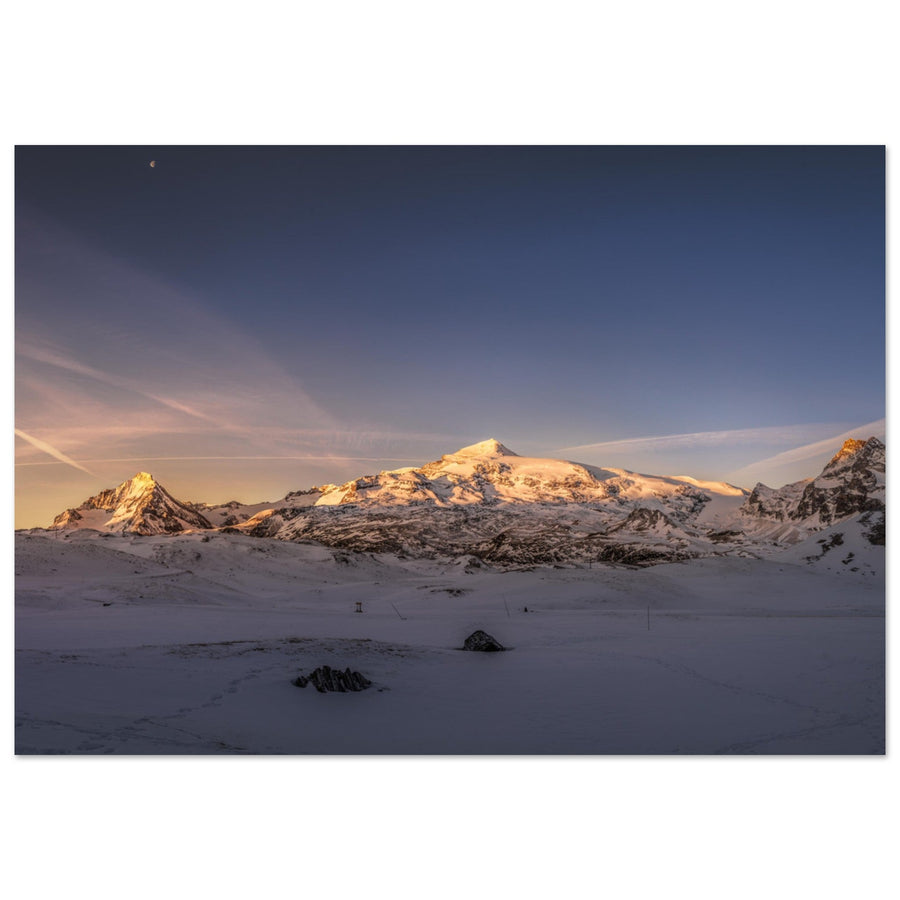
Dent Parrachée, Dôme de Chasseforêt and Mont Pelve — progression rather than a single summit
This Vanoise scene works through succession. Several major mountain forms occupy the frame, and the first light does not act like a switch illuminating the whole landscape at once. A ridge stands out, a glaciated area takes on a warmer tone, then a second summit begins to separate from the blue shadows.
That rhythm earns its place here. A sunrise photograph can be spectacular with a single subject, but here the eye travels. The landscape gains a sense of depth and scale because the summits do not all play the same role.
Here, the panorama works best when the summits remain individually legible. The exact viewpoint may vary, and this selection imposes no single route. Simply understand that being at altitude before daylight requires different preparation from a roadside viewpoint.
The main limitation is visual as much as practical: mediocre visibility or too wide a frame can flatten the differences between the mountain forms.

First light moves across the Vanoise
Several summits receive light at different rates, giving the panorama a depth an isolated summit cannot produce.
Photography: Pierre Thiaville
View the photo print of the Dent Parrachée at sunrisePhotographing the Dent Parrachée in the Vanoise →
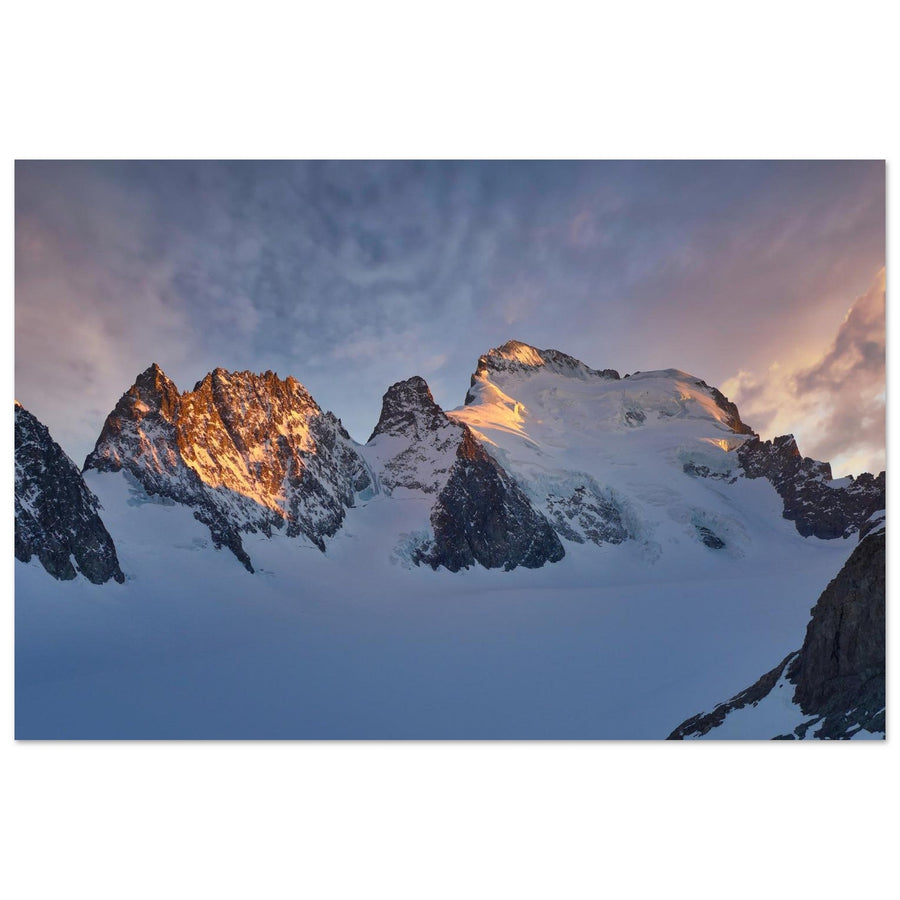
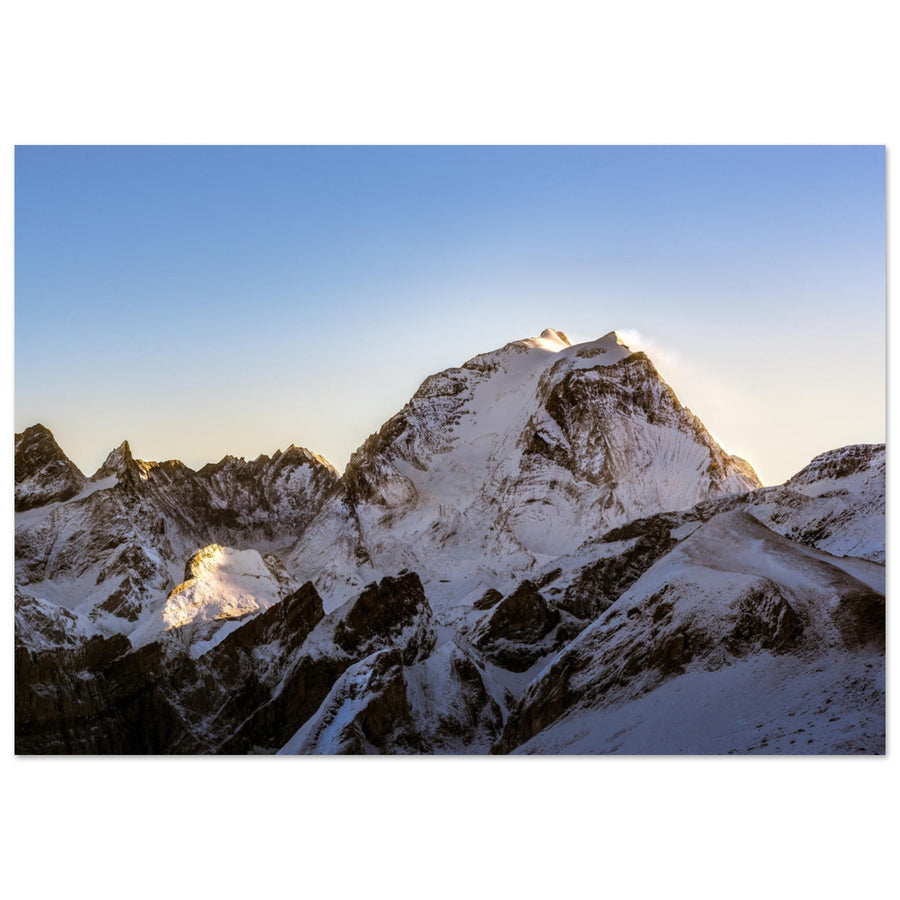
Grande Casse — reading the transition from alpenglow to direct light
Isolated within the frame, the Grande Casse tells another story. Its silhouette alone structures the image, letting you focus more on the progression of light than on the surrounding landscape's complexity.
Before direct sunlight, the highest parts may turn pink while the rest of the relief retains cooler tones. When light actually reaches the face, contrast becomes clearer and forms gain presence. This is one of the selection's most useful profiles for visually distinguishing alpenglow from direct light without turning the article into a technical tutorial.
The Grande Casse suits a summit portrait here, from a viewpoint far enough away to retain the mountain's overall shape. There are several ways to see the Grande Casse within the Vanoise; choose the precise area later using the Vanoise guide.
The trade-off is dependence on clear air. A single summit leaves less scope to compensate for poor visibility or a background that is too close.

The Grande Casse between alpenglow and direct light
The summit's silhouette focuses attention on the transition between cool shadow tones and light arriving on the upper slopes.
Photography: Pierre Thiaville
View the photo print of the Grande Casse at sunrisePhotographing the Grande Casse in the Vanoise.
Mont Revard — a dawn panorama without high-mountain commitment
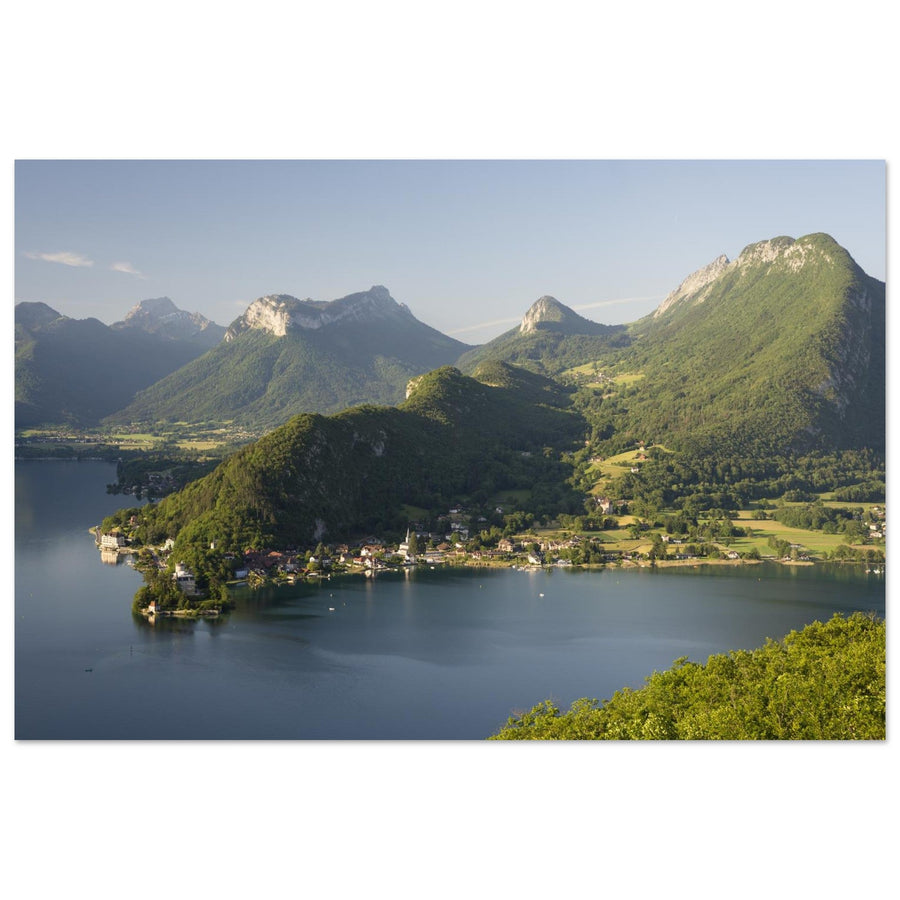
Mont Revard plays a different role from the other scenes in this first group. First light is sought not to isolate a nearby summit, but to reveal horizons, successive layers and atmospheric variations above the basin visible from the viewpoint.
This scene deserves its place because it radically changes the practical decision. The viewpoint is accessible by road, so you can be there before dawn without arranging a hut stay or Alpine travel. That does not make the outing automatic: wind, visibility and winter road conditions can completely change the experience.
At Le Revard, the image benefits from giving atmosphere as much room as relief. Low mist or successive layers can add depth, but no such condition should be promised in advance.
Le Revard is already documented in the guides and gallery, but the photograph currently associated with the viewpoint does not explicitly demonstrate sunrise. The profile therefore remains without a supporting image in this selection.
Explore photography at Mont Revard →
When atmosphere transforms the scene
Grande Casse and Montagne de la Seigne — mountains above a sea of cloud
The Grande Casse appears a second time, but the choice is no longer the same. Here, the summit alone does not explain the image. An inversion hides the valleys and turns emerging mountains into successive layers separated by clouds.
First light crosses this atmosphere with less harshness. Contrasts can remain gentler, and the landscape gains depth as distant ridges separate. This approach is especially interesting for readers who prefer a quiet, diffuse atmosphere to the power of an isolated summit.
For the scene to work, the viewpoint must be high enough above the inversion. This condition cannot be promised: a sea of cloud depends on weather and atmospheric structure. That is its main trade-off and part of its appeal.

A sea of cloud transforms the landscape's depth
The inversion hides the valleys and separates the mountains into successive layers, with more diffuse light than in a summit portrait.
Photography: Pierre Thiaville
View the photo print of the Grande Casse above a sea of cloudCervin and moon — a few minutes between night and day
The Cervin is one of the Alps' most recognisable summits; it needs no spectacular sky to be legible. In this scene, however, the moon adds a second presence that changes the story: day is beginning, but night has not entirely left the frame.
The image rests on balance between two subjects. Dawn's first tones must remain gentle enough for summit and moon to coexist without one overwhelming the other. The result can be far more restrained than a brightly coloured sunrise.
Several viewpoints around Zermatt offer views of the Cervin. This page does not fix an exact spot, because the moon's relative position depends on date, time and framing. That is precisely the scene's trade-off: the visual relationship seen in the artwork cannot be reproduced at will.

The Cervin and moon linger between night and day
The moon adds a second presence to the Cervin's silhouette and creates a more restrained image than a sunrise based solely on sky colour.
Photography: Pierre Thiaville
View the photo print of the Cervin and moon at sunrisePhotographing Zermatt and the Cervin.
When an element tells the sunrise story
Robert Blanc hut — the high mountains become inhabited
The Robert Blanc hut introduces a built element into a very rocky landscape. At dawn, the building immediately gives scale to the surrounding slopes and mountains. Without it, the scene could be read as a composition of rock, snow and light; with it, it also tells of human presence at altitude.
Sunrise is therefore more than sky colour. The appeal lies in the contrast between still-cool areas and the hut or mountains beginning to receive light. The frame should retain enough surroundings for the building's isolation to remain apparent.
Access is that of a high-mountain hut, not an urban viewpoint. Being there at sunrise often makes an overnight stay more sensible than a very long pre-dawn start. Check conditions, opening and stay arrangements with the official source when planning.
The trade-off is commitment: altitude, terrain and weather truly matter. This page stops at that decision-making level.

The Robert Blanc hut gives scale to the high mountains
The building adds a fixed human presence to a rocky environment and makes the scale of the relief immediately apparent.
Photography: Pierre Thiaville
View the photo print of the Robert Blanc hut at sunriseExplore the landscapes of the Mont-Blanc massif →
Lac de Presset and Pierra Menta — a natural reflection clearly tied to dawn
Lac de Presset brings a different geometry. The Pierra Menta stands out with its highly recognisable vertical silhouette, while the lake surface can form a much calmer second layer. When the water is stable enough, the reflection extends the mountain rather than simply repeating it.
This scene was selected because its sunrise character is explicitly documented. It adds a natural reflection with a clearly established link to dawn.
The scene works particularly well when the light stays soft, the sky need not be spectacular and water provides structure. Reflection nevertheless depends on wind and surface conditions: understand it as a possibility, never a promise.
Being there before daylight requires a more demanding high-altitude approach than Le Revard. The hut and local rules then help you prepare the outing without turning this article into a route guide. The exact sunrise photograph of Lac de Presset and the Pierra Menta is by Bel Cassandra; it documents the scene without being presented as Pierre Thiaville's personal experience.

Lac de Presset's natural reflection at dawn
The Pierra Menta and lake surface create a two-level composition whose reflection remains dependent on wind and calm water.
Photography: Bel Cassandra
View the photo print of Lac de Presset and the Pierra Menta at sunrisePhotographing the Presset area in the Beaufortain.
Cervin in the Gornergrat train — use infrastructure rather than hide it
This scene deliberately departs from the classic Alpine landscape. A train window becomes a reflective surface and makes the Cervin appear a second time. Infrastructure does not disrupt the composition: it creates it.
Morning light must remain balanced enough for the reflection not to disappear in contrast. The result is more graphic than a traditional panorama. It shows that sunrise can be interesting without removing every human or technical trace from the frame.
Feasibility depends on timetables. Seasonal Gornergrat services may allow you to be travelling at sunrise, but this changes and must be checked each season. Even with a suitable train, the reflection's exact angle and the space available in the carriage make the scene hard to reproduce precisely.

The Gornergrat train becomes a compositional element
The window reflects the Cervin and turns Alpine infrastructure into a second graphic layer rather than something to hide.
Photography: Pierre Thiaville
View the photo print of the Cervin reflected in the Gornergrat trainMountaineers at the foot of the Lanchettes ridge — light gives scale to the effort
In this scene, people are not decorative details. The silhouettes immediately reveal the size of the snowy terrain and the distance between humans and the surrounding mountains. Low morning light emphasises tracks and variations in the snow, while the mountaineers give scale to the whole.
The intended image is not a close-up of a group. People must remain small enough for the mountain to keep the main role. Sunrise then reveals forms rather than simply providing a coloured sky.
Above all, understand the nature of the scene: this is mountaineering. The profile does not name a tourist viewpoint to reach in darkness and wait for the sun. Skills, conditions and any professional guidance belong to high-mountain preparation beyond the scope of this selection.

Silhouettes give scale to the Lanchettes terrain
Low-angle light reveals tracks and slopes while the mountaineers remain small enough to convey the scale of the high-mountain terrain.
Photography: Pierre Thiaville
View the photo print of mountaineers at the Lanchettes at sunriseInspiration and technique: two different decisions
This page answers a choice: which kind of sunrise scene appeals to you most, and what level of commitment fits your project? It does not aim to explain azimuth calculations, precise sun prediction, exposure choices or bracketing.
Once the scene is chosen, the mountain sunrise photography guide takes over for method. The massif guides then let you explore the Vanoise, Mont-Blanc massif or Mont Revard further when the area becomes your next decision.
Sources and provenance
The official sources below document the area, access and information that may change. Always recheck timetables, opening and conditions before travelling.
- Vanoise National Park — area information and local conditions
- Robert Blanc hut — official access, opening and stay information
- Presset hut — official access
- Presset hut — local bivouac regulations
- Gornergrat — sunrise service and seasonal timetables
- Zermatt — official local information
- Le Revard viewpoint — official tourism information
Photographs accompanying the profiles are used only when they truly demonstrate the scene described and the exact image has been validated. Mont Revard remains without a supporting image on this page until an AAM photograph explicitly taken at sunrise is validated.
Key points
No Alpine sunrise is superior to all others. The Dent Parrachée and neighbouring summits favour panorama; the Grande Casse, a summit portrait; the sea of cloud, atmosphere; Robert Blanc, the hut; Presset, natural reflection; Cervin and moon, the boundary between night and day; the Gornergrat train, graphic composition; the Lanchettes, human presence; and Le Revard, an accessible broad panorama.
The right choice therefore depends on the image you want to see — and the setting you are prepared to be in before dawn.