Vanoise | Photographing the Grande Casse
Photographing a dominant summit
The Grande Casse works when it remains a sovereign mass, measured by a smaller plane rather than lost in a panorama of summits.
Its broad pale face, glacier and shoulders form an expansive shape: first preserve its continuity, then choose what will provide scale.
Choose the summit's dominance
Mass alone, human scale or broad territory?
Decide whether the mass, its scale or its territory should be read first.
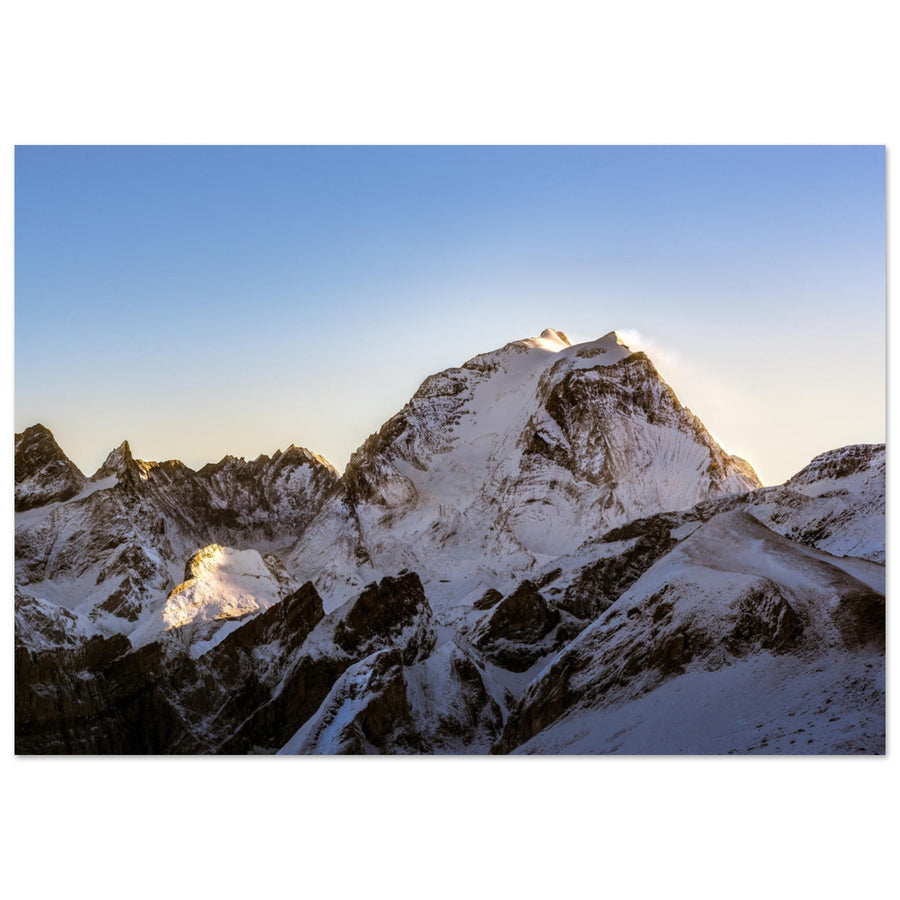
A tighter frame and few competing summits turn the Grande Casse into a single figure.
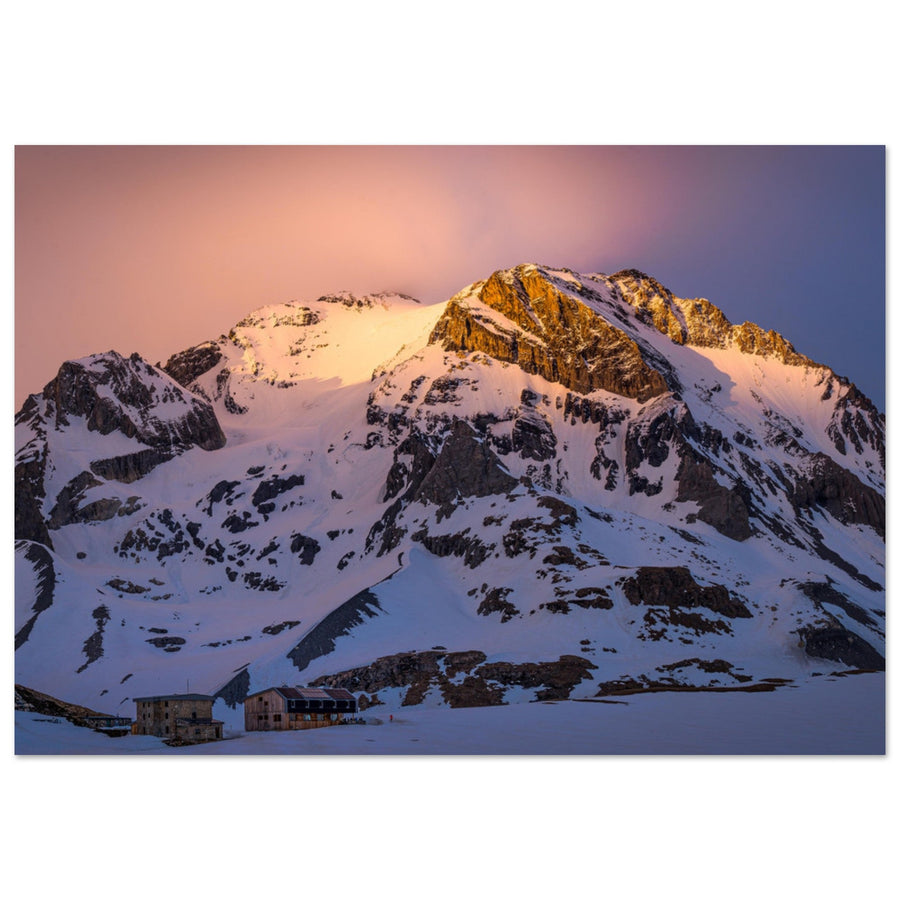
A tiny refuge or human trace is enough to provide scale without diverting the eye.
A wider frame shows hollows and ridges, provided the Grande Casse remains the first mass the eye reads.
Continuity of the face
Preserve a complete summit mass
Even in changing light, face, profile and scale relationship should remain united.
Preserve large snow or pale-rock surfaces: too much micro-contrast fragments them.
Let both sides of the summit breathe so its profile does not merge with neighboring ridges.
Place a familiar element in another plane, small enough to measure the mountain without becoming the subject.

Artwork — measure the face
A tiny refuge is enough to measure the face
The building remains a discreet marker while the Grande Casse occupies most of the scene: the scale relationship strengthens the mountain without opposing it with a second subject.
Photograph: Pierre Thiaville. View the Grande Casse and the Refuge de la VanoiseDistance and profile
What the angle and snow change
The chosen area changes the visible face; snow cover changes how its volumes appear.

A wider view of the landscape
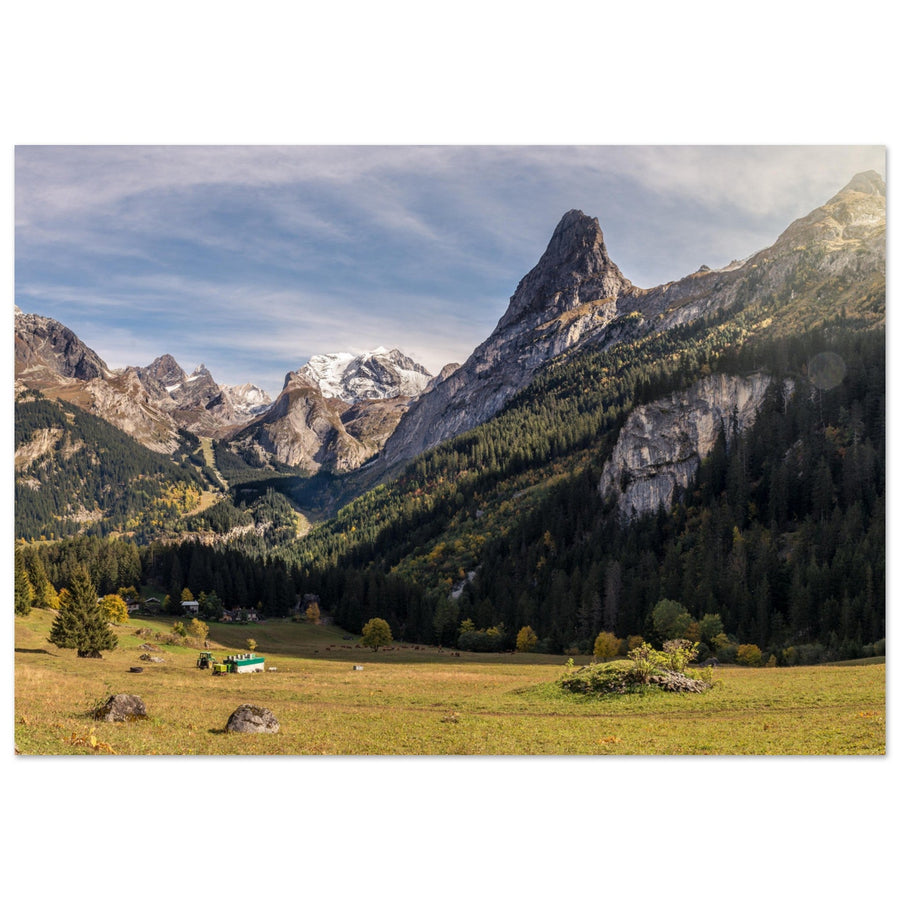
The valley leads the eye towards the Grande Casse
The meadow and wooded slopes create several layers before the snow-covered mountain. The rocky peak on the right frames the opening. The summit retains its place within a wider landscape than in the close view of the refuge.
Photograph: Pierre Thiaville View the Grande Casse beyond the valleyHierarchy of the mass
Compose to let the summit dominate
The summit's dominance is built through free edges, a reduced scale marker and readable volumes.
Keep obstacles away from the profile
Place trees, rocks or ridges below the summit line rather than in front of it.
Reduce the human marker
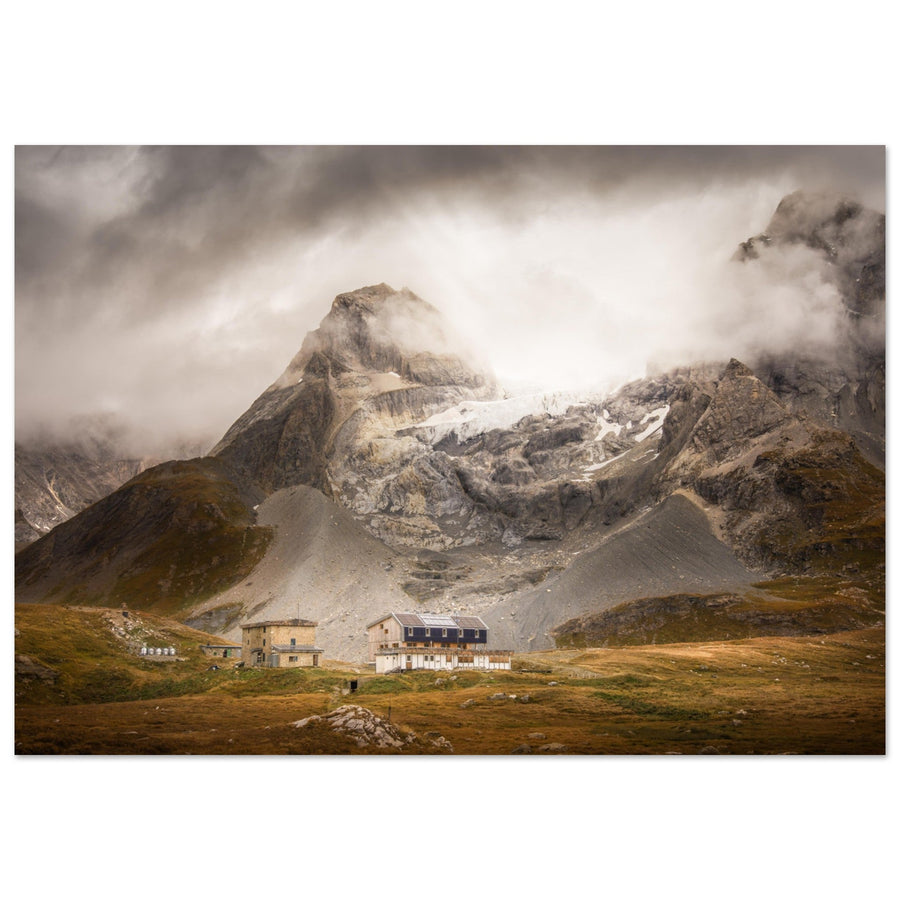
A very small refuge measures the mass; too large, it turns the image into a refuge scene.
Make volumes readable before colour
Raking light reveals folds; flat light calls for a more graphic composition.
Boundary of the dominant summit
When is the image still about the Grande Casse?
The Grande Casse stops dominating when the refuge, neighboring ridges or panorama receive equal weight.
Its profile stays complete, its surface is the strongest mass and other elements provide scale.
If the building becomes detailed and close, the image is primarily about life at altitude.
If several summits carry the same weight, the image is about high Vanoise rather than one summit.
Reduce the image mentally: if the face is no longer the first shape recognized, simplify the hierarchy.
When the mass breaks apart
Recover volume despite clouds, harsh light or wind
When profile or volume disappears, move to a more graphic reading instead of manufacturing absent grandeur.
Wait for an outline, not a complete disappearance
A brief opening can restore the profile; without a clean separation, switch to nearby folds.
Look for plane boundaries
Reduce the sky and use dark ridges to rebuild depth.
Simplify the shoot
Choose one stable frame and avoid unnecessary position changes on exposed terrain.
Move to graphic form
In even light, favor the summit line, snow shapes and one restrained scale marker.
Commitment around the Grande Casse
Prepare for a high-mountain approach
Closer readings lie in high-mountain terrain where weather, snow cover, trail conditions and refuge opening can change quickly.
The normal route and glacial sectors are mountaineering terrain. This page helps build an image; it does not replace appropriate skills, equipment or guidance.
Check just before the outing
Summit visibility, snow and commitment should be reassessed for the actual sector and time chosen.
- weather and summit visibility
- snow cover, exposed passages and route conditions
- refuge opening and local access
- core-area National Park rules
Official sources
Open the pages that match your access and date.
Change scale in Vanoise
Extend the work on the dominant summit
Two subjects that extend this decision
Change geometry while keeping a similar photographic question.
- Photograph Lac des Vaches — to approach the Grande Casse through reflections and stepping stones.
- Photograph Refuge de la Valette — to reverse the scale relationship and give priority to the shelter.
Return to the Vanoise choice
The overview helps compare the great summit mass with six different geometries.