Where to see marmots in the Alps?
Seeing a marmot in the Alps depends less on a “spot” than on three things: recognising a coherent habitat, choosing a period when the species is genuinely active and observing calmly enough not to change its behaviour. Alpine and subalpine grasslands, open pastures and mosaics of grass and rock are the most characteristic environments. Season, altitude, snow cover, temperature and visitor pressure then shift the observation window considerably.
The Alpine marmot is present across much of the Alpine arc. Vanoise, Écrins, Mercantour, Gran Paradiso, the Swiss National Park and Vercors offer very different readings of the same species; Hohe Tauern and Queyras broaden the contrast even further. The aim of this guide is therefore not to designate a “guaranteed” place, but to compare territories where presence is documented and understand what each one changes in the encounter: habitat, season, behaviour and type of photographic scene.
For photography, the logic is the same: the subject is not only the marmot, but the marmot in its environment. A snowmelt scene, a family in an Alpine meadow, an animal feeding in late summer or a silhouette on a limestone plateau tell the story of the Alps better than a portrait obtained by getting too close. Detailed settings, lenses and autofocus remain covered in the Technique guide devoted to mountain wildlife.
First look for coherent open grasslands and Alpine pastures rather than a precise coordinate.
Altitude, snow, heat and weather matter more than a universal hour.
Vanoise, Mercantour, Vercors and Engadine do not produce the same environments or the same scenes.
A whistle, flight or an animal that stops feeding are signals to increase the distance.
Which territory should you choose at a glance?
| Territory | Dominant environment | Rhythm to understand | What sets it apart | Plausible photographic scene | Main trade-off |
|---|---|---|---|---|---|
| Vanoise / Haute Maurienne | High-altitude grasslands and pastures, large mountain relief | Strong variability with altitude and snow cover | Long-term scientific monitoring and a very high-mountain reading | Family in an Alpine pasture, residual snow, animal placed within major summits | Visitor pressure and very different seasonal conditions depending on altitude |
| Écrins | Alpine pastures, heathland, high-altitude meadows and broad slopes | Activity sensitive to hot hours and weather | Major mountain scenery clearly structured around open habitats | Marmot in a meadow with mineral or glacial relief in the background | Do not confuse known sites with guaranteed presence |
| Mercantour / Southern Alps | Sunny slopes, high-altitude grasslands and meadows | Marked seasonal cycle; summer heat matters | Drier, more southern atmosphere | Pale rock, short grass, harder or low-angle light | Heat, mountain roads and strong local seasonality |
| Gran Paradiso | Italian Alpine meadows and family territories | Social behaviours strongly linked to conditions | Long-term research programme since 2006 | Play, grooming, interactions or feeding in the meadow | Research results are not formulas for choosing an hour |
| Swiss National Park / Engadine | Subalpine pastures and meadows | In summer, especially avoid the hottest midday hours | Particularly strict protection framework | Animal in a very wild landscape, observed from the trail | Leaving trails is prohibited and visiting rules are strict |
| Vercors | Grasslands, heathland and limestone high plateaus | Distributed presence; observation is not uniform | Prealpine contrast very different from the inner Alps | Limestone grassland, open plateau, less glacial relief | Do not convert observation data into a list of spots |
| Hohe Tauern | Alpine grasslands, boulder fields and pastures among major relief | Short summer devoted to feeding and family life | Eastern Alps reading | Family group in a vast pasture dotted with boulders | Huge territory: no fine localisation in this guide |
| Queyras | Drier Alpine grasslands, high passes, nearby larches | Activity from spring to late summer depending on altitude | Dry, bright palette of the inner Southern Alps | Marmot in a dry pasture with pale stone or larches in context | Partial overlap with Mercantour: avoid repetition |
This table compares contexts, not quantified probabilities. Documented presence and suitable habitat never guarantee that an animal will be visible on the day of your outing. The purpose is to rule out territories that fit your project poorly and better understand those that remain.
Read the habitat before looking for a place
The marmot is above all an animal of open environments. In the Alps, it is typically associated with Alpine and subalpine grasslands, high-altitude meadows, pastures and certain mosaics of short vegetation, rocks and scree. Parc national du Mercantour describes it mainly on sunny, open slopes, while Écrins presents it as one of the easiest animals to observe in Alpine pastures when conditions are favourable.
For the reader, this information is more useful than a list of car parks. An area becomes coherent when it provides food, visibility and soils that allow burrows to be established. That does not mean looking for burrow entrances. On the contrary: burrows are the animal’s vital refuge and must never become a prospecting or photography objective.
The best method is to slow down before entering a large Alpine pasture, observe first with the naked eye or binoculars and look for animals already active in the landscape. A marmot feeding, moving calmly or interacting with other individuals is a better indicator than a hole in the ground. If alarm calls begin as soon as you arrive, you have not “found the colony”: you have already changed its behaviour and should reduce your pressure.
When can you see marmots? Season matters more than a fixed hour
Marmots are diurnal, but that does not mean they show the same level of activity all day or all year. The calendar changes with altitude, exposure, snow cover and weather. Écrins indicates emergence from hibernation in spring and return to the burrow in autumn; Mercantour generally places hibernation from October to March. These references describe a cycle, not universal dates.
Emergence from hibernation and snowmelt
In spring, the first snow-free, vegetated areas concentrate feeding activity. It can be a strong photographic period when snow remains in the landscape, but the animals emerge with limited reserves: making them flee costs energy at the very moment they need to feed again.
Early summer and family life
Family groups become more visible and young gradually appear outside. The date can be very late at altitude: in the 2025 Grande Sassière monitoring in Vanoise, young marmots emerged between 21 June and 13 July. This result concerns that monitored population and above all illustrates variability, not a date to apply across the Alps.
High season and heat
In summer, temperature strongly affects visible activity. Écrins recommends avoiding the hottest hours; the Swiss National Park gives the same guidance. In cool or cloudy weather, observation may remain possible in the middle of the day. There is therefore no “magic hour” independent of conditions.
Late summer and preparation for hibernation
Feeding becomes central as marmots build their reserves. The scene changes: less snow, heavier-looking coats and silhouettes, drier grass and often lower light late in the season. Observation should remain discreet so as not to divert animals from this essential phase.
Recent research adds a useful nuance. In Gran Paradiso, a study published in August 2026 based on observations made between 2023 and 2025 found that play, especially among young animals, decreased sharply as temperature rose and became almost absent above 21 °C in the studied population. This is not a threshold to use for scheduling an outing; it shows instead why heat changes the nature of visible behaviour.
Which scenes and behaviours should you observe naturally?
Photographing a marmot in an interesting way does not require provoking a posture. The richest behaviours are precisely those that appear when the animal continues its life despite your presence. In family groups, feeding, grooming, play, social contact, movement and natural vigilance produce more meaningful scenes than an animal forced upright by a sound or movement.
Feeding
A marmot grazing or searching for food directly tells the story of its relationship with the Alpine pasture. In late summer, this activity is even more meaningful because the animal is building the reserves needed for hibernation.
Natural vigilance
An upright posture can indicate vigilance. It is interesting only if it happens naturally. If the animal stares at you, stops feeding or repeatedly calls, the right photographic response is to step back, not wait for the next “pose”.
Social interactions
Marmots live in family groups where play, grooming, greetings and sometimes conflict are part of social behaviour. These interactions create strong images because they tell the story of the species’ life, not just its silhouette.
Young and family
Young marmots may play or explore around the family group. They are also among the subjects most easily disturbed indirectly: never cut off the route to refuge and increase the distance rather than trying to tighten the frame.
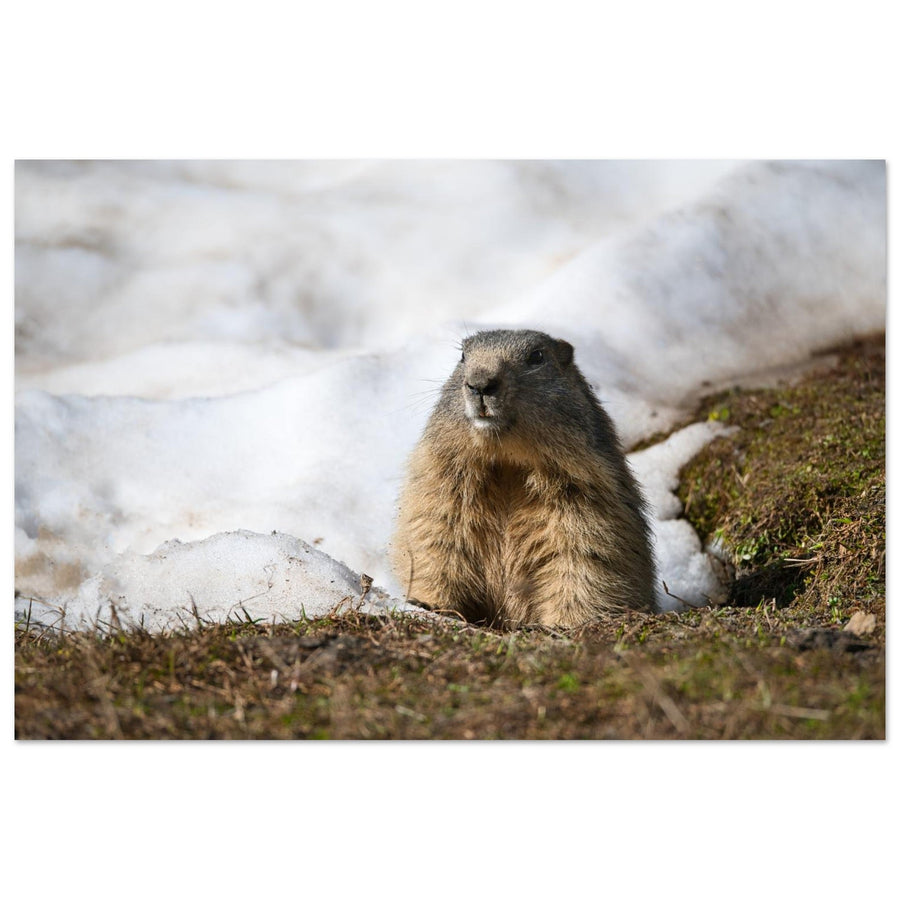
Residual snow
In spring and early in the high-altitude season, residual snow simplifies the setting and immediately places the scene in the mountains. It works best when the animal remains connected to its habitat: vegetated area, rock, slope and major relief around it.
Animal in the wider landscape
A tight portrait shows the expression; an environmental scene shows the Alps. Depending on the territory, keep part of the limestone plateau, southern pasture, subalpine meadow or major mountain relief so that the image also tells the story of the place.
For lenses, shutter speed, autofocus, ISO or the choice between portrait and environmental frame, see Photographing mountain wildlife: equipment, settings and advice. Here, the question remains one of scene and behaviour, not camera settings.

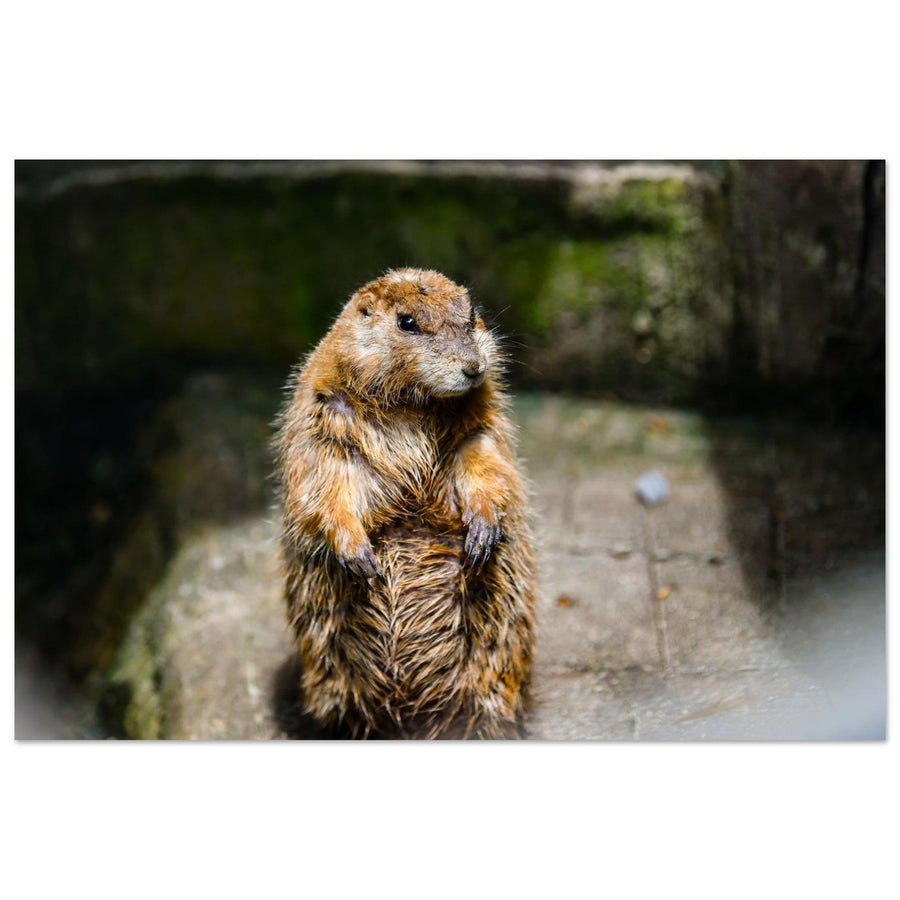
A young marmot placed within its environment
This photograph illustrates the presence of a young animal in an Alpine setting without attaching the scene to a territory that is not documented.
Photograph: Wirestock Creators
View the young marmot photo printObserve and photograph without disturbing
Which territory should you choose according to the scene you want?
High mountains, snow and family life
Vanoise, Écrins and Gran Paradiso are the three most complete readings if you want to connect behaviour with major high-altitude landscapes. Vanoise brings the scientific depth of long-term monitoring; Écrins a very clear reading of Alpine pasture and heat; Gran Paradiso especially strong material on social behaviour.
Drier, more southern atmosphere
Mercantour stands out for sunny slopes, high-altitude grasslands and a lighter rock palette. Queyras extends this reading with more dry grassland and larches in the landscape.
Observation in a very strict reserve
The Swiss National Park offers a different reading: the animal is observed from the trail, in a space where the protection framework is directly part of the experience. It is a good choice for understanding that responsible observation can also be a positive constraint.
Limestone Prealps
Vercors is the most distinctive territory for moving away from the classic image of the inner Alps. Grasslands, heathlands and limestone high plateaus create a more Prealpine context while remaining coherent for the species.
Eastern Alps
Hohe Tauern opens the comparison eastward: broad Alpine pastures, boulders and extensive relief where marmots live in family groups during a short summer.
Savoie or Haute-Savoie without a “department spot”
Use these names as travel references, then return to natural geography: Vanoise and Haute Maurienne in Savoie; Bauges or Haut-Giffre/Passy for certain readings in Haute-Savoie. A department is not a habitat.
Vanoise and Haute Maurienne — high-altitude pastures, season and family life
Vanoise is one of the best-documented territories in this guide. Marmots are associated with many high-altitude pastures and the massif is especially home to an exceptional scientific monitoring programme. At Grande Sassière, a population has been studied for more than thirty years through capture, marking, counts and behavioural observations. This scientific site proves the depth of knowledge available on the species; it must not be turned into an observation “spot”.
The main lesson from Vanoise is seasonal variability. At high altitude, snow cover and the date of vegetation growth can strongly shift visible reproduction. In 2025, in the population monitored at Grande Sassière, young marmots appeared between 21 June and 13 July, with an average date of 30 June. This precision does not say when “all Vanoise marmots emerge”; on the contrary, it shows why a single calendar would be misleading.
Photographically, Vanoise is particularly strong when the family group or animal remains within a broad landscape: Alpine pasture, residual snow, open slope and then major summits in depth. It is a more monumental reading than Vercors and a less dry one than Mercantour. A calm feeding or family-life scene works better than a pursuit toward a burrow.
Visitor pressure can create the impression that some animals are “used to people”. That is not permission to reduce the distance. A marmot remaining near a path must keep its routes, feeding behaviour and access to refuge without being surrounded.
To prepare the massif, its landscapes and photography sectors without turning this guide into a route description, see Where to photograph the Vanoise?.
Écrins — read habitat, heat and the scale of the high mountains
In Écrins, the marmot is intimately linked to Alpine pastures. The National Park presents it as one of the easiest animals to observe while hiking in these environments, with two important qualifications: the hottest hours and bad weather often reduce visible activity. The park’s natural-history database contains several thousand recent observations, confirming broad presence at massif scale without providing a guaranteed place.
This logic completely changes how to prepare an outing. Rather than targeting a famous place name as a promise, it is more reliable to read the environment: open meadow, subalpine heath, grass-rock transition, good visibility. Some well-known areas remain places where the species is known, but they are not the structure of this guide.
Heat is a real observation variable here. On a hot summer day, morning and late day are often more coherent. In cool weather, daytime activity remains possible. A marmot resting or returning to its burrow in the middle of the day does not mean that “the spot does not work”; it is simply responding to conditions.
For photography, Écrins makes a powerful connection between the animal and the scale of the high mountains: grassland in the foreground, mineral slope, summit or glacier farther away. Keeping space around the subject helps tell this scale. Calm behaviour — feeding, grooming, movement — is worth more than a portrait obtained after an alarm.
To explore the landscapes and preparation of the massif further, use Where to photograph the Écrins?.
Mercantour and the Southern Alps — sunny grasslands and a southern rhythm
Mercantour brings a distinctly more southern reading of the marmot. The National Park describes the species on sunny, open slopes, in high-altitude meadows and grasslands, with a wide elevation range — from 800 to 3,200 metres — but mainly subalpine and Alpine presence. Marmots there generally hibernate from October to March.
This elevation gradient and sunshine make temperature particularly important. In summer, a highly exposed slope can become less active during hot hours, while cooler weather changes the rhythm. Mercantour’s editorial value is therefore not to cite a famous lake or pass, but to show how the Southern Alps change the scene: drier vegetation, pale rock, stronger contrasts and often very direct light.
Family groups can offer feeding or vigilance scenes on short grass and among rocky blocks. The photographer benefits from keeping these elements rather than completely isolating the animal. Low-angle light at the beginning or end of the day can give the rocks a lot of relief, but it should not be presented as a guarantee of presence.
Mercantour is also a useful safety reminder: some encounters take place near mountain roads. A marmot visible from the road never justifies a dangerous stop or stepping into traffic. Use only an authorised stopping place and keep the animal from associating vehicles with food.

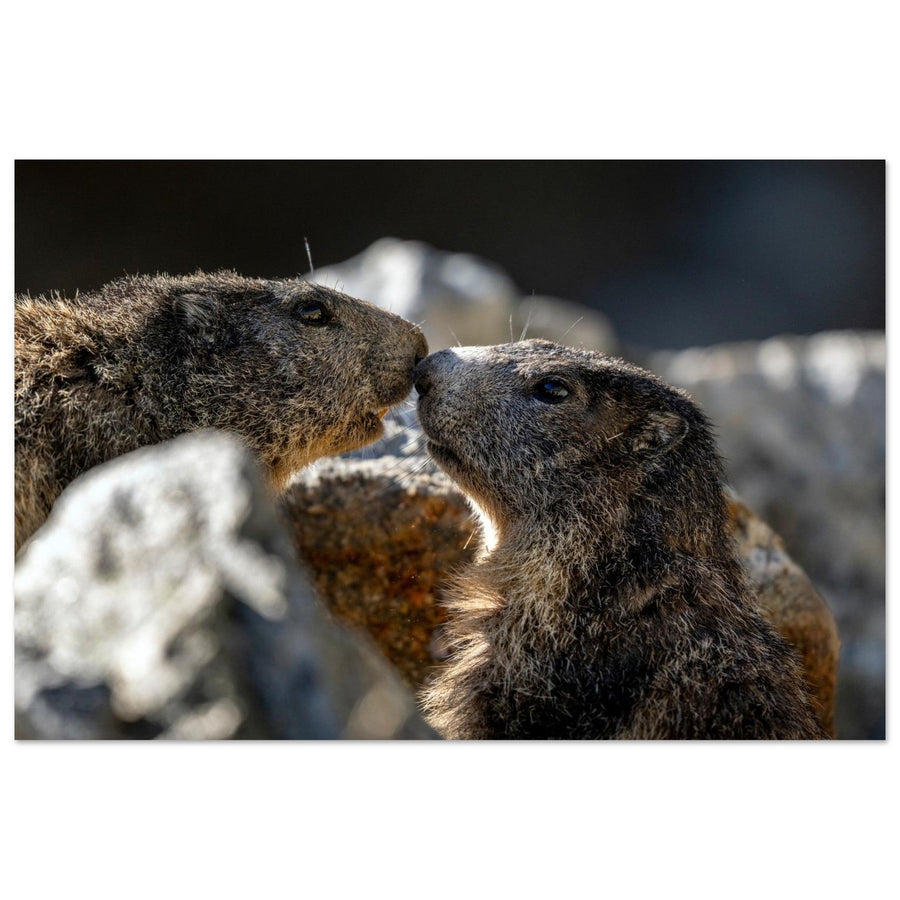
Two marmots in the rocky setting of Mercantour
The closeness of the two animals creates a readable social scene while keeping the rocks and colours of Mercantour as an Alpine context.
Photograph: Michel PERES
View the two Mercantour marmots photo printGran Paradiso — heat, activity and social behaviour
Gran Paradiso is one of the most interesting territories for understanding the marmot beyond simple presence. Since 2006, the Park has run a long-term research programme on the species’ eco-ethology. It documents a good density of marmots in the Park and studies sociality, hibernation, space use, territoriality and individual behavioural differences.
This scientific depth changes the photographic reading of the territory. A marmot is not simply “visible in a meadow”: it belongs to a family group and has a social repertoire. Play, grooming, greetings, feeding and agonistic interactions do not all respond in the same way to conditions.
A study published in August 2026 illustrates this very clearly. Between 2023 and 2025, researchers observed 83 marmots from 14 family groups for 189 hours and recorded 667 social interactions. In this population, play peaked around 12.8 °C and then decreased rapidly as temperature rose, becoming almost absent above 21 °C. Other social interactions were much less affected.
For the reader, the conclusion is definitely not “go when it is 12.8 °C”. The result shows that the same meadow can produce very different scenes depending on conditions. In hotter weather, waiting for play behaviour may be unrealistic; feeding, grooming or other interactions may still occur. This relationship between weather, behaviour and scene is precisely what gives Gran Paradiso its value in this comparison.
No precise research area is used here as a place to visit. The scientific programme serves to understand the species at territory scale, not to turn a monitored population into an attraction.
Swiss National Park and Engadine — a reserve that defines the framework
The Swiss National Park provides another definition of a “good” observation: one in which the protection constraints are integrated from the start. Marmots are present in subalpine pastures and meadows; the Park notes that they can be observed in several places until the end of September and that they especially avoid the hottest midday hours in high summer.
But the territory’s main value comes from the framework. Leaving marked trails and resting areas is prohibited, dogs are not admitted even on a lead, drones are prohibited and visits are allowed only during the day. The Park is closed in winter. These rules are not an obstacle added afterwards: they partly explain why wildlife can be observed in an environment where human pressure is better contained.
Photography must therefore be conceived from the trail, with binoculars or a telephoto lens as distance tools. This framework naturally pushes the image toward a more environmental composition: animal on a subalpine meadow, wild slope, forest or relief in depth. It is unnecessary and prohibited to improve the viewpoint by crossing the habitat.
The Swiss National Park also states an important principle of honesty: wildlife observation remains a matter of patience and luck. This is probably the fairest formulation for the whole guide. Understanding behaviour improves the quality of the search; it never turns the animal into a guaranteed appointment.
Vercors — a Prealpine, limestone reading of the marmot
Vercors deserves a full section because it changes the geographic language of the marmot. The regional park’s official atlas records 1,289 observations across 47 municipalities, with data extending to 2025. These figures prove a well-established presence at massif scale; they must not be converted into a ranking of municipalities or a map of colonies.
The habitats associated in the atlas — hay meadows, mountain and subalpine heathlands, high-altitude dwarf heath — create an atmosphere different from the large glacial valleys of Vanoise or Écrins. Here, the marmot appears in a more Prealpine, limestone context, with plateaus, grasslands and relief where pale rock often replaces a glacier backdrop.
Photographically, this difference is valuable. A relatively small animal in open grassland, with a limestone bar or plateau behind it, immediately tells a different story from a marmot surrounded by snow or very high mountains. Vercors therefore shows that the species belongs to the Alps without limiting it to their most vertical image.
To explore the territory, landscapes and viewpoints further, see Where to photograph the Vercors?.
Two territories that broaden the Alpine reading even further
Hohe Tauern — families, pastures and the Eastern Alps
In Hohe Tauern, the National Park states that marmots are frequently observed. They live in large family groups in burrows set within Alpine grasslands, boulder fields and pastures between about 1,400 and 2,700 metres. The short summer is devoted to accumulating the reserves needed for winter.
This territory is especially useful because it opens the guide toward the Eastern Alps. The scene can bring together family, broad Alpine pasture and extensive relief without needing to add a list of valleys or routes. Hohe Tauern therefore remains a strong secondary territory: different enough to matter, but without any need to artificially give it the same depth as the six main profiles.
Queyras — dry grasslands, high passes and larches
Queyras Regional Natural Park documents an important marmot population in Alpine grasslands. The massif brings a clear visual combination: drier terrain, pale stone, high passes and larches near the open zones. This palette is distinct from Vanoise and Vercors even though it shares some southern character with Mercantour.
Queyras therefore remains a very good complementary territory, especially for environmental photography. It should not, however, repeat the Mercantour section with another list of “best places”. To prepare the massif, use Where to photograph the Queyras?.
Savoie, Haute-Savoie and Annecy: references, not habitats
Many travellers naturally think in terms of departments or towns where they stay. This is useful for orientation but insufficient for understanding a species. “See marmots in Savoie” first points toward natural territories such as Vanoise and Haute Maurienne. “Near Annecy” may lead to areas of the Bauges massif; in Haute-Savoie, Haut-Giffre and the Passy reserve also document the species.
These references remain secondary in this guide because, on their own, they do not add a reading as strong as Vercors, Mercantour or Engadine. Chartreuse also has reintroduced marmots now present in several scree areas, but its interpretation overlaps more with the other limestone Prealps. None of these names justifies a section simply to fill a geographic quota.
What this guide can — and cannot — promise
After choosing: prepare observation and photography
Once the type of territory has been chosen, every other question should return to its proper owner. Destination guides take over for landscapes, light and the general organisation of a massif. For lenses, shutter speeds, autofocus, ISO and shooting method, use the Technique guide devoted to mountain wildlife.
Key takeaways
To see marmots in the Alps, start with the environment: open grassland or Alpine pasture, subalpine or Alpine context, enough vegetation and good visibility. Then choose the period by considering altitude, snow and heat rather than applying a fixed time of day.
The territories are not interchangeable. Vanoise and Écrins tell the story of the high mountains; Mercantour a southern atmosphere; Gran Paradiso social life and the effect of conditions; the Swiss National Park highly regulated observation; Vercors the limestone Prealps; Hohe Tauern and Queyras complete this reading toward the east and drier pastures.
Finally, photography is successful only if behaviour remains natural. Do not feed, do not look for burrows, do not provoke whistles and increase the distance as soon as the animal becomes vigilant. The best image is the one that shows a marmot still busy living in its landscape.
Information and official sources
Presence, protection rules and some visiting conditions can evolve. For the natural-history facts and local rules used in this guide, prioritise the following sources.
- Vanoise National Park — 2025 marmot monitoring at Grande Sassière
- Écrins National Park — M comme… Marmotte
- Biodiv’Écrins — Alpine marmot
- Parc national du Mercantour — Marmot
- Parco Nazionale Gran Paradiso — research programme on Alpine marmot eco-ethology
- Parco Nazionale Gran Paradiso — 2026 study on temperature and social behaviour
- Swiss National Park — wildlife and marmot observation
- Swiss National Park — protection regulations
- BiodiVercors — Alpine marmot
- Hohe Tauern National Park — fauna and marmots
- Queyras Regional Natural Park — fauna of Alpine grasslands