The Most Beautiful Sunsets in the Alps
The most beautiful sunsets in the Alps are not necessarily those with the reddest sky. In the mountains, the strongest scene may begin before the sun reaches the horizon, when a summit remains lit while the valley is already in shadow. It may also form around a reflection, a ridge cutting across the sky, a tiny hut beneath a glaciated face or, instead, after sunset, when blue hour simplifies the relief.
This selection brings together ten Alpine scenes chosen for those differences. The Lacs des Chéserys mirror Mont-Blanc's last light in the water. The Aiguille Crochue layers the ridges of the Aiguilles Rouges and the Mont-Blanc massif. The Col des Aravis offers much more accessible twilight. Snow-covered Chartreuse plays with layers of forest and snow. Le Sire opens the view towards the Bauges and Lac du Bourget. In the Vanoise, the Grande Casse towers over a hut that provides scale. In the Écrins, Pelvoux brings ice and rock into the scene. At Val Thorens, the resort may already be blue while the Aiguille de Péclet retains the last colours. In Zermatt, Riedweg lets the spectacle continue into blue hour facing the Cervin. In the Queyras, Rochebrune adds drier light on a limestone pyramid of the Southern Alps.
This is not a universal ranking. Here, “the most beautiful” means an AluArtMountains editorial selection designed to help you choose an atmosphere and a landscape type. Seven scenes are directly documented by Pierre Thiaville's photographs for AluArtMountains; the other three rely on official tourism sources that describe their appeal specifically at sunset or nightfall.
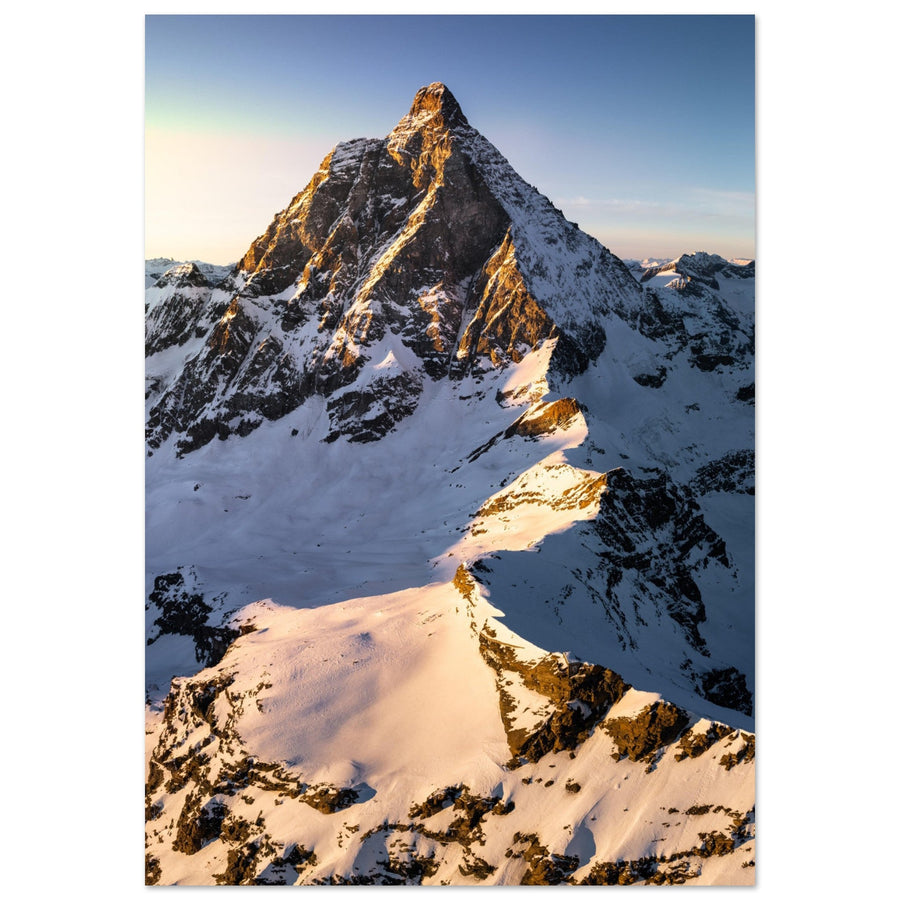
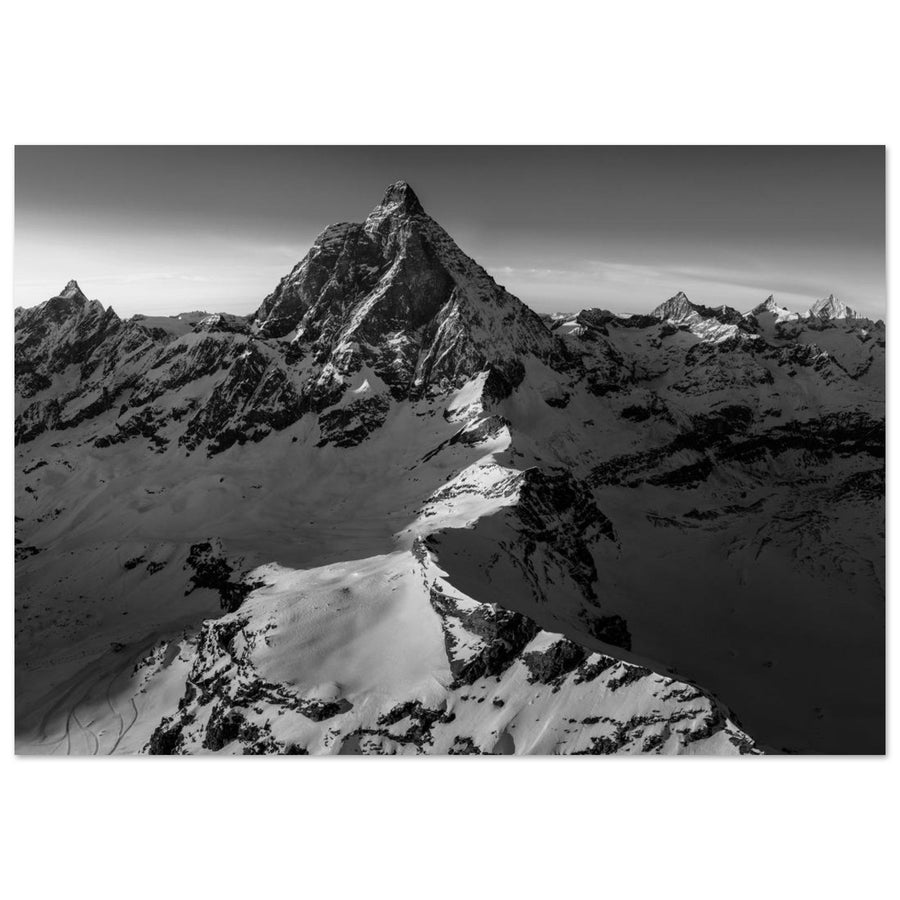
The sun need not be visible: a summit or face still catching the light can carry the entire scene.
The horizon and gradual fading of the light become the subject, as at Le Sire.
Silhouettes and blue hour can take over, particularly at Riedweg facing the Cervin.
The real challenge may begin after the photograph: darkness, cold, closed lifts or high-altitude conditions.
How this selection was put together
I chose scenes that genuinely change the reader's decision. A famous massif was not enough. Each entry needed an identifiable relationship between light and relief, a visual language distinct from the others and a practical trade-off that could influence the choice. That explains why some very photogenic scenes were left out: another place already told the same story more precisely.
An artwork's presence in the AluArtMountains collection was never enough to include a place. I first chose scenes for their visual appeal and usefulness in deciding; where an exact photograph exists, it then illustrates the profile. Elsewhere, I prefer a profile without an image to one using a merely “nearby” photograph.
Quick comparison of the ten scenes
| Scene | Choose it for | Light phase | Access / return | Trade-off |
|---|---|---|---|---|
| Lacs des Chéserys | Mont-Blanc reflection | Last light | Hike + return after the light fades | Reflection depends on wind |
| Aiguille Crochue | Layers of ridges | Last light | Altitude / conditions / lifts | More demanding than a road pass |
| Col des Aravis | Twilight facing Mont-Blanc | Twilight | Low commitment | Visibility and visitor numbers |
| Snow-covered Chartreuse | Snow, forests, pre-Alpine layers | Pastel late-day light | Varies with viewpoint and snow | No single spot |
| Le Sire viewpoint | Bauges + Lac du Bourget | The sunset itself | 20-minute walk from the Sire car park | Horizon visibility |
| Grande Casse + hut | Summit + human scale | Last light | High mountains / hut stay or late return | Altitude and season |
| Mont Pelvoux + glaciers | Ice, rock, mineral landscape | Last light | Check access to the area | Terrain and changing conditions |
| Val Thorens + Péclet | Blue resort + warm summit | Transition to blue hour | Seasonal late access | No permanent service |
| Riedweg + Cervin | Silhouette + village | After sunset / blue hour | From Zermatt | Cervin visibility |
| Pic de Rochebrune | Southern Alps limestone | Last light | Viewpoint varies | Choose the precise terrain |
Last light, sunset itself or after sunset: three different scenes
In the mountains, “sunset” covers several visually different moments. Last light is often the most spectacular on summits: the sun is already low, sometimes hidden by relief, but its rays still reach a face or ridge. The foreground may be cool or dark while the high mountains remain warm. Grande Casse, Pelvoux, Rochebrune and the Aiguille Crochue illustrate this particularly well.
The sunset itself works differently. The horizon becomes more important, and the scene can read as an open landscape. At Le Sire, Lac du Bourget and the Bauges mountains create exactly that depth. The sun can remain outside the frame, but its direction and the gradual fading of light structure the panorama.
After sunset, intensity drops, but the layers may become easier to separate. Villages light up, shadows merge and the sky turns blue. At Riedweg, Zermatt Tourism specifically recommends waiting for this “blue hour”, when the Cervin sends its last glow towards the village. This phase may be more interesting than a blazing sky if the summit's silhouette is your main subject.
Which Alpine sunset should you choose?
For a reflection, the Lacs des Chéserys are the clearest choice in this selection. Water adds a second reading of Mont-Blanc and can turn the last light into an almost symmetrical composition.
For overlapping mountain layers, the Aiguille Crochue is more suitable. The subject is not one summit but the sequence of nearby ridges and the distant Mont-Blanc massif.
To reduce commitment, the Col des Aravis offers a very different option. La Clusaz lists it among its sunset locations and suggests watching Mont-Blanc take on twilight colours there. Le Sire also belongs to this easier-access group, but with Lac du Bourget and the Bauges rather than Mont-Blanc.
For winter, snow-covered Chartreuse and Val Thorens tell different stories. The first consists of forests, snow and pre-Alpine layers; the second juxtaposes a resort and a high-mountain summit, with a much sharper break between artificial light, blue shadow and last light.
For high mountains, choose the Grande Casse if you want the hut to add a human presence. Choose Pelvoux instead for rock and glaciers without dominant architecture.
For after sunset, Riedweg is the most coherent choice. For drier light and a Southern Alps aesthetic, Rochebrune completes the selection with limestone that reacts very differently from snow or glaciers.
After the light, the challenge increases
A sunset often shifts the most delicate part of the outing to after the photograph. The return may be in darkness, a lift may close before twilight ends, and a comfortable late-afternoon temperature may fall sharply an hour later. Snow, path and road conditions must therefore be checked at the time of the outing.
This page compares scenes. It does not replace a detailed route, official timetables or a conditions bulletin. For the Chéserys, Grande Casse, Pelvoux or Péclet, the latest information must take precedence over anything remembered.
The ten scenes
Lacs des Chéserys — Mont-Blanc doubled in the water
At the Lacs des Chéserys, sunset's strength comes first from the relationship between water and the Mont-Blanc massif. The chain of small lakes lies in the Aiguilles Rouges nature reserve, below Lac Blanc, facing the massif. When the air is calm, the last light can repeat on the surface and give the landscape a structure found nowhere else in this selection.
Reflection should not be taken for granted. A light breeze is enough to break the symmetry. The light can also remain beautiful without a perfect mirror: a few still-lit parts of the massif above darker water already create a clear contrast. The place's appeal is therefore less about “getting a perfect reflection” than using water as a second light-bearing layer.
The trade-off is the return. The Chéserys remain a mountain hiking area, subject to snow cover and reserve regulations. La Flégère can shorten part of the approach when operating, but staying for the last light means planning the descent after lift hours. If you want sunset facing Mont-Blanc with much less commitment, the Col des Aravis is more logical.

Mont-Blanc from the Lacs des Chéserys
The photograph shows the precise relationship between the massif's last light and its reflection in the water.
Photography: Pierre Thiaville
View the photo print of sunset at the Lacs des ChéserysAiguille Crochue — nearby ridges facing Mont-Blanc
The Aiguille Crochue brings a drier, more graphic view of the same side of the Aiguilles Rouges. Water disappears here. Nearby ridges become dark or still faintly lit lines, while the Mont-Blanc massif occupies a more distant layer. The photograph can therefore work even with a relatively simple sky.
What distinguishes it from the Chéserys is the depth created by successive landforms. The eye crosses several layers before reaching Mont-Blanc's glaciers and domes. Late in the day, light does not necessarily touch every element equally: a ridge may already be dark while a summit behind still holds a warm strip.
The area remains a high-altitude choice. Lift opening, snow cover and path conditions can change the outing's character. Choose this scene for its geometry and accept more mountain logistics than a road pass requires. If your priority is last light on successive ridges rather than an easily observed sunset, this choice clearly favours ridge geometry over ease of access.

The Aiguille Crochue facing Mont-Blanc
The photograph shows the ridge layers and late light on the Mont-Blanc massif.
Photography: Pierre Thiaville
View the photo print of the Aiguille Crochue facing Mont-BlancCol des Aravis — twilight facing Mont-Blanc without a long hike
The Col des Aravis answers another question: how can you enjoy a real twilight landscape without turning the end of the day into a high-mountain return? La Clusaz lists it among five recommended sunset places and suggests simply stopping at the pass, walking a little or sitting on a terrace to watch Mont-Blanc change colour.
Visually, the scene is more open than the Chéserys or Aiguille Crochue. The foreground is pastoral and roadside, Mont-Blanc remains distant, and twilight links the two. It is not the best choice for high-mountain immersion; that is precisely its value in a comparison.
The trade-off shifts to visibility and visitor numbers. If Mont-Blanc is in cloud, much of the subject disappears. La Clusaz also recommends checking its webcam before going up. On popular evenings, the atmosphere will be less secluded than at the Chéserys. For a reader seeking a clear late-day scene with low commitment and real Alpine depth, the Col des Aravis is a very clear option.
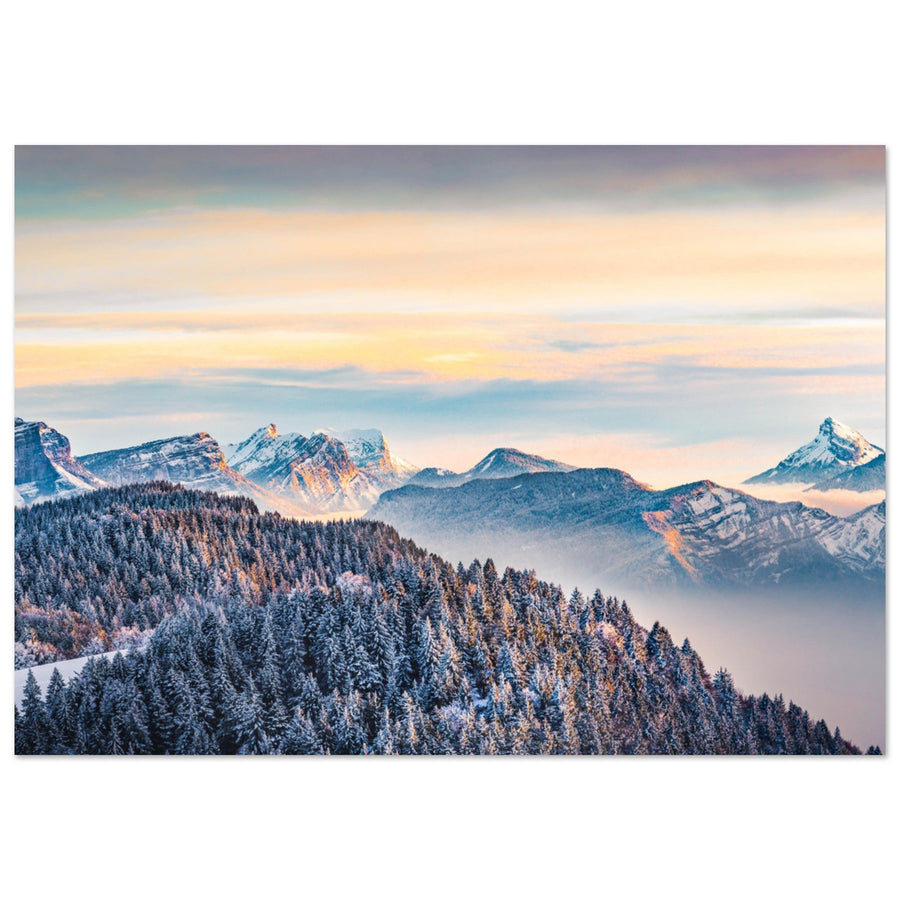
Snow-covered Chartreuse — pastel light on pre-Alpine relief
Chartreuse is deliberately included as a scene rather than a single spot. The aim is not to name one definitive viewpoint, but to show what late-day light does to a snow-covered pre-Alpine massif: very dark forests, white slopes, limestone bands and several layers separating in progressively cooler light.
This aesthetic differs from a sunset on Mont-Blanc. The relief is closer, less vertical and often more wooded. Winter simplifies colours and emphasises layers. A band of pastel sky can then give depth without the sun appearing in the frame. This scene works especially well when snow remains on the slopes and the forest retains its dark mass.
The trade-off is that the precise viewpoint greatly changes the scene, and winter access varies with conditions. For choosing the terrain, then use the Chartreuse massif photography guide and local information. Here, Chartreuse mainly brings a sunset language that neither Écrins glaciers nor Haute-Savoie panoramas can replace.

Snow-covered Chartreuse at sunset
The photograph shows layers of snow, forest and relief in pastel light.
Photography: Pierre Thiaville
View the photo print of snow-covered Chartreuse at sunsetLe Sire viewpoint — sunset above Lac du Bourget
Le Sire gives the Bauges a sunset scene far more specific than a generic massif panorama. Chambéry Montagnes directly presents it as a prime place to watch sunset over the Bauges and Lac du Bourget. The choice is therefore clear: a very open horizon, a lake adding depth to the panorama, and a far lighter approach than a high-mountain hut.
The lake plays a different role here from the Chéserys. The aim is not a close reflection, but a large expanse of water within a panorama. Light gradually drops across the mountains and horizon, while the Bourget remains a dark or luminous mass depending on the angle. This breadth makes the place interesting even without a spectacular sky.
Access remains straightforward: the viewpoint is reached only on foot from the Sire car park, with about 20 minutes of uphill walking. The main limitation is then atmospheric: if the horizon closes in, the lake disappears beneath cloud or visibility becomes flat, the scene loses some appeal. For an actual sunset with a clearly legible landscape and a relatively simple return, however, Le Sire is among the most accessible options in this selection.
Grande Casse and Col de la Vanoise hut — giving the high mountains a human scale
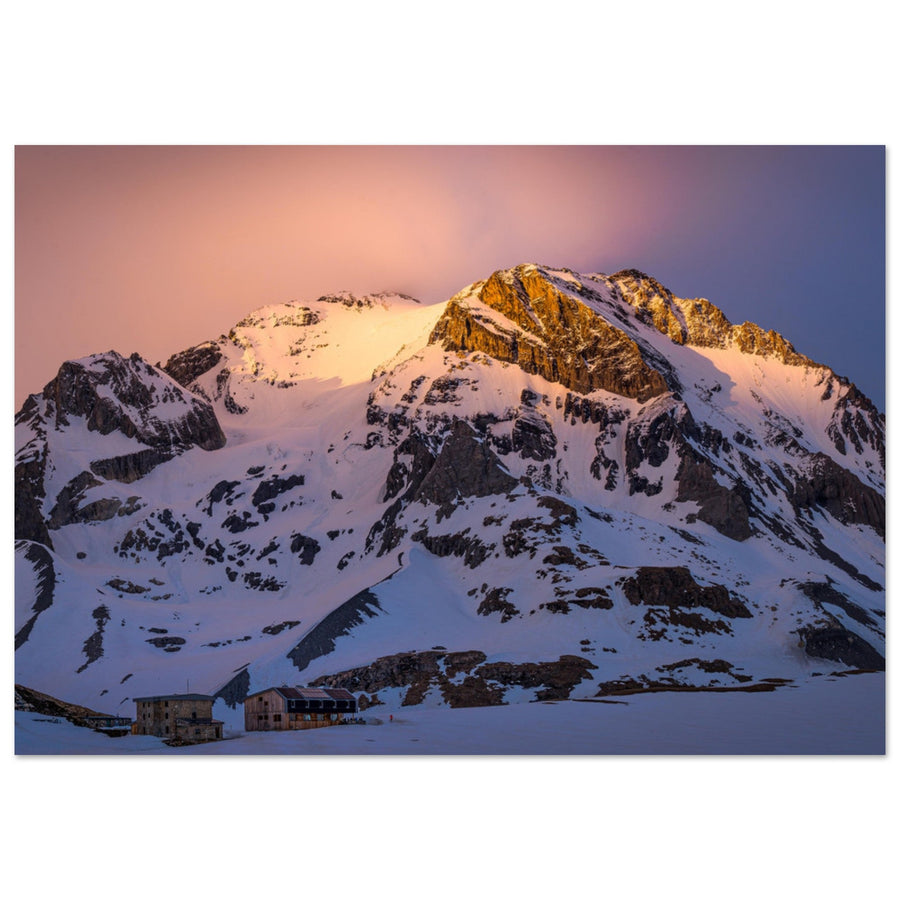
The Grande Casse is imposing almost everywhere in the Vanoise, but the hut's presence completely changes the sunset scene. The building introduces a human scale at the foot of a much larger landscape. When the last light still touches the summit or neighbouring relief, the hut sits in an already darker world, further emphasising the difference in size.
That relationship earns its place here. Without the hut, the scene would be closer to a high-mountain portrait such as Pelvoux. With it, the landscape also tells of human presence at altitude: shelter, a crossing pass and a rocky mass dominating the frame. The whole sky need not be spectacular; a few warm areas high on the mountains are enough.
The choice requires real logistics. The Col de la Vanoise hut operates seasonally, and the national park states that bivouacking is prohibited there. Staying for the last light may therefore mean sleeping at the hut or accepting a return after dark, depending on the outing. Check opening dates and conditions before departure. Do not choose this scene solely because the Grande Casse is famous: its interest lies in the sense of scale provided by the hut, absent from the other profiles.

The Grande Casse and Vanoise hut
The photograph shows the contrast in scale between the hut's architecture and the high mountains.
Photography: Pierre Thiaville
View the photo print of the Grande Casse and Vanoise hut at sunsetMont Pelvoux and glaciers — the rockiest sunset in the selection
In the Écrins, Pelvoux shifts the focus to materials. Dark rock, ice, remaining snow and steep terrain create a scene where the last light may be highly localised. The high mountains do not necessarily turn entirely orange; one lit ridge or glacier surface can be enough to separate the forms.
This restraint distinguishes it from the Grande Casse with its hut and Rochebrune with its drier rock. Pelvoux remains a glacial scene: cool areas dominate and warm light works through contrast. The image benefits from clarity more than from seeking a spectacular sky.
The main constraint is the terrain. Access in the Écrins can change quickly after a weather event. At the time of this update, in September 2026, the national park reports that the flood of 27 and 28 August washed away several road sections beyond Ailefroide towards Pré de Madame Carle. This must not become a permanent statement: it shows why the area's condition needs checking just before the outing. For a rocky, glacial landscape, Pelvoux remains a strong choice; for a more easily accessible scene, choose elsewhere.

Mont Pelvoux and its glaciers
The photograph shows dark rock, ice and last light meeting.
Photography: Pierre Thiaville
View the photo print of Mont Pelvoux and its glaciers at sunsetVal Thorens and Aiguille de Péclet — the resort in shadow, the summit still lit
Val Thorens adds a landscape type often missing from Alpine sunset lists: the resort itself. As the light fades, buildings and pistes can quickly turn blue while the Aiguille de Péclet retains a strip of warm light. The contrast therefore rests not on an empty horizon, but on two mountain levels that enter night at different times.
This relationship is particularly strong in winter. Snow reflects the last colours, then cools very quickly as the resort begins to light up. Visually, it is almost the opposite of the Col des Aravis: here, architecture is part of the subject and high altitude remains ever-present.
Late access must be checked as seasonal information. In 2026, the Péclet by Night programme extended Funitel operation to 18:30 on certain Wednesdays between February and April for skiers and snowboarders with a valid pass; pedestrian passes were not accepted, and opening remained weather-dependent. This programme illustrates the constraint well, but must not be read as a permanent timetable. Choose Val Thorens for the meeting of resort and high mountains, then check the actual access for the day.

Val Thorens beneath the Aiguille de Péclet
The photograph shows the already cool-toned resort beneath a summit still touched by light.
Photography: Pierre Thiaville
View the photo print of Val Thorens and the Aiguille de Péclet at sunsetRiedweg in Zermatt — the Cervin just before nightfall
The Cervin is one of the Alps' most photographed summits. Including it without specifying the scene would not help you choose. Riedweg provides that precision: Zermatt Tourism recommends it as a photography spot for the Cervin “kurz vor dem Einnachten”, just before nightfall, when high-altitude lifts are no longer running and you can wait for blue hour from the village.
The subject is therefore less a blazing sunset than a transition. The Cervin may retain a final luminous presence before becoming a dark silhouette beneath a cooling sky. The village below adds a second layer without distracting from the outline. This combination works especially well when you want to show the icon without depending on a lake or a panorama at 3,000 metres.
The access trade-off is relatively small, but conditions still matter. A Cervin hidden by cloud obviously removes the main subject, and winter can make waiting cold even near the village. Riedweg is nevertheless this selection's simplest choice for exploring after-sunset light and blue hour without relying on a last train or a high-mountain descent.
Pic de Rochebrune — last light on Queyras limestone
Rochebrune brings another material to Alpine sunsets. Its limestone pyramid above the Souliers and Izoard area catches drier light than the glaciated faces of the Écrins or Vanoise. Warm tones often remain concentrated on the rock as the surroundings quickly darken.
This scene is interesting precisely because it does not try to compete with the Cervin. The Cervin selected here belongs to blue hour and an iconic silhouette above a village. Rochebrune belongs to last light and a rawer Southern Alps landscape. Limestone and the area's relative dryness change the palette.
The exact viewpoint makes a big difference and deserves a separate detailed route description. Routes around Souliers, Lac de Roue, Côte Belle and the Izoard offer several possible relationships with Rochebrune. The Queyras photography guide then helps choose the precise terrain. In this selection, Rochebrune is mainly the option for a less glaciated, drier and rockier high-mountain scene.

Pic de Rochebrune in the last light
The photograph shows golden light on the Queyras limestone pyramid.
Photography: Pierre Thiaville
View the photo print of Pic de Rochebrune at sunsetAfter choosing your scene
This page helps you decide which type of sunset suits your wishes. Once you have chosen a place, the massif's destination guide takes over for terrain, access points and alternatives. For photographic method — exposure, contrast management, possible bracketing, filters or planning — the guide to photographing a mountain sunset remains the dedicated reference.
For fast-changing information, use official sources: lift times, hut opening, road and path conditions, snow and regulations. The principle of last light is predictable; actual access to the scene is not always so.
Discover Alpine sunsets as photo prints
Scenes in this selection with a related artwork are available as prints on matt aluminium Dibond, a finish that preserves sky gradients and shadow nuances without adding glossy reflections. Explore the full mountain sunset collection.
Official sources and references
Access and schedules change: always check local information before a late-day outing.
- Chamonix-Mont-Blanc — Lacs des Chéserys
- Chamonix-Mont-Blanc — Lac Blanc from La Flégère, conditions and season
- La Clusaz — sunsets, including the Col des Aravis
- Chambéry Montagnes — Le Sire viewpoint
- Vanoise National Park — Col de la Vanoise hut
- Écrins National Park — Pelvoux hut
- Écrins National Park — access to Pré de Madame Carle after the August 2026 flood
- Val Thorens — Péclet by Night 2026
- Zermatt Tourism — Riedweg photo spot
- Guillestrois-Queyras — Rochebrune / Côte Belle area