Where to see chamois in the Alps?
Seeing a chamois in the Alps rarely begins by searching for one precise summit. The species uses a mosaic of habitats: forest, forest edge, grassland, heath, scree, ledges and rocky slopes. What links these landscapes is less altitude than the presence of terrain where chamois can feed, watch their surroundings and quickly reach refuge. An animal may therefore be very high on an open slope in summer, then much lower, sometimes in forest, when the season or snow changes its needs.
This adaptability strongly distinguishes chamois from ibex. Ibex remain closely tied to rock and can sometimes appear indifferent to human presence; chamois are generally more vigilant and may flee long before an observer feels close. To find them without pushing them to move, you therefore need to learn to read transitions in terrain and accept that the right distance is often greater than expected.
Alpine territories do not produce the same encounter. Mercantour combines heat, rock and Southern Alps pastures; Écrins brings forest and high mountain together; Chartreuse shows a very Prealpine chamois between woodland and limestone cliffs; Vanoise makes the seasonal migration between lower areas and altitude especially readable; Gran Paradiso brings a long research tradition on behaviour; the Alpes vaudoises place herds within a landscape of limestone pastures and forests. Queyras, the Swiss National Park and Hohe Tauern then broaden this reading toward other forms of the Alpine arc.
For photography, the most interesting scene is therefore not necessarily a tight portrait. A chamois crossing a forest edge, a herd spread across a slope, a female with her young in snow or a male moving during the rut tell more about the species when habitat and season remain visible. Lenses, shutter speeds, autofocus and detailed settings remain covered in the Technique guide devoted to mountain wildlife.
Forest, edge, grassy slope and rock can all belong to the same chamois territory.
Spring grass, summer heat, rut and snow change altitude, activity and sensitivity.
A rock band, woodland or steep slope may be the area toward which the animal will try to retreat.
The success of an observation is measured by normal behaviour being maintained, not by the distance achieved.
Which territory should you choose at a glance?
| Territory | Dominant mosaic | Rhythm to understand | What sets it apart | Plausible photographic scene | Main trade-off |
|---|---|---|---|---|---|
| Mercantour | Alpine pastures, rocky slopes, valleys and refuge areas | Summer heat, morning activity, autumn rut | Very well documented southern reading and historically high densities | Chamois in spring vegetation, pale rock or a distant rut pursuit | In winter, unnecessary flight is costly; in summer, do not follow an animal toward shade or higher ground |
| Écrins | Forests, edges, cliffs, scree and broad slopes | Possible winter descent followed by ascent with vegetation | Especially readable forest–high mountain gradient | Small animal on a vast slope, herd between forest and rock, dark coat on snow | Vast relief; accept distant observation and do not enter wintering areas |
| Chartreuse | Mountain forest, grassy ledges and limestone cliffs | Fine use of ledges and forest cover depending on season and pressure | Limestone Prealpine profile very different from the inner Alps | Female and young in snow, silhouette on a grassy ledge or at the forest edge | An anxious chamois can disappear instantly into the relief; observe before moving forward |
| Vanoise | Forests, rut areas, large slopes and Alpine grasslands | Fresh grass lower down in spring, gradual ascent, then heat constraints | Vertical migration, climate and tourism pressure are very well documented | Herd at the edge, animal on open slope, season readable in the frame | Very high winter sensitivity and increasingly valuable quiet areas |
| Gran Paradiso | Steep slopes, meadows and rocky habitats | Resources, temperature and reproduction change movements and groups | Long eco-ethological research on Alpine chamois | Male showing rut behaviour, group on a slope or animal placed within an Italian massif | Research areas and tracking data are not localisation tools |
| Alpes vaudoises / Pays-d’Enhaut | Limestone pastures, forest and Prealpine relief | Summer grazing, use of high-altitude grasslands and protected areas | Western Swiss Prealps and the relationship between pastoralism and protection | Herd on a rocky promontory with forest and pastures in depth | Keep a broad level of detail: a reserve or lake does not become a wildlife appointment |
| Queyras | Larch forests, grassy slopes and dry relief | Alternation between forest and grassland depending on season | Open Alpine forest and Southern Alps atmosphere | Chamois at the edge of larches or on a dry slope | Old population figures are not current counts |
| Swiss National Park / Engadine | Protected forest, Alpine grasslands and rocky relief | Summer observation in a park closed in winter | Full protection and very strict rules | Chamois observed at distance in a broad wild scene | Trails are compulsory, dogs and drones are prohibited; no off-trail movement for the image |
| Hohe Tauern | Large slopes, Alpine zones and eastern relief | Groups of females/young and more isolated males outside breeding season | Opening toward the Eastern Alps and current spatial monitoring | Herd in large relief or solitary male in a mineral scene | Marking and telemetry belong to science, not spot hunting |
This table does not rank territories and gives no probability of observation. Strong local presence, suitable habitat or an official page devoted to chamois never guarantees a sighting on the day of the outing. The comparison is used to choose a type of landscape, season and scene, then adapt observation to what the mountain actually presents.
Read forest, edge, slope and refuge before looking for a place
Chamois are often described as high-mountain animals, but that formula oversimplifies their ecology. Écrins National Park sums up the reality well: they are “at home everywhere in the mountains”, in forest as well as among rocks. Vanoise even notes that their original habitat was forest. The altitude visible in a photograph is therefore not a useful criterion on its own.
The useful question is instead: where is the combination of food and refuge? Grassland or a clearing provides food; a rock band, steep slope or dense woodland makes rapid retreat possible. Forest edges, breaks in slope, corridors between forest and rock or grassy strips below a cliff are therefore particularly coherent landscape forms.
This principle changes how you search. Instead of walking toward a reputed point, stop before entering the most favourable area. Slowly scan with binoculars the boundaries between forest cover and open terrain, ledges, benches and slopes that allow an animal to disappear in a few bounds. The chamois will often have detected you before you distinguish it.
Forest is not merely a backdrop. In winter or during strong heat, it can again become a thermal and feeding refuge. In Écrins, winter observations and field notes show that chamois can move down toward wooded areas. In Vanoise, rising temperatures are also associated with movements toward cooler areas and reduced activity during hot periods.
When can you see chamois? Season matters more than a universal hour
There is no “best hour” that applies throughout the Alps and all year. Chamois activity depends on temperature, vegetation, snow cover, disturbance and the reproductive period. The right calendar is therefore a set of logics, not a time slot to apply mechanically.
Spring: follow the returning grass
In Vanoise, chamois are described in lower areas in spring, where they seek fresh grass before gradually moving upward with vegetation growth. This transition can produce very readable scenes: still-cold woodland, greening grass, residual snow and an animal between two mountain zones. May is also the period when females isolate themselves to give birth: this biological signal calls for greater distance, not for searching out an isolated female.
Summer: heat can move the encounter more than the clock
Mercantour indicates that, during the first hot spells, females with young quickly move toward shaded and higher areas; summer observations there are therefore often better early. Research relayed by Vanoise more broadly shows that high temperatures reduce activity and can push chamois toward cooler areas. The photographic challenge then becomes reading shade, orientation and habitat transitions rather than following an animal that is moving away.
Autumn: the rut changes movement
In autumn, males spend more time with female groups. In Mercantour, the rut is particularly visible between October and November; in Gran Paradiso, long-term research describes male reproductive tactics and movements during this period. For a photographer, chases can create powerful images, but composition must be made from outside the scene: never try to cut across a route to anticipate a passage.
Winter: an observation that looks easy can be biologically costly
Snow makes the dark coat very visible and some chamois move down toward snow-free slopes or forests. This is precisely the season when approach must be most conservative. Vanoise describes winter sensitivity to disturbance as very high: flight can begin at a long distance and consumes energy the animal struggles to replace. In Écrins, the same principle has long been repeated: reserves accumulated during the warmer season are key to survival.
Overcast weather and cool days: avoid a rigid morning/evening rule
When temperatures are moderate, chamois can remain active at very different times. The observer gains more from understanding relief, wind, vegetation and human pressure than from arriving at a “magic” hour. A cool, quiet outing in the middle of the day may be more coherent than an early arrival in an already busy area.
Annual weather also changes the rules
No two winters have the same snow and no two springs offer the same vegetation. Chamois are mobile and adaptable. The seasonal descriptions in this guide help anticipate likely needs, never predict the position of a herd.
Chamois or ibex? Useful differences in the field
An adult male ibex is generally easy to distinguish thanks to its massive body and long, thick horns curving backwards. Chamois are more slender, have much shorter black horns ending in a marked hook, and show a highly characteristic dark-and-light facial mask.
Confusion is more plausible with a female ibex or a young animal observed from afar. In that case, do not reduce the distance simply to obtain certain identification. Look at the whole picture: silhouette, horns, facial mask, way of moving and immediate habitat. Chamois can use forest and edges much more naturally than ibex, even though both species also occur on rocky ground.
Behaviour provides another clue. Mercantour describes chamois as shyer than ibex. This does not mean all chamois flee and all ibex stay still; it simply means the observer should expect chamois to react to a presence from a greater distance.
Read behaviour before reducing distance
Chamois have very well-developed hearing and smell. In Écrins, the sharp nasal snort is described as a genuine alarm signal. If you hear it, the animal is no longer in a neutral scene: it has probably detected you or is reacting to another danger. This is not the moment to move forward to “make the most” of the gaze.
The simplest signs are often enough: a head suddenly raised, prolonged staring, body oriented toward an escape route, a group tightening its structure, interruption of feeding or rapid movement toward refuge. The reaction can be very brief; a chamois does not need to wait until you are close before deciding.
For females and young, herd structure matters. Females and kids often live in groups, while adult males are more often solitary outside the rut. Photographing a group therefore means leaving enough space around the scene for each animal to maintain its distances and route.
The best indicator is negative: if the animal continues grazing, ruminating, walking slowly or interacting with the group without reorganising its behaviour around you, your position is probably more acceptable. That does not justify moving closer; on the contrary, it indicates that you have already found a distance that works.
Which photographic scenes should you look for naturally?
With chamois, photography benefits greatly from showing habitat transitions and movement. Where an ibex can become highly graphic on a slab, chamois often tell the mountain story better when placed between cover, slope and refuge.
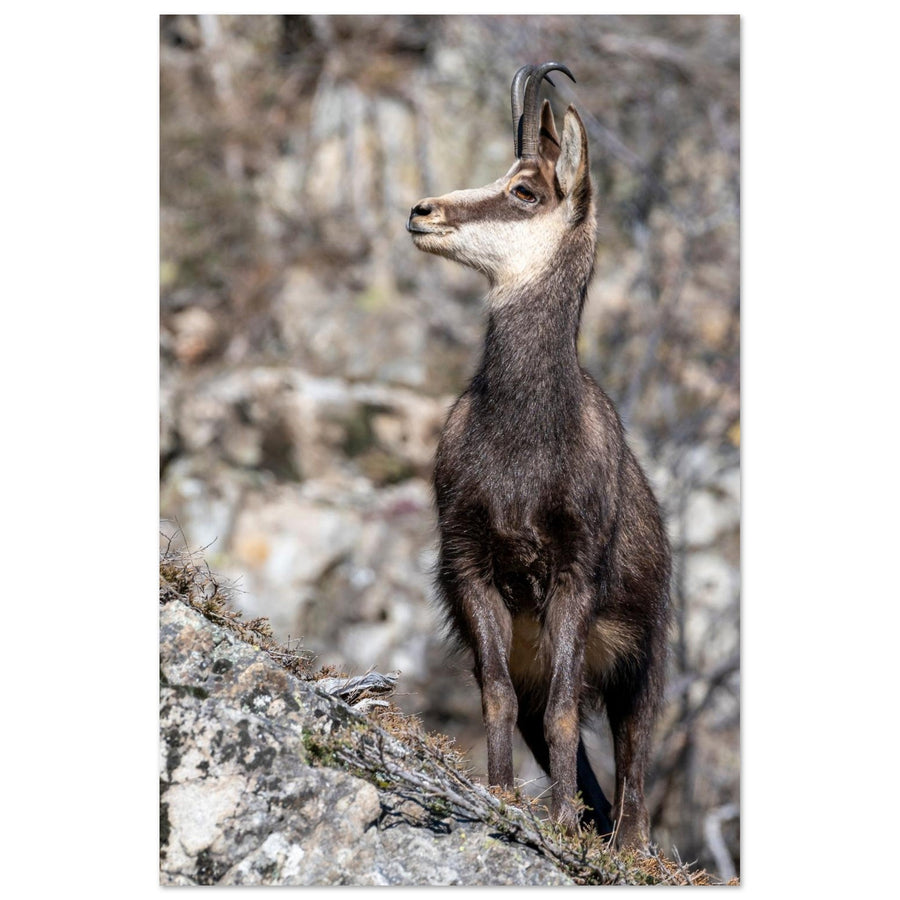
The forest edge
An animal emerging from woodland or standing a few metres inside it immediately tells the forest part of its ecology. In Vanoise, Queyras or the Alpes vaudoises, keeping trunks, larches or the edge of cover helps avoid a generic ungulate against a blurred background.
The ledge or grassy band
In Chartreuse or Écrins, a grassy strip between two rocky levels makes both food and refuge understandable. The photographer should remain outside this axis: the strength of the scene comes from the terrain, not from a position that traps the animal.
The herd in the landscape
Females and young spread across a slope create an image different from a portrait. Distances between individuals, common orientation and the presence of forest or rock reveal group structure and territory.
Rut movement
Autumn pursuits add a very strong dynamic dimension. The interest is in letting animals cross their own landscape, not in seeking a route toward the photographer. A wide frame can show speed and slope better than a tight shot.
Snow
The dark winter coat stands out strongly on a white slope. This visual ease must not become ease of approach. A distant silhouette on snow also tells the story of the season’s energy constraint, especially when relief and dry vegetation remain in the frame.
The broad slope
In Écrins, Gran Paradiso or Hohe Tauern, a relatively small chamois in the image can give a more faithful high-mountain scene than a close-up. The relief explains the species’ agility and provides scale.
For lens choice, the shutter speed needed for running, autofocus modes, ISO or snow settings, see Photographing mountain wildlife: equipment, settings and advice. Here the question remains: what scene already exists, and how can you read it without changing it?
Observe a chamois without causing flight
Which territory should you choose for your project?
To understand chamois in the Southern Alps
Mercantour is an excellent starting point: the species is very present there and the Park clearly describes the rut, the response to summer heat and winter sensitivity. The territory connects behaviour and southern light without needing to list valleys.
To read the full forest–high mountain mosaic
Écrins offers the most complete contrast between woodland, edges, slopes and major relief. It is a territory where distant observation can remain photographically powerful because the landscape explains the animal.
For the limestone Prealps
Chartreuse concentrates a very different reading: forest, cliffs, grassy ledges and more immediate relief. It is particularly suited to photography in which the chamois almost disappears into the structure of the terrain.
To understand seasonal movements
Vanoise is particularly instructive: the Park describes lower spring areas, ascent following vegetation, winter difficulties and the current effects of heat and disturbance.
For the Italian scientific reading
Gran Paradiso has monitored chamois for decades and allows behaviour, reproduction and environment to be integrated into an Alpine reading. The territory also reminds us that chamois are abundant far beyond the French Alps.
For the western Swiss Prealps
The Alpes vaudoises and Pays-d’Enhaut combine limestone pastures, forests and reserves where coexistence between livestock and wildlife is considered at territory scale. It is also a visual context very different from the major national parks.
Mercantour — heat, rut and the Southern Alps
Mercantour is one of the best-documented territories for understanding how season changes chamois observation. The National Park states that density there is among the highest in Europe and mentions around 10,000 chamois in 2021. This figure must remain dated: it describes the population at that time, not a number to use to promise an encounter.
For the observer, the most useful information is behavioural. Chamois are described there as shyer than ibex. The rut, between October and November, makes pursuits between males more visible. In winter, the Park recommends avoiding disturbance because the animal lives on its reserves. In summer, females with young move into shade and higher areas as soon as the first heat arrives, making temperature as important as the hour.
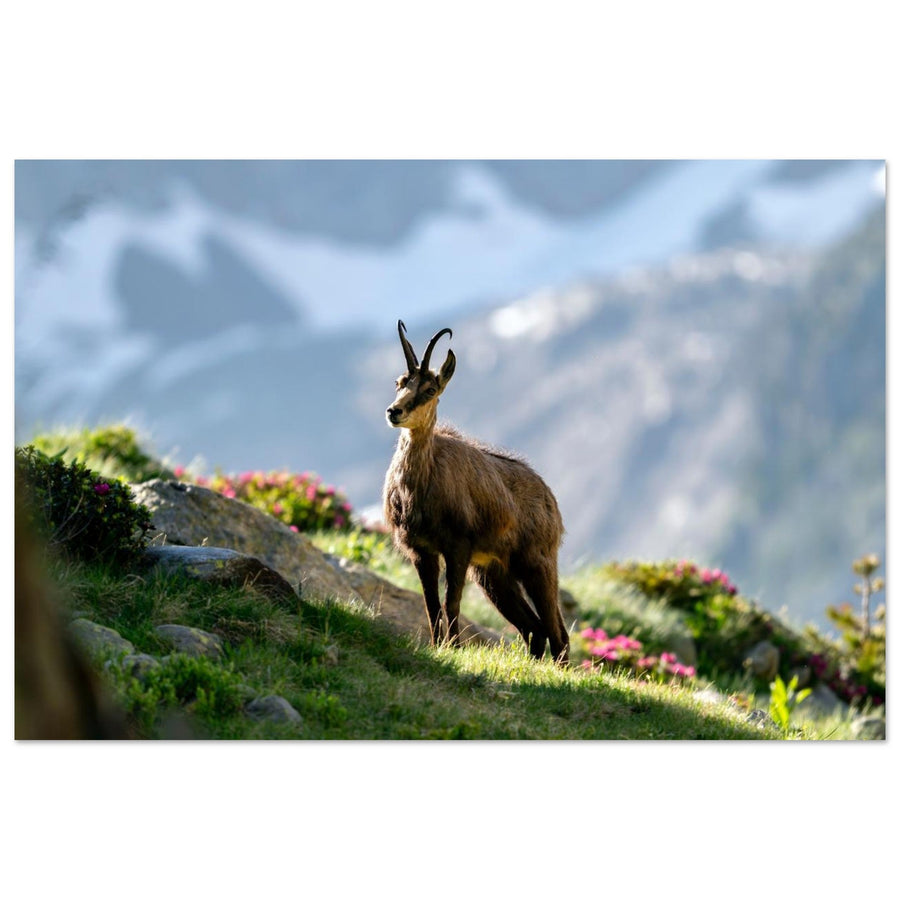
The photographic territory should therefore not be reduced to one known valley. The Southern Alps offer drier grasslands, often pale rock, very open slopes and light different from the Northern Alps. A chamois in spring vegetation or a group far across a slope may be enough to identify the atmosphere of the massif.

A chamois in Mercantour spring
Fresh vegetation and rocky terrain keep the season readable around the animal. The photograph illustrates the “habitat + time of year” logic better than a portrait detached from its territory.
Photograph: Michel PERES
View the Mercantour chamois photo printÉcrins — from forest to broad slopes
Écrins is probably the clearest territory for correcting the idea that chamois are exclusively “animals of the summits”. The Park describes them in forest as well as among rocks and lists habitats ranging from edges and clearings to cliffs, scree and high-altitude grasslands. This breadth explains why one altitude or one type of hike is not enough.
In winter, animals can move lower and use forest more. The Park archives also document strong sensitivity to disturbance: flight through snow draws on already limited reserves. Some older official content names precise observation points. They remain useful for understanding winter ecology, but this guide does not repeat them as “best spots”.
Écrins also monitors chamois health as a sentinel species. A January 2026 article describes protocols designed to detect diseases and possible interactions between wildlife and domestic herds. This scientific depth reminds us that a chamois territory is also a living system subject to pastoralism, disease, climate and disturbance.
Photographically, the massif offers great freedom of scale. A herd can appear at the edge of a forest; an isolated animal can become tiny against a slope. Relief then provides a more faithful image of the species than trying to fill the frame.
To prepare the massif’s landscapes after choosing Écrins, see What to photograph in the Écrins massif?.
Chartreuse — chamois of forests, grassy ledges and limestone cliffs
Chartreuse brings one of the most distinctive profiles in this guide. Its limestone relief places mountain forest, long cliffs and grassy bands side by side. The regional natural park describes an observation on ridge ledges and stresses a simple point: using binoculars before entering the area would often have made it possible to spot the animal earlier. Once a chamois is close, remaining still becomes the right strategy.
This configuration is particularly instructive for photography. A chamois can merge into the forest then appear for a few seconds on a ledge, or stand in snow with a cliff or woodland behind it. The scene is harder to anticipate than an animal already visible on an open slope, but it tells the relationship with refuge much better.
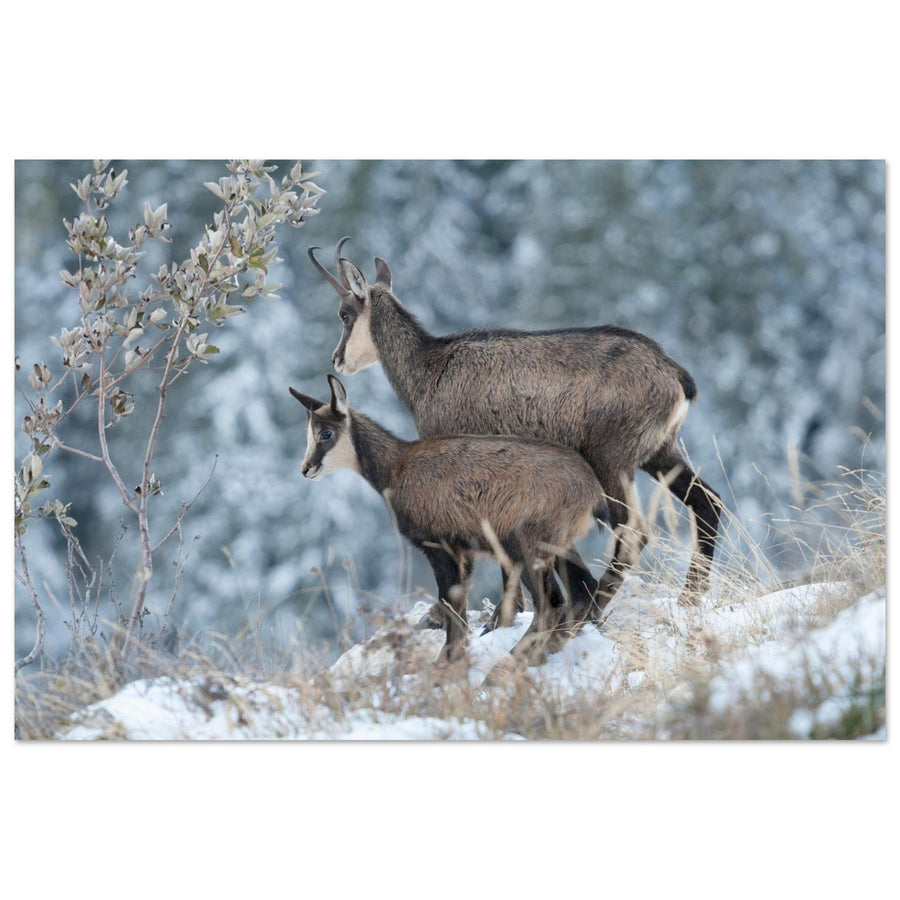
Winter increases the responsibility further. A dark animal on snow is immediately visible while its reserves are low. Ease of detection should therefore lead to fewer movements, not a more ambitious approach.

A female and her young in a Chartreuse winter
The pair remains within a winter scene instead of becoming a portrait. Snow makes the silhouettes readable, but it also reminds us why distance should increase at this time of year.
Photograph: Florent Lacroute
View the Chartreuse chamois photo printTo explore the massif and its landscapes further, see What to photograph in the Chartreuse massif?.
Vanoise — an especially readable vertical migration
Vanoise gives a very educational reading of the annual cycle. The Park reminds visitors that chamois originally had a forest-based habitat and that in spring they are found in lower areas to take advantage of fresh grass. They then move upward with vegetation. In May, females isolate themselves to give birth, after which herd structures become more visible again.
Winter is described as difficult: scarce food, reliance on reserves and high energy expenditure if they flee. “Be Part of the Mountain” campaigns indicate that a chamois may leave while the observer is still more than 100 metres away. This is not a universal regulatory distance; it simply reminds us that pressure begins well before the close-up.
Vanoise now brings another dimension: climate and visitor pressure. The Park’s 2025–2026 technical sheets explain that high temperatures can reduce activity and push animals toward cooler areas, while tourism growth reduces some quiet spaces. Additional movements between cool areas and feeding grounds have an energy cost of their own.
For photography, this reality encourages building the image around the shift in elevation zone: lower forest, rut area, broad slope or high-altitude grassland. The season becomes visible in the landscape instead of being mentioned only in the caption.
To prepare the mountain after choosing this territory, see What to photograph in the Vanoise massif?.
Gran Paradiso — a major behavioural reference on the Italian side
In Gran Paradiso, chamois are described as the Park’s most widespread and abundant ungulate. They occupy both the Aosta Valley and Piedmont valleys and use varied environments that mainly share two characteristics: steep slopes and the presence of rock. Summer food relies largely on fresh grass, while leaves, shrubs, lichens and mosses become more important in winter.
The territory stands out above all for the depth of its research. The Park has run an eco-ethology programme on chamois since the 1990s and has notably monitored the reproductive behaviour of adult males. Research shows that the breeding period is not limited to a few spectacular fights: male tactics, female movements and resource distribution are all part of the same system.
For a photographer, this reading helps avoid forcing the scene. During the rut, a moving male can cross a slope very quickly; the right position is one that lets you watch the behaviour unfold without entering its route. Outside the rut, groups of females and young or more solitary males offer very different compositions.
Scientific information about study areas, marked individuals or tracked movements must never be translated into a search itinerary. Gran Paradiso is used here as a territory for understanding, not an inventory of coordinates.
Alpes vaudoises and Pays-d’Enhaut — limestone pastures, forest and protection
The Alpes vaudoises add a profile that the major French massifs do not replace. In La Pierreuse Nature Reserve, south of Château-d’Oex, Pro Natura describes pastures and grasslands of the northern limestone Alps, intact wildlife and high-altitude grasslands partly reserved for chamois and ibex. Pastoral use is organised in a way that maintains less-disturbed habitats.
This relationship between livestock farming, forest, pasture and protection is the territory’s real value. The CURRENT guide also cited very precise places in the Alpes vaudoises; they show that demand for observation exists, but A19 does not turn them into recommendations. “Alpes vaudoises” and “Pays-d’Enhaut” are a much more honest level for preparing an outing.
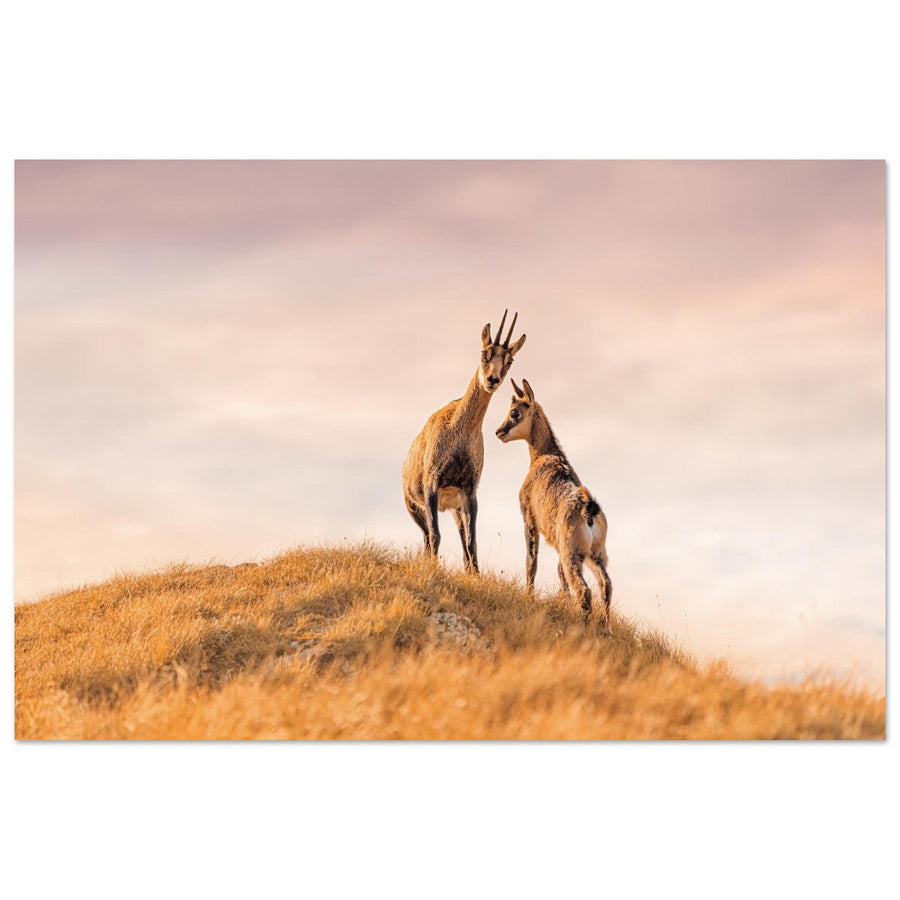
Photographically, a herd on a promontory with forest in the background shows the chamois mosaic very clearly. Rock provides refuge and verticality; forest cover reminds us that the species does not belong only to the open Alpine zone.

A herd in the Alpes vaudoises
The group occupies the rock while forest remains visible in the landscape. This layering shows exactly what distinguishes chamois from a view limited to high-altitude ridges alone.
Photograph: WildMedia
View the chamois herd photo printTo prepare Swiss landscapes more broadly, see What to photograph in the Swiss Alps?.
Three complementary territories that broaden the Alpine reading
Queyras — larches, grassy slopes and Southern Alps light
Queyras Regional Natural Park notes that grassy slopes and larch forests are both suitable for chamois. This combination makes it a very good complementary territory: the cover is more open there and the forest has a strong visual identity, especially in autumn. Population figures published on older Park pages are not repeated here as current counts; only the habitat–species relationship is used.
To prepare the massif, see What to photograph in Queyras?.
Swiss National Park and Engadine — observing in a space where rules structure the scene
The Swiss National Park states that chamois can be observed in different areas and recommends scanning zones above the treeline. This type of information helps understand the species’ presence, but the Park’s real lesson is its regulation: leaving trails is prohibited, dogs and drones are prohibited and the Park is closed in winter.
This constraint is almost a lesson in composition. The photographer does not choose to move toward the animal to improve a background; they work with the authorised viewpoint and the distance. Protecting the territory takes priority over optimising the image.
Hohe Tauern — chamois in the Eastern Alps
Hohe Tauern National Park describes chamois as the most frequently observed large ungulate in the Park. Females live in groups with young, younger males can form their own groups and older males are more solitary outside the breeding season. Current programmes also study population dynamics and spatial behaviour.
This territory helps move beyond a purely French-Swiss-Italian reading. The broad relief of the Eastern Alps provides a different context for chamois. Here again, marked or transmitter-equipped animals belong to research; if one is observed, the information can be sent to the manager without trying to reconstruct its movements.
Savoie, Haute-Savoie, Alpes-de-Haute-Provence and Belledonne: reference points, not automatic chapters
Users naturally think in terms of departments, towns or massifs near where they are staying. “Chamois Savoie” usefully points toward Vanoise and other Savoyard territories; “chamois Alpes-de-Haute-Provence” can point toward south-eastern massifs or valleys depending on the actual area. These words help orientation, but they are not proof that an administrative division should become the architecture of the guide.
The same principle applies to Haute-Savoie. Chamois are genuinely present there, but this guide does not create a section simply because Search Console shows a few impressions for “where to see chamois in Haute-Savoie”. First there needs to be a sufficiently distinct natural unit, well-documented presence and a genuine difference for the user’s decision.
Belledonne also appears in a few queries. Here again, the signal is kept as discovery and orientation vocabulary, not editorial authority. If a future source-first enrichment shows that a Belledonne profile brings a major difference compared with Écrins, Chartreuse or Vanoise, the topic can be reopened.
What this guide can — and cannot — promise
After choosing the territory: prepare the massif, then the photography
Once the territory has been chosen, each question returns to its proper owner. Destination guides are used to prepare landscapes, light and the general organisation of the massif. The Technique guide explains lenses, shutter speeds, autofocus, ISO and tracking a moving animal. This Chamois guide keeps only what changes the observation decision, ethics and photographic reading of the scene.
Key takeaways
To see chamois in the Alps, do not look only at ridges. Look for a mosaic where food and refuge meet: forest and edge, grassy slope and rock band, grassland and scree. Chamois use a much wider range of habitats than the classic image of an animal posed at high altitude.
The season transforms this mosaic. In spring, lower areas and fresh grass can become attractive; in summer, heat shifts activity toward cooler areas; in autumn, the rut changes movements; in winter, forest and snow-free slopes may make observation easier but the energy cost makes any flight more problematic.
The territories are not interchangeable. Mercantour brings the Southern Alps and a well-documented rut; Écrins shows the full forest–high mountain range; Chartreuse the Prealpine ledges and cliffs; Vanoise vertical migration and current climate pressures; Gran Paradiso a long-term behavioural reading; the Alpes vaudoises a protected landscape of pastures and forests. Queyras, Engadine and Hohe Tauern complete the Alpine arc.
Finally, chamois are often more sensitive to your presence than ibex. Always leave a route toward refuge, use binoculars before moving and step back as soon as the animal reorganises its behaviour. A strong photograph does not need to prove that you were close.
Information and official sources
Local rules, population monitoring, access and knowledge evolve. The natural-history facts and protection rules used in this guide come primarily from the following managers and organisations.
- Parc national du Mercantour — Chamois
- Biodiv’Mercantour — Alpine chamois
- Écrins National Park — Chamois
- Écrins National Park — 2026 health monitoring of ibex and chamois
- Vanoise National Park — Chamois
- Vanoise National Park — winter sensitivity of chamois
- Vanoise National Park — chamois and climate change
- Chartreuse Regional Natural Park — Chamois
- Parco Nazionale Gran Paradiso — Chamois
- Parco Nazionale Gran Paradiso — chamois eco-ethology research
- Pro Natura — La Pierreuse Nature Reserve, Pays-d’Enhaut
- Queyras Regional Natural Park — fauna of Alpine grasslands
- Swiss National Park — observing wildlife
- Swiss National Park — protection regulations
- Hohe Tauern National Park — fauna / chamois
- Hohe Tauern National Park — ungulate monitoring