The most beautiful places in the French Alps in autumn
The Alps do not turn a single colour in autumn. In a high valley, the season may appear in golden larches beneath summits already dusted with snow. Lower down, it comes through orange beeches, a canopy of deciduous trees above a canal or meadows turned tawny. Elsewhere, the landscape remains mostly rocky and autumn appears through contrast: a few coloured trees beneath a glacier, a golden shore around a lake, chalets in alpine pasture abandoned by the herds.
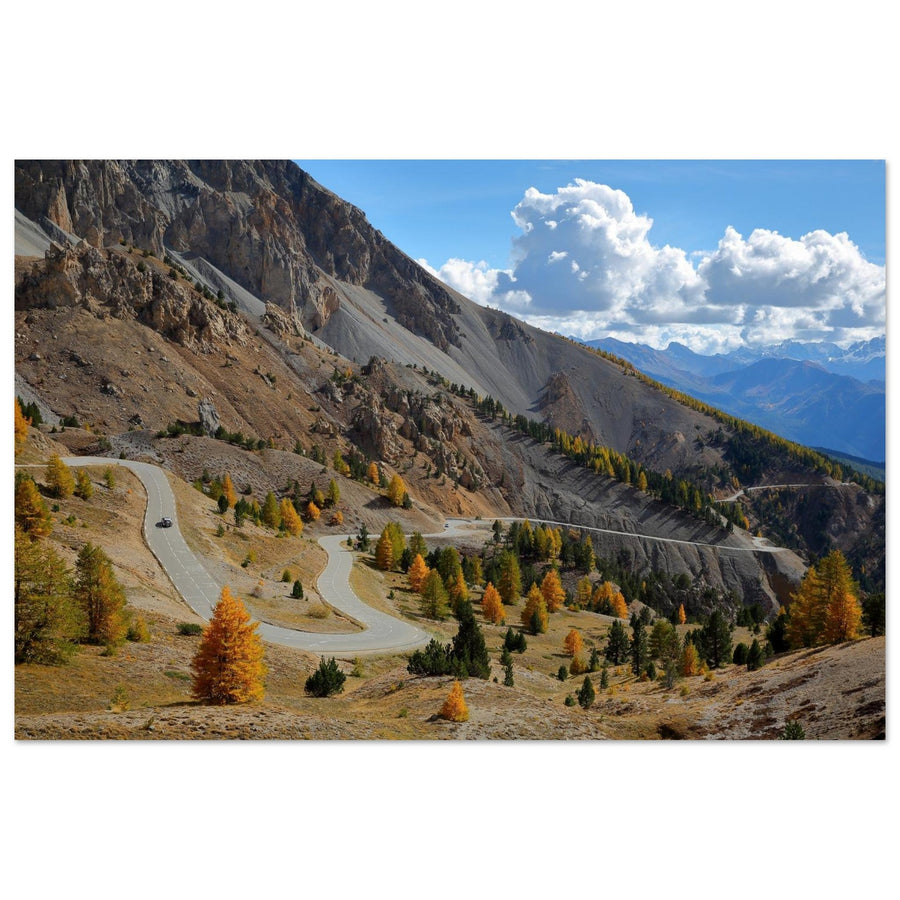
For a quick choice, the Clarée suits a whole valley structured by river and larches. L’Orceyrette adds a lake reflection within the forest. Le Monal combines colour with a hamlet of stone, wood and stone-slab roofs facing glaciers. La Grave sets golden slopes against La Meije and the high mountains. Montenvers brings autumn woodland into contact with moraine and glacier. Grand Arc works especially well when autumn begins to meet the first snow. Clapeyto favours pastoral alpine meadows and high-altitude chalets. Ambel offers another palette of beeches, ochres, fallen leaves and sometimes fog. Estenc provides a more southern version of Alpine autumn, between meadows, undergrowth and larch forest. Finally, the Canal du Vassé shows that an Alpine autumn landscape can also be low-lying, urban and shaped almost entirely by deciduous trees and their reflections.
There is therefore no absolute ranking. The right place depends above all on the scene you want and the actual state of the season when you set out.
Colours change from year to year. Altitude, aspect, cold, wind, dry or wet spells and the first snow can bring forward, delay or shorten the most colourful period.
Two places only a few kilometres apart can develop at different rates. Even in a larch valley, the trees do not necessarily change together.
Mist and the first snow do not necessarily mean an outing has “failed”. They can simplify layers, separate relief or create a stronger contrast between warm vegetation and cold high mountains.
Missing peak colour does not necessarily ruin the landscape. Dry grasses, partial foliage, trunks, water, rock, glacier and a dusting of snow can make a quieter but equally structured scene.
Understanding the autumn window without seeking a magic date
The temptation to seek an ideal week is strong. Yet that is unreliable across the French Alps. The season does not move like a uniform front from north to south or from low to high ground. It depends on tree species, altitude, aspect, recent temperatures and the weather preceding the visit.
In high larch valleys, the change can seem very quick: needles turn from green to yellow and then fall, while a cold spell may bring snow to the summits or down to alpine pastures. In deciduous areas, the palette can be more fragmented, with still-green trees beside yellows, oranges and browns. Precisely this lack of synchronisation can give the image depth.
It is therefore better to choose the type of landscape first, then check the area’s actual state shortly before departure. Local sources, webcams where available and access information are more useful than a fixed calendar.
Compare the 10 places at a glance
The windows remain relative: they compare scenes rather than promise a week of colour.
| Place | Choose it for | Dominant texture | Relative window | Compromise |
|---|---|---|---|---|
| La Grave / La Meije | the contrast between golden slopes, high mountains and glaciers | Larches, birches, alpine pastures and possible snow | A highly variable window depending on altitude | the atmosphere can quickly turn wintry |
| Le Monal | combining a traditional hamlet, larches and the Mont Pourri glaciers | Stone, wood, stone-slab roofs and colourful forest | A window tied to larch colour at mid and high altitude | check access and local rules |
| Montenvers / Mer de Glace | relating autumn forest to a glacial landscape | Larches/valley forest, moraine, rock and ice | A seasonal window dependent on both vegetation and site operation | timetables and closures may change in autumn |
| Grand Arc / Lauzière | a russet ridge in front of colder summits, sometimes already white | Dry grasses, rock and possible snow | A highly variable transition window | distant visibility and high-altitude conditions |
| Canal du Vassé, Annecy | red, orange and yellow deciduous trees above the water | Urban foliage, branches, canal and reflections | A low-altitude rhythm different from the high valleys | visitor numbers and no guarantee of simultaneous colour |
| Upper Vallée de la Clarée | a whole larch valley crossed by water | Larches, dry grasses, river and Cerces summits | A window varying with altitude and aspect | one part of the valley may be further advanced than another |
| Bois des Ayes and Lac de l’Orceyrette | forest and reflections | Larches, Swiss stone pines, undergrowth and water | A variable high-valley window | wind and light strongly change the mirror effect |
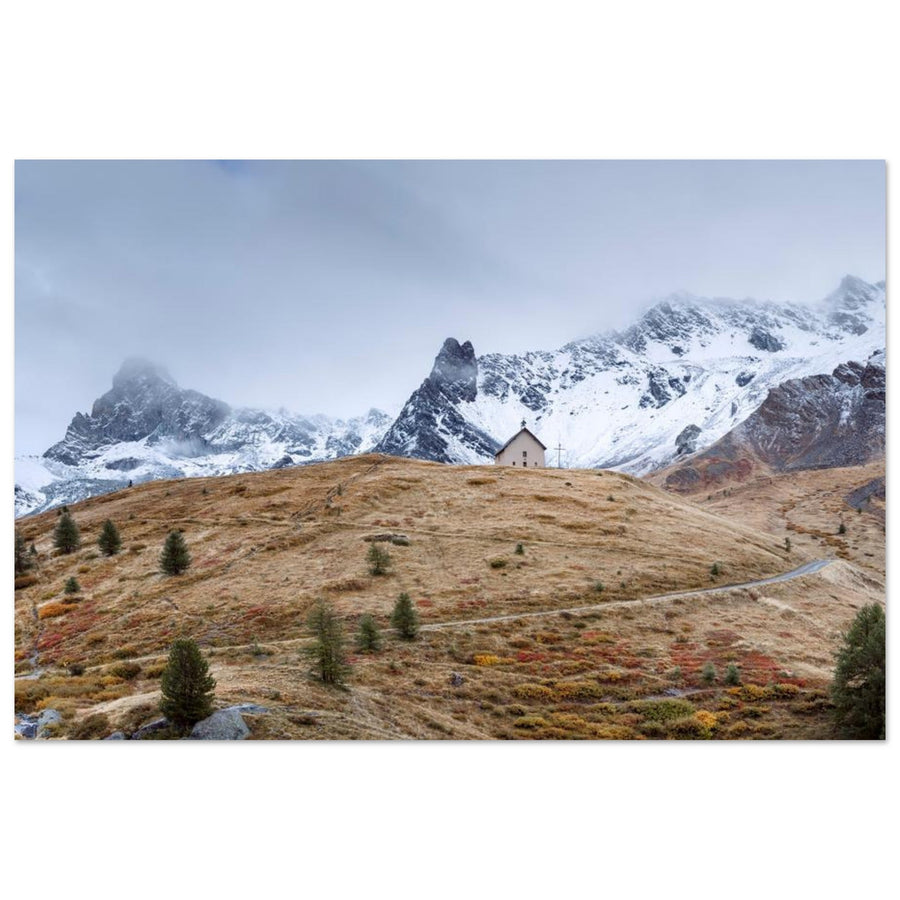
| Clapeyto chalets | high alpine pasture turned quiet after summer grazing | Chalets, short grasses, scattered larches and possible first snow | A late window highly dependent on cold | passability depends on weather and snow cover |
| Ambel plateau | an autumn of deciduous trees, fallen leaves and fog | Beeches, firs, maples, meadows and limestone cliffs | A window specific to mid-altitude mountains | fog can shape or conceal the scene; wildlife needs peace during the rut |
| Estenc plateau | a Southern Alps atmosphere of meadows, undergrowth and larch forest | Grasses, larches, streams and rock | A window varying with the first cold spells | the transition to more wintry conditions can be swift |
Which autumn landscape should you choose?
If your priority is larch colour on the scale of a valley, the Clarée is the most direct choice in this selection for combining a whole valley with river and larches. The river and valley axis give the landscape a continuous structure: you do not depend on a single tree or viewpoint. If you want to add a reflection and a more enclosed scene, L’Orceyrette gathers the landscape around forest and water.
Two options stand out for combining colour with a strong human presence. Le Monal places a traditional hamlet among larches facing glaciers; Clapeyto, by contrast, opens the scene onto alpine pastures and more scattered chalets. The first works as a protected mountain village; the second as a high-altitude pastoral landscape.
For the contrast between autumn and high mountains, La Grave, Montenvers and Grand Arc offer different relationships. La Grave directly opposes golden slopes to La Meije and the glaciers. Montenvers places forest beneath moraine and ice. Grand Arc becomes interesting when grasses remain warm while slopes and summits already take on a wintry tone.
If you seek something other than larches, Ambel and the Canal du Vassé change the palette completely. Ambel is more wooded, damper and more tactile: fallen leaves, beeches, meadows and fog. Le Vassé is a low-lying urban scene, where branches form an arch over water and colours extend into reflections. Estenc lies between these worlds: more southern Alpine, more pastoral, mixing meadows, undergrowth and larch forest.
The 10 places
La Grave and La Meije — golden tones below the high mountains
At La Grave, autumn is interesting because it does not transform the whole scene in the same way. Slopes, pastures and forests turn warm, while La Meije, glaciers and high relief remain rocky and cold. Local sources describe precisely this contrast between golden pastures and forests, coloured larches and birches, and possible first dustings of snow after frosts.
La Grave is therefore less a choice for “seeing lots of yellow trees” than for placing two seasons in one landscape. When snow remains high, colour dominates the middle layers. If cold descends lower, white begins to define the ridges and strengthens the contrast with russet grasses and trees still in colour.
Its limitation is also part of its appeal: the transition can be rapid. An outing planned for colour may find a landscape already more wintry than expected. That is not necessarily a failure. After some needles have fallen, dry grasses, the village, glaciers and fresh snow can retain a very coherent palette.
Photographing La Meije from La Grave.
Le Monal — larches, chalets and the Mont Pourri glaciers
Le Monal adds a precise architecture to the season. The listed hamlet, its buildings of stone, wood and stone-slab roofs, and the Mont Pourri glaciers give the landscape a structure that colour underlines rather than replaces. Sainte-Foy documentation explicitly describes Le Monal surrounded by orange larches in autumn.
That sets it apart from Clapeyto. At Le Monal, the eye first catches the hamlet’s volumes, then the trees and glaciers. Larches link dark roofs to pale high mountains. Even when the trees have not all reached the same stage, tonal diversity can serve the image by separating layers.
Check access and any local rules before departure. If peak colour has passed, stone, slab roofs, dry grasses and Mont Pourri prevent the scene from losing all substance. Autumn then becomes less flamboyant but rockier in character.
Photography guide to the Vanoise massif.
Montenvers and the Mer de Glace — forest beneath the glacial landscape
At Montenvers, autumn reads through layers. Coloured forest occupies the lower levels of the Chamonix valley; above, moraine, walls and the Mer de Glace establish a much colder world. This layering gives the area a different identity from La Grave: the forest–glacier relationship is more vertical, and the moraine strengthens the transition from vegetation to high mountains.
The season does not need perfect synchronisation to work. A few golden masses above the valley may be enough to introduce colour beneath Les Drus, the Aiguille Verte and the glacial landscape. Partial foliage can even open the layers further and make the transition to rock clearer.
The compromise is practical: Montenvers depends on the train and Mer de Glace gondola, with specific autumn closure periods. Check current operation rather than repeating a fixed timetable. Choose this place when the glacier is part of the subject; if you primarily want an immersive golden forest, the Clarée or L’Orceyrette make more sense.
Photographing the Mer de Glace from Montenvers.
Grand Arc and Lauzière — when autumn begins to meet winter
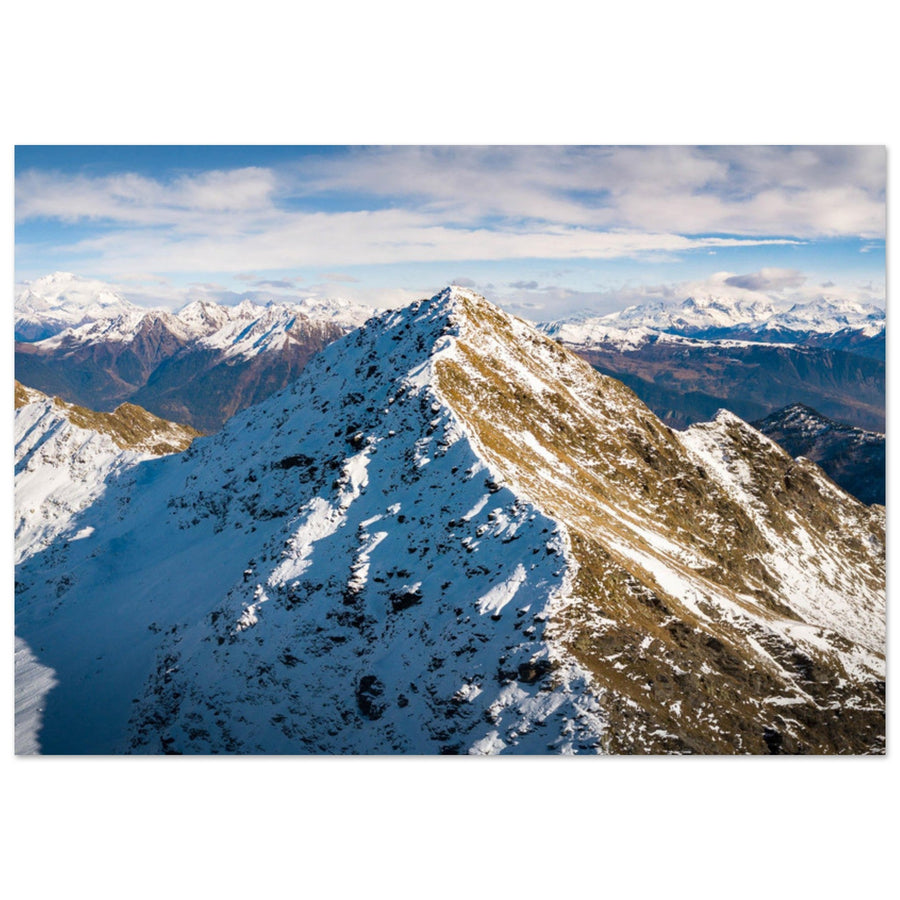
Grand Arc works less through dense foliage than through changing textures. On the ridges, grasses turn russet and brown, while snow may begin whitening a slope or more distant ranges. Along the ridge, one slope can retain warm tones while another is already white; distant ranges then extend that contrast towards Mont-Blanc.
This is a transitional scene. It may be less spectacular if you seek only yellow larches, but much more interesting if you want to show autumn turning into winter. Tones are more restrained, relief lines more important, and atmospheric visibility becomes decisive for distant layers.
The window is therefore less about “peak colour” than a combination of dry vegetation, light and a possible dusting of snow. If valley trees have already lost some colour, Grand Arc can remain very readable through ridge, grass and snow. High-altitude conditions must, of course, take precedence over seeking the image.

Grand Arc between autumn and the first snow
The russet ridge, already whitened slope and distant Mont-Blanc show the seasonal transition that distinguishes this place.
Photograph: Pierre Thiaville
View the Grand Arc in autumn photo printCanal du Vassé in Annecy — deciduous trees and their reflections
The Canal du Vassé provides a counterpoint to the high-altitude landscapes in this selection. There is no high valley or glacier in the foreground: autumn is carried by deciduous trees meeting above the water. Branches form a tunnel, reds, oranges and yellows repeat in the canal, and boats give the perspective a discreet sense of scale.
This scene also reminds us that there is no single calendar for the Alps. Annecy’s deciduous trees do not follow the rhythm of the Clarée or Queyras larches. Trying to make both coincide on a fixed date would make no sense. The right indicator is the trees’ actual state in town and around the lake.
Even before or after the most vivid colours, the canal retains several strengths: repeated trunks, water, depth of perspective and often softer light. The main drawback is urban visitor numbers rather than the mountains. Choose it for a clearly readable autumn scene without relying on a high-altitude panorama.

The Canal du Vassé beneath autumn foliage
The canopy of deciduous trees and its reflections in the canal precisely illustrate the selection’s low-altitude counterpoint.
Photograph: Mumemories
View the Canal du Vassé in autumn photo printUpper Vallée de la Clarée — a valley structured by river and larches
The Clarée is one of the areas where autumn becomes part of the landscape’s identity. Recent Hautes Vallées tourist office content highlights the golden season, larches and valleys transformed by colour. Here, the river provides a permanent axis while trees colour slopes and terraces beneath the Cerces massif.
Its strength is scale. Unlike L’Orceyrette, where the scene closes around a lake and its forest, the Clarée can be read as a landscape extending along its length: water, meadows, hamlets or chalets, larch forest and summits follow one another. This depth also allows composition when colours are uneven.
Avoid thinking of the valley as a synchronised whole. Altitude, aspect and microclimate can create different stages between two areas. That is a weakness if you come seeking a very precise colour; it is an advantage if you accept a more gradual palette. After the peak, river, dry grasses and rock retain a strong structure.

The Clarée valley in autumn
The river and golden larches structure the valley across several layers, exactly in keeping with the selected profile.
Photograph: beboy
View the Clarée valley in autumn photo printBois des Ayes and Lac de l’Orceyrette — autumn forest around water
At L’Orceyrette, the seasonal subject is more concentrated. Forest surrounds the lake, and larches create a mass of colour that the water can extend. Hautes Vallées lists the area among the places of the “golden season”, where larch forest gives the lake an identity very different from an open valley.
The point is not to create another ranking of Alpine lakes. Here, water makes the season readable: it separates trees from the foreground, opens breathing space in the forest and, when wind allows, repeats some of the colours. Undergrowth and Swiss stone pines also add a more wooded texture than in the open Clarée.
A reflection remains an effect, not a guarantee. Wind, light and water level can change the scene completely. Even without a perfect mirror, the relationship between dark shore, golden forest and lake surface remains strong. Before or after peak colour, the structure of woodland and water preserves the place’s interest.

Lac de l’Orceyrette among the larches
Golden forest and water show the forest–reflection relationship that distinguishes L’Orceyrette from the open Clarée.
Photograph: Francois Roux
View the Lac de l’Orceyrette in autumn photo printClapeyto chalets — the pastoral autumn of the Queyras
Clapeyto stands out for its space. Chalets are scattered across open alpine pasture rather than grouped as a village. The Queyras tourist office explicitly describes softer autumn light, warm tones on the slopes and, at altitude, the return of cold after the herds descend. The first snow may already appear, depending on conditions.
This combination creates a scene less wooded than the Clarée and less centred on built heritage than Le Monal. Short grasses, tracks, chalets and scattered larches draw a landscape where the season reads mainly through the ground’s overall colour and the quiet returning after summer grazing.
The compromise is altitude and passability. The area should not be presented as a setting accessible in the same way throughout autumn: weather and snow cover can change conditions quickly. Yet if the larches have passed their peak, brown pasture, chalets and a light dusting of snow can still build a coherent image.
Photography guide to the Queyras.
Ambel plateau — the autumn of beeches, leaves and fog
Ambel changes the vegetation completely. Inspiration Vercors describes autumn on the plateau through leaves crunching underfoot, carpets of orange, ochre and brown, and the presence of deer. The site itself combines broad grasslands, beech and fir forests, limestone cliffs and frequent fog.
Here, a day without a distant panorama is not necessarily a bad day. Fog can isolate a few trees, erase a cliff or reduce the scene to successive trunks and clearings. This is a more intimate autumn photography than at Grand Arc or La Meije, accepting that atmosphere sometimes replaces the horizon.
The place also requires behaviour suited to wildlife, especially during the rut. Stay on paths, remain discreet, follow local guidance and do not seek to approach animals for a photograph. After peak foliage, trunks, the carpet of leaves, meadows and mist continue to offer seasonal texture very different from larch landscapes.
Photographing the Ambel plateau in the Vercors.
Estenc plateau — meadows and larch forest at the sources of the Var
Estenc brings the tone of the Southern Alps. Parc national du Mercantour and official itineraries describe a peaceful plateau at the sources of the Var, where meadows, undergrowth and larch forest follow one another beneath wilder relief. The official route photograph is itself captioned as a view of the Estenc plateau in autumn.
This mix matters to the selection. The landscape is neither a larch valley as structured as the Clarée nor a beech forest like Ambel. Meadows retain a large role, trees occupy more of the edges and stream margins, then rock takes over towards the summits. Autumn therefore reads through contrasts between textures rather than a uniform mass of colour.
As often at this altitude, the first cold spells can accelerate the transition. Check road and local conditions rather than fixing an ideal period. Even with partly bare larches, tawny meadow, undergrowth, rock and possible light snow retain a late-season identity.
If you miss peak colour
The most vivid colours are photogenic, but they are not the only way to show autumn. Partial foliage can make a forest more transparent and better separate its layers. Dry grasses provide a less spectacular but often more even palette. First snow on summits or a slope can introduce a very clear contrast with the remaining warm tones.
Mist can also help by hiding what overloaded the landscape. At Ambel, it can isolate the beech forest; in a valley, it can separate slopes. On a lake or canal, water remains a compositional tool even when trees have lost some of their leaves.
That does not mean all conditions are equivalent. Persistent rain, strong winds or snow too low down can make an outing unhelpful or dangerous. The point is simply not to reduce autumn to one mental photograph taken on one day of the year.
After choosing the place
This selection helps you choose a type of landscape. To then prepare the terrain, precise points and alternatives, the Destination guides explore each area in depth; the Mountain Photography Techniques guides cover composition, exposure and equipment.
For the most changeable conditions — Montenvers lifts, high-altitude roads, snow and passability — always consult the latest local information before departure.
Discover autumn mountain photo prints.
Official sources and references to check before departure
Colours and access change: these sources provide references for the most variable seasonal or practical facts.
- Hautes Vallées tourist office — golden season, La Grave, Clarée, L’Orceyrette
- Sainte-Foy Tarentaise — Le Monal beneath autumn larches
- Chamonix-Mont-Blanc — Mer de Glace and Montenvers train
- Guillestrois-Queyras — Clapeyto chalets
- Inspiration Vercors — autumn in the Vercors forests
- Inspiration Vercors — Col de la Bataille and Ambel viewpoint
- Destination Marittime Mercantour — Estenc plateau circuit
- Parc national du Mercantour — upper Var valleys
- Lac d’Annecy tourist office — Canal du Vassé