Where to see ibex in the Alps?
Seeing an ibex in the Alps depends less on a “spot” than on the ability to read its habitat and the season. Alpine ibex seek terrain where rock remains close — cliffs, ledges, scree, ridges and steep slopes — while also using high-altitude grasslands and meadows for feeding. In spring, fresh vegetation can bring them lower; as snow melts and summer advances, the animals generally move back toward higher, cooler areas. In winter, exposure, snow and energy conservation become decisive.
This logic is shared across the Alpine arc, but the territories do not tell the same story. Vanoise holds the largest French population and an exceptionally deep scientific monitoring history. Gran Paradiso is the last Alpine nucleus where the species survived before being reintroduced elsewhere. Écrins, Vercors, Chartreuse and Mercantour show different stories of return. The Aiguilles Rouges place ibex opposite the Mont-Blanc massif, while Engadine and Hohe Tauern extend the reading toward Switzerland and the Eastern Alps.
For photography, the subject is therefore not only the ibex: it is the ibex in an environment and behaviour that make sense. A herd on a rocky slope, a female with her kid, an isolated male on a ridge or an animal placed within a broad landscape can tell the story of the Alps better than a portrait obtained by reducing distance. Lenses, shutter speeds, autofocus and detailed settings remain covered in the Technique guide devoted to mountain wildlife.
Look for coherent habitat: steep terrain, nearby grasslands, favourable exposure and natural retreat areas.
Altitude, vegetation, heat, snow, rut and birthing alter the areas used and the behaviours that can be seen.
A fixed stare, upright ears, interrupted activity or flight are signals not to approach any further.
Vanoise, Gran Paradiso, Vercors and Aiguilles Rouges offer neither the same history, nor the same landscape, nor the same photographic scene.
Which territory should you choose at a glance?
| Territory | Dominant habitat | Rhythm to understand | What sets it apart | Plausible photographic scene | Main trade-off |
|---|---|---|---|---|---|
| Vanoise / Haute Maurienne | Rock faces, Alpine grasslands, high valleys | Strong seasonal movement between spring, summer and winter | Largest French population and exceptionally deep scientific monitoring | Herd, female and kid, animal within a vast high-mountain landscape | Animals can be relatively unafraid: do not confuse proximity with absence of disturbance |
| Gran Paradiso | High-altitude meadows and rocky faces | Spring descent toward fresh grass, then ascent as snow melts and temperatures rise | Last surviving Alpine nucleus and source of modern reintroductions | Animal in the massif’s meadows and cliffs, with strong historical and ecological meaning | Do not turn research or concentration areas into “spots” |
| Écrins | Large slopes, cliffs, high-altitude valleys | Animals often remain high in summer and become more mobile in shoulder seasons | Several nuclei resulting from successive reintroductions | Relatively small ibex in a broad mineral or glacial setting | Observation is often distant; terrain is more demanding |
| Mercantour / Argentera | Rocky high valleys and grasslands of the Southern Alps | Exposure and heat become especially important | Cross-border population and history of genetic reinforcement | Family or group on southern Alpine pasture, pale rock and drier vegetation | Do not use GPS monitoring data as a localisation tool |
| Vercors | Limestone cliffs, ridges and high plateaus | Prealpine reading, with open areas very different from the inner Alps | Successful reintroduction and immediately recognisable limestone scenery | Silhouette on limestone, animal against a ridge horizon | Exposed terrain and nature reserve: stay at a macro scale |
| Aiguilles Rouges / Chamonix | Rock slabs, scree, grasslands and reserves opposite Mont-Blanc | Presence must be read alongside visitor pressure and reserve rules | Mont-Blanc glacial context and strong photographic coherence with AAM | Family or ibex on rock with glaciers and summits in depth | Strict regulation; never try to improve the viewpoint by approaching |
| Swiss National Park / Engadine | Rocky terrain and Alpine meadows of Graubünden | Reintroduced population observed under strict protection | Swiss history of the ibex’s return | Animal set in a highly protected landscape and observed at distance | No “Macun spot”: the broader territory matters more than a precise point |
| Hohe Tauern | Cliffs, scree and large Eastern Alpine relief | Space use monitored scientifically in an eastern Alpine climate | Provides a genuine opening toward the eastern Alpine arc | Ibex on a mineral slope with broad glacial relief | Marked animals and telemetry data must not become observation shortcuts |
| Chartreuse | Limestone cliffs and the Hauts de Chartreuse | Recent population in gradual expansion | Latest major French reintroduction, with a very readable return of a once-absent species | Ibex in Prealpine limestone and vertical terrain | Smaller population; spring tranquillity is especially important |
This table compares contexts and trade-offs, not probabilities. A large population or well-documented presence never guarantees an observation on the day of your hike. The aim is to choose a territory that suits the season and the type of scene you are looking for, then accept that the animal remains free not to show itself.
Read the habitat before looking for a place
Ibex are ungulates of rocky terrain. Their hooves, hard around the edges and grippy on the softer inner part, allow them to use slopes and rock faces that quickly become uncomfortable for a walker. But rock alone is not enough: the species also needs access to vegetation. It is the combination of cliffs or scree, Alpine grasslands and favourable exposure that gives a landscape its coherence.
Vanoise describes a preference for well-exposed rocky slopes that clear of snow quickly, with use of high-altitude meadows. Gran Paradiso emphasises the same balance between grasslands and cliffs: food grows in the meadows, while rock remains an important refuge, especially for females with young. Temperature and snow cover then alter this balance throughout the year.
For the reader, the consequence is simple: start by reading the massif at a broad scale. Look for breaks in slope, rocky bands, adjoining grasslands and slopes that lose their snow earlier. Then use binoculars to slowly scan ridgelines, benches and transitions between grass and rock. It is far more relevant to find an animal already calm in its environment than to reach a place where someone photographed it a few hours earlier.
When can you see ibex? The season changes altitude, groups and the scene
There is no universal best hour that works across the Alps. With ibex, the seasonal cycle is often more useful to understand than the clock. Vegetation, temperature, snow cover, sex and age influence how space is used. Research in Gran Paradiso also shows that males and females can use resources differently and remain separate for much of the year.
Spring: follow the returning vegetation
As snow melts, the first accessible grasses can attract ibex to lower elevations than in summer. In Gran Paradiso, groups of males descend toward greening meadows from spring, then move back up as snow disappears higher. It is a period when contrasts between fresh vegetation, residual snow and rock create a very Alpine reading.
Early summer: females, young and the safety of rock
Births take place around early summer, with variation between populations and conditions. Females then seek protective rocky areas. The existence of this window must never become an invitation to look for a birthing site: if a female isolates herself or appears especially vigilant, observation should remain distant.
Summer: altitude and heat
As grass greens higher up, ibex move upward. In Vanoise, the Park describes typical summer presence at high altitude; in Écrins, historical monitoring also shows animals settled very high during the warmer season. Gran Paradiso additionally highlights the species’ sensitivity to high temperatures: a hot summer can shift activity toward cooler areas and alter the trade-off between food and thermal comfort.
Late autumn and early winter: the rut
The rut takes place around the start of winter. In Gran Paradiso, the mating season is described from late November to mid-January. Males then spend more time with females and interactions change. This period can produce strong behavioural scenes, but it is also energetically demanding: an animal remaining still in snow is not an invitation to reduce the distance.
Winter: less margin for the animal
Ibex readily use snow-free, rocky, well-exposed slopes. They are nevertheless less comfortable in deep snow and must conserve energy. In winter, a flight caused by a visitor can cost much more than in summer. Photography should therefore mean anticipating the animal’s route and staying back, not testing its flight distance.
A season never creates a guarantee
No two springs have the same snow cover; no two summers have the same heat. Groups also move between slopes and sometimes between valleys or countries. A good calendar provides a search logic, not an appointment.
Ibex or chamois? Useful clues without turning the guide into an encyclopaedia
Confusion is mainly possible at a distance, especially with females or young animals. An adult male ibex is generally easiest to recognise thanks to its massive body and long, thick horns, curved backwards and marked with prominent ridges. The female ibex is smaller and has much shorter, thinner horns.
Chamois generally look lighter and more nervous in their movements, with a contrasting facial mask and slender horns ending in a hook. Both species can use rocky zones, but chamois also readily use more varied habitats, including areas near forests. At long distance, good practice is to accept uncertainty rather than move closer solely to identify the animal.
Which photographic scenes should you look for naturally?
Ibex photography becomes especially strong when behaviour and territory remain readable. There is no need to provoke a look or posture: the most interesting scenes are those already happening when the photographer arrives.
The silhouette on rock
A ridge or break in slope can sometimes make the body and horns stand out very simply. This scene works especially well in Vercors, Écrins or Hohe Tauern because it immediately tells the species’ relationship with vertical terrain.
The animal in the wider landscape
In the Aiguilles Rouges, an ibex can be placed against the glaciers of Mont-Blanc; in Écrins or Vanoise it can become a small presence among rock faces and summits. The more distinctive the landscape, the less the portrait needs to fill the frame.
The herd and group structure
Male groups, females accompanied by young or rut gatherings do not tell the same seasonal story. An image with several animals can be more informative than a portrait when it preserves the distances and relationships between them.
The female and kid
Young animals create very expressive scenes, but this is precisely when caution should increase. Never position yourself between a female, her kid and the rock that serves as refuge. A family scene obtained at distance is stronger than a close-up that alters their movements.
The southern context
In Mercantour, drier grasslands, pale rock and high valleys create a different palette from Vanoise. Keeping these elements in the frame distinguishes the territory instead of producing an interchangeable portrait.
Snow, with an extra rule
Snow simplifies shapes and strengthens the graphic presence of the horns. But winter is an energetically delicate period. If the composition requires making the animal move or blocking a comfortable route, it is not a good composition.
For lens choice, shutter speed, autofocus, ISO, snow metering or tracking settings, see Photographing mountain wildlife: equipment, settings and advice. Here, the subject remains behaviour, environment and distance.
Observe an ibex without disturbing it: apparent calm is not permission
Which territory should you choose for your project?
To understand French ibex
Vanoise is the most obvious starting point: a large population, a long protection history, individual monitoring and a well-documented seasonal dynamic. It makes it possible to read the species without reducing it to one famous site.
To understand why the species still exists
Gran Paradiso is essential. This is where the last Alpine nucleus survived before directly or indirectly supplying the animals behind many reintroductions. The territory gives historical meaning to the other sections of this guide.
For a very high-mountain reading
Écrins offers a more discreet presence across vast slopes. The interest lies in scale: the animal is not necessarily close, but visually belongs to a broad landscape of rock faces and valleys.
For the Southern Alps
Mercantour and Argentera combine a cross-border history, genetic issues and a more southern atmosphere. A herd on Alpine pasture or a group on rock tells a different Alpine light.
For the limestone Prealps
Vercors provides the strongest contrast with the inner Alps: limestone cliffs, high plateaus and open horizons. Chartreuse extends this reading with a much more recent population.
For the wildlife + Mont-Blanc relationship
The Aiguilles Rouges provide one of the most immediately recognisable photographic contexts: ibex on rock slabs or grasslands with the glaciated Mont-Blanc massif in depth. Reserve regulations are an integral part of this choice.
Vanoise and Haute Maurienne — the major French reference
Vanoise is inseparable from the return of ibex in France. The national park was created in 1963 partly to protect the species, when only a small population remained in the massif. Today the Park estimates the population at around 3,000 animals, the largest in France. This historical depth also explains the quality of monitoring on demography, genetics, health and reproduction.
The ibex landscape in Vanoise combines rocky faces, high-altitude meadows and well-exposed slopes. The Park notes that in summer the species can remain very high, whereas in spring it can descend toward the first available grasses. This mobility is more useful to the photographer than the name of a valley: a route crossing coherent habitat at the right time of year is more valuable than coordinates shared on social media.
Vanoise also helps explain a frequent mistake. Some monitored animals or individuals accustomed to human passage remain relatively calm around people. FaceBouq does not treat this proximity as permission: it asks visitors to keep their distance and stop approaching at the slightest sign of concern. This is the rule to apply everywhere in the Alps.
Females and kids are currently the subject of fine scientific monitoring, particularly around the perinatal period and possible effects of climate change. This work shows why birthing season deserves caution; it gives no reason to publish the locations used by monitored females.
To prepare the massif, its landscapes and its light after choosing Vanoise, see What to photograph in the Vanoise massif?.
Gran Paradiso — the territory without which Alpine ibex would probably not exist as they do today
Gran Paradiso is not an additional territory added simply to make the guide broader: it is central to the story. The National Park notes that it is the only Alpine area where ibex survived uninterrupted through the near-extinction of the nineteenth century. This final nucleus then served as a reservoir for reintroductions that allowed the species to return across much of the Alpine arc.
This history also provides a photographic lesson. Other massifs often show the success of a return; Gran Paradiso shows the source territory. Ibex live there in high-altitude meadows and on rocky faces. In spring, animals take advantage of lower meadows that green first before gradually moving back upward as vegetation develops higher.
The Park also highlights the effect of heat. Ibex tolerate low temperatures better than high ones and in summer must balance access to quality vegetation against the need for cooler areas. Females with young also remain strongly linked to nearby rocky refuge areas. A very hot day therefore cannot be read as a simple question of hour: it changes how the animal uses the territory.
The rut takes place around the beginning of winter and births around late spring and early summer, with documented variability. These periods provide rich behavioural material, but they also increase the observer’s responsibility. The Park itself reminds visitors that winter and the breeding season are periods when disturbance should be limited.
The comprehensive September 2025 census counted 2,869 ibex in the Park. This dated figure describes the state of a monitored population; it must not be used as a promise of easy observation or as a ranking against other massifs.
Écrins — the return through several nuclei and the strength of the wider landscape
Ibex had disappeared from Écrins before several reintroduction operations. The National Park notably recalls releases in Valbonnais in 1989 and 1990, involving 28 animals from Vanoise, as well as other operations within the massif. The different nuclei then evolved and some individuals recolonised other valleys.
This history creates a territory that is less homogeneous than a simple “ibex massif”. Animals can stay high in summer and move across very large slopes. Historical Valbonnais monitoring mentions observations between 2,500 and 3,000 metres during the warmer season. For a photographer, this often means accepting a more distant observation and making the relief part of the image.
Écrins is particularly suited to environmental photography: an animal on a rocky bar, a female on a slope or a group below an immense rock face can be more expressive than a tight portrait. The relief immediately gives the scale of the scene.
The Park has long used marking and sometimes telemetry to understand movements. These data are scientific tools. They must not be converted into real-time search methods for visitors: the article deliberately remains at the scale of the massif and its habitats.
To prepare the massif’s landscapes afterward, see What to photograph in the Écrins massif?.
Mercantour and Argentera — a cross-border population in the Southern Alps
In Argentera-Mercantour, the history of ibex is cross-border. After disappearing locally, the species was reintroduced on the Italian side in the early twentieth century. Parc national du Mercantour now describes a Franco-Italian population established in the high valleys, with a particular genetic-diversity issue linked to the small number of founding animals.
This issue led to ibex being transferred from Vanoise to Mercantour to strengthen the population’s genetic diversity. The territory therefore becomes interesting at two levels: visually, through its high valleys, rock and southern light; biologically, through exchanges between Alpine populations.
The field reading remains simple: prioritise high rocky landscapes and adjacent grasslands, then adapt the outing to temperature and exposure. The point is not to list valleys where an ibex was seen recently. The Park’s natural-history database broadly documents the species’ presence; it is not an appointment map.

An ibex family in the Fontanalba pastures
The scene keeps the animals within a pastoral, rocky Mercantour landscape. It shows why a group and its environment can tell more about a territory than an isolated portrait.
Photograph: Muszynski Johann
View the ibex family photo printVercors — ibex in the limestone Prealps
Vercors immediately changes the setting. Here, ibex live in a massif where limestone cliffs, high plateaus and long ridges create a very different reading from the broad glacial valleys of Vanoise or Écrins. The regional natural park recalls that 28 ibex from Vanoise were released in 1989 and 1990 and that the population around the Archiane cirque and eastern ridges subsequently increased strongly.
For photography, the territorial difference is particularly clear. Pale rock, ridge grasslands and the openness of the plateau allow a lot of space to remain around the animal. A silhouette on a slab or a male among boulders can stay very graphic without cutting the ibex away from its environment.
The Hauts-Plateaux Nature Reserve nevertheless reminds visitors of the general fragility of these habitats. The fact that the species is well established does not turn the eastern escarpment into an animal park. Observation should remain part of the hike, at a distance compatible with normal group behaviour.

An ibex in the limestone of Grand Veymont
The ibex remains small enough for the rocks, grass and Vercors horizon to build the scene. It is precisely this animal–landscape relationship that distinguishes the massif.
Photograph: Pierre Thiaville
View the Grand Veymont ibex photo printTo explore the massif and its landscapes further, see What to photograph in the Vercors massif?.
Aiguilles Rouges and Chamonix — wildlife facing Mont-Blanc
For a reader staying in Chamonix or looking for ibex in Haute-Savoie, the Aiguilles Rouges are the most coherent natural reference in this guide. The massif combines rock slabs, high-altitude grasslands and direct views of Mont-Blanc. The Haute-Savoie conservancy documents ibex presence in the massif’s reserves and reminds visitors of strict rules, including bans on dogs and overflight.
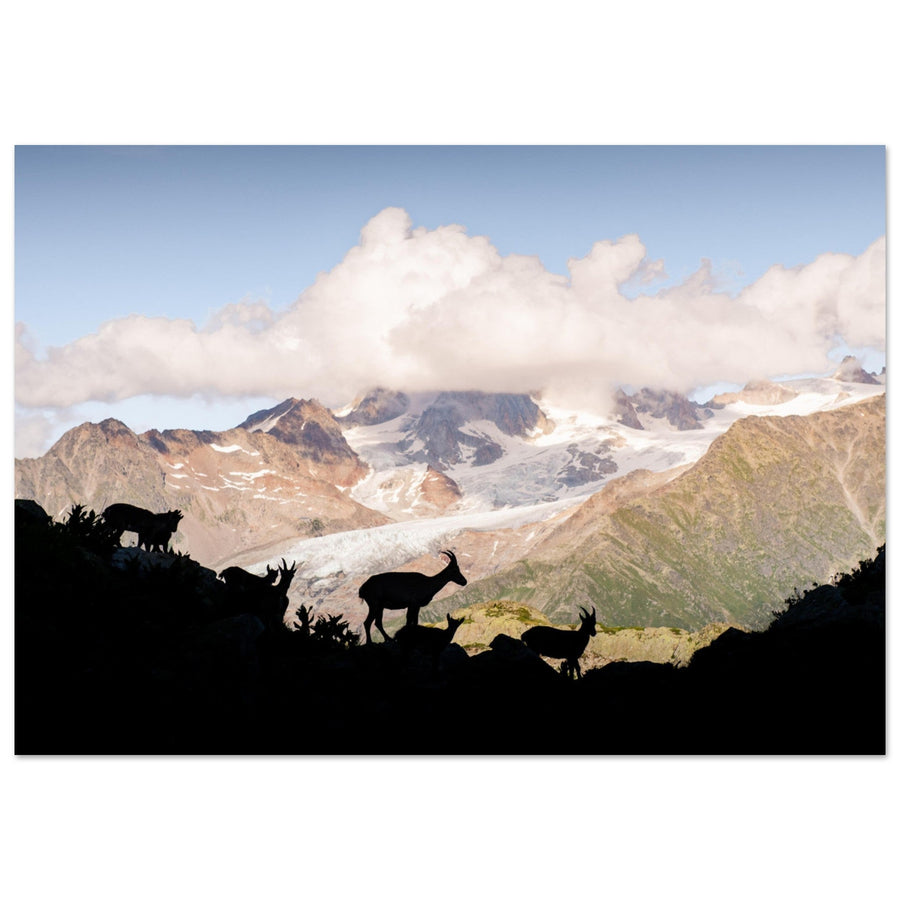
The photographic strength of the territory does not come from a promise of proximity. It comes from the possibility of linking a rock-dwelling animal to an immediately recognisable glacial backdrop. An ibex or family placed in the foreground of a large snow-covered massif provides scale and depth that do not appear in quite the same way in Chartreuse or Mercantour.
This visual strength should make ethical attention even stronger. The reserves concentrate several sensitive species and habitats. Leaving the path simply to gain a few metres or improve a leading line can damage more than the scene being photographed. The viewpoint available from your position should be treated as a creative constraint.

An ibex family facing the glaciers of Mont-Blanc
Adults and kids occupy different levels of the rock while the glacial landscape remains visible behind them. The scene brings together family behaviour and territory without needing to bring the subject artificially closer.
Photograph: Pierre Thiaville
View the ibex family photo printTo prepare the massif’s landscapes and light, see What to photograph in the Aiguilles Rouges massif?.
Three complementary territories that broaden the Alpine reading
Swiss National Park and Engadine — the return of ibex on the Swiss side
The Swiss National Park tells a different story. Ibex disappeared from Graubünden in the seventeenth century; the first animals from the Swiss breeding programme were released in the Park in 1920. The manager states that around 300 ibex now live there.
This territory helps show that the return of ibex was built in several different ways around the Alpine arc. Photographically, it mainly invites distant observation in a highly protected landscape. The name Macun often appears in the local history of the species, but this guide does not use it as a “spot”: Engadine and the Park are the right level of reading.
Hohe Tauern — extending the comparison toward the Eastern Alps
Hohe Tauern National Park now estimates its ibex population at around 1,100 animals after reintroductions that began in the 1960s. The Park describes the species on cliffs and scree and conducts cross-border monitoring of space use, health and genetics.
The value of this territory is that it avoids an exclusively Franco-Italian or western view of the species. The large eastern relief, scree and glacial context create a different scene. Marked animals seen during an outing can be reported to the manager; their scientifically monitored movements must not be used to guide an approach.
Chartreuse — fifteen years after reintroduction
Chartreuse offers a recent story. Thirty ibex were released in 2010 and 2011 in the Hauts de Chartreuse Nature Reserve. In 2025, the regional natural park estimated the population at between 120 and 170 animals and described gradual expansion.
The massif adds a limestone Prealpine reading close to Vercors but with a temporal contrast: here, reintroduction is much more recent. This younger population also justifies particular vigilance. The Park reminds visitors of the need to preserve tranquillity at certain sites, especially in spring. It is therefore more appropriate to speak of cliffs and the Hauts de Chartreuse than to publish the areas used by females.
To prepare the massif’s landscapes, see What to photograph in the Chartreuse massif?.
Savoie, Haute-Savoie and Chamonix: useful for orientation, insufficient for choosing habitat
Visitors naturally search using departments and towns. “See ibex in Savoie” points first, in the logic of this guide, toward Vanoise and Haute Maurienne. “See ibex in Haute-Savoie” or “ibex Chamonix” leads more naturally toward the Aiguilles Rouges and the protected areas around the valley.
These words are useful for organising a stay, but they should not structure the article as an administrative list. A department contains very different massifs, exposures and habitats. The question remains: which natural territory am I in, at what season, and is the landscape in front of me coherent with the species?
The Bargy massif deserves special treatment. Its ibex population is subject to major health monitoring linked to brucellosis. This is a conservation and management issue, not a reason to create an observation recommendation. This guide therefore does not turn that health context into a destination.
What this guide can — and cannot — promise
After choosing the territory: prepare the mountain, then the photography
Once the territory is chosen, each question should return to the right guide. Destination pages are used to prepare a massif, its landscapes, its light and general organisation. The Technique guide then explains lenses, settings, autofocus, shutter speeds and shooting methods. This Ibex guide keeps only what changes the observation decision and the photographic reading of the scene.
Key takeaways
To see ibex in the Alps, first look for a landscape that combines rock and food: cliffs, scree, ridges and nearby grasslands. Then adapt your reading to the season. In spring, fresh vegetation can bring animals lower; in summer they use higher elevations and also seek tolerable thermal conditions; at the start of winter, the rut changes group structure while snow reduces their energetic margin.
The territories are not interchangeable. Vanoise is the major French reference; Gran Paradiso explains the survival of the species and its return across the Alps; Écrins tells the story of several high-mountain reintroductions; Mercantour the cross-border history of the Southern Alps; Vercors and Chartreuse the limestone Prealps; Aiguilles Rouges the wildlife–Mont-Blanc relationship; Engadine and Hohe Tauern broaden the reading toward Switzerland and the Eastern Alps.
Finally, the best photograph is one in which the ibex continues behaving normally. An animal that is not very shy is not an animal to approach. Leave a free route, use binoculars and telephoto lenses as distance tools, and back away as soon as signs of concern appear. The image should retain a mountain scene, not prove proximity.
Information and official sources
Population figures, access rules and monitoring evolve. For the natural-history facts, conservation context and local rules used in this guide, prioritise the following managers and institutional sources.
- Vanoise National Park — Le bouquetin
- Vanoise National Park — FaceBouq: observe without disturbing and contribute to monitoring
- Vanoise National Park — 2025 monitoring of marked females
- Écrins National Park — history of ibex reintroduction
- Parc national du Mercantour — Opération Bouquetin
- Biodiv’Mercantour — Alpine ibex
- Parco Nazionale Gran Paradiso — Lo stambecco
- Parco Nazionale Gran Paradiso — history of the Park and reintroductions
- Swiss National Park — Ibex
- Hohe Tauern National Park — Ibex
- Hohe Tauern National Park — ungulate monitoring
- Vercors Regional Natural Park — ibex reintroduction
- Chartreuse Regional Natural Park — 2025 ibex update
- CEN Haute-Savoie — Aiguilles Rouges Nature Reserve and regulations