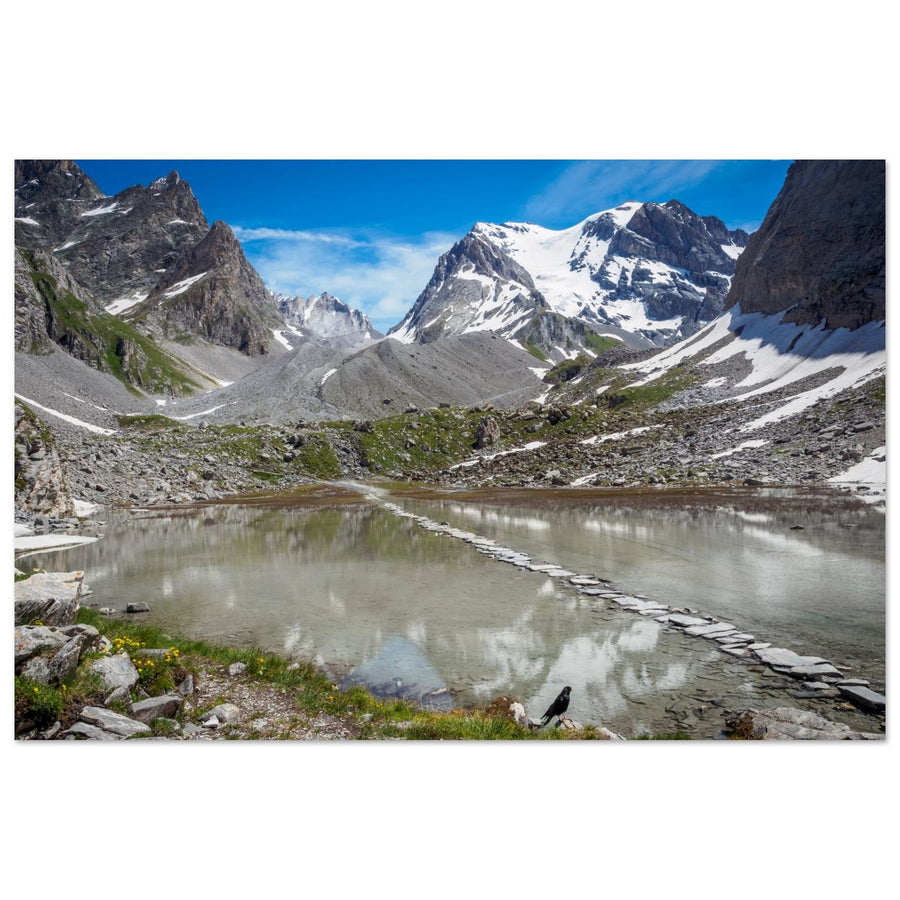
Vanoise | Photographing Lac des Vaches
Photographing a lake you cross
Lac des Vaches stands out less for a perfect mirror than for the line of stepping stones that cuts across the water and leads the eye towards the Grande Casse.
The crossing creates an unusual geometry: a human line, a changing surface and a major summit share the frame. The success of the image depends on their hierarchy.
Choose the role of the crossing
Leading stones, expressive water or a lived passage?
Decide whether the stones lead towards the summit, organise the water or tell the story of people crossing.
Align the stones towards the Grande Casse without letting them leave the frame abruptly.
Give more room to reflections, ripples or colours, with the stones acting as a reference.
Frame the relationship between walkers, stones and water while keeping a readable sense of scale.
A line of stones through the water
Preserve the crossing and its destination
The stone line, the water surface and the mountain background should retain distinct roles.
The route should remain continuous or deliberately interrupted, never accidentally cut.
Changes in water, ice or wind alter the contrast of the stones and reflections.
The summit often closes the perspective, but it should not overwhelm the lake's design.
Artwork — follow the crossing
The line of stones connects the water to the summit
The crossing begins in the foreground, cuts through the calm surface and finds a destination in the Grande Casse. Enough water remains for the place not to become merely a path.
Photograph: Pete Stuart. View the stepping stones across Lac des Vaches
Axis, shore and perspective
How position transforms the line of stones
Your chosen axis decides whether the crossing becomes depth, graphic separation or a story of movement.
Hierarchy of the crossing
Compose the water around a deliberate line
The composition rests on three visible choices: the route of the stones, the character of the water and the place given to people.
Decide where the crossing begins and ends
Both ends should be intentional: inside the frame, outside it or hidden by another plane.
Choose between reflection and texture
Calm water calls for a simple composition; rippled water suits a more graphic frame. The guide to photography filters in the mountains explains how to adjust a polariser to balance transparency and reflection without removing a useful mirror image.
Use people sparingly
One silhouette shows the width of the passage; a crowd turns the scene into a story about visitor traffic.
Boundary of the crossed lake
When is the image still about Lac des Vaches?
The lake becomes secondary as soon as the Grande Casse or the walkers take first place in the reading.
Water clearly surrounds the stones and the crossing organizes the eye.
If the summit occupies most of the frame, the lake becomes only its foreground.
If walkers and the path dominate, the image is mainly about how the crossing is used.
At thumbnail size, water should still surround the passage; otherwise the image is about a path or a summit.
When the line becomes unclear
Reorganize stones, water and summit according to conditions
Rippled water, a hidden summit or a busy crossing each require a different hierarchy.
Embrace the texture
Frame the stones as a firm line over a moving surface instead of waiting for a mirror.
Wait or change the axis
A side view can isolate part of the line without losing the idea of a crossing.
Make the lake the destination
Look for the shape of the water, shoreline and stones; do not let an empty sky dominate the frame.
Work with materials
Use contrasts between rock, water and residual snow rather than forcing a soft mood.
Access towards the Col de la Vanoise
Prepare the crossing without obstructing it
Lac des Vaches lies on the route to the Col de la Vanoise from Pralognan. Access, snow cover, visitor numbers and shuttle services can change with the season.
The stones are used for crossing: do not block passage for a photograph and keep your equipment compact when other people are crossing.
Check just before the outing
Water level, snow and access services should be checked for the planned day.
- trail condition and residual snow
- water level and condition of the crossing
- weather and visibility of the Grande Casse
- timetables of any lifts or shuttles used
Official sources
Open the pages that match your access and date.
Change the line in Vanoise
Continue with the summit or a glacial basin
Two subjects that extend this decision
Change geometry while keeping a similar photographic question.
- Photograph the Grande Casse — to give the summit priority over the foreground.
- Photograph the Cirque des Évettes — to replace the crossing line with a deep glacial reading.
Return to the Vanoise choice
The overview lets you move from a line through water to another Vanoise geometry.