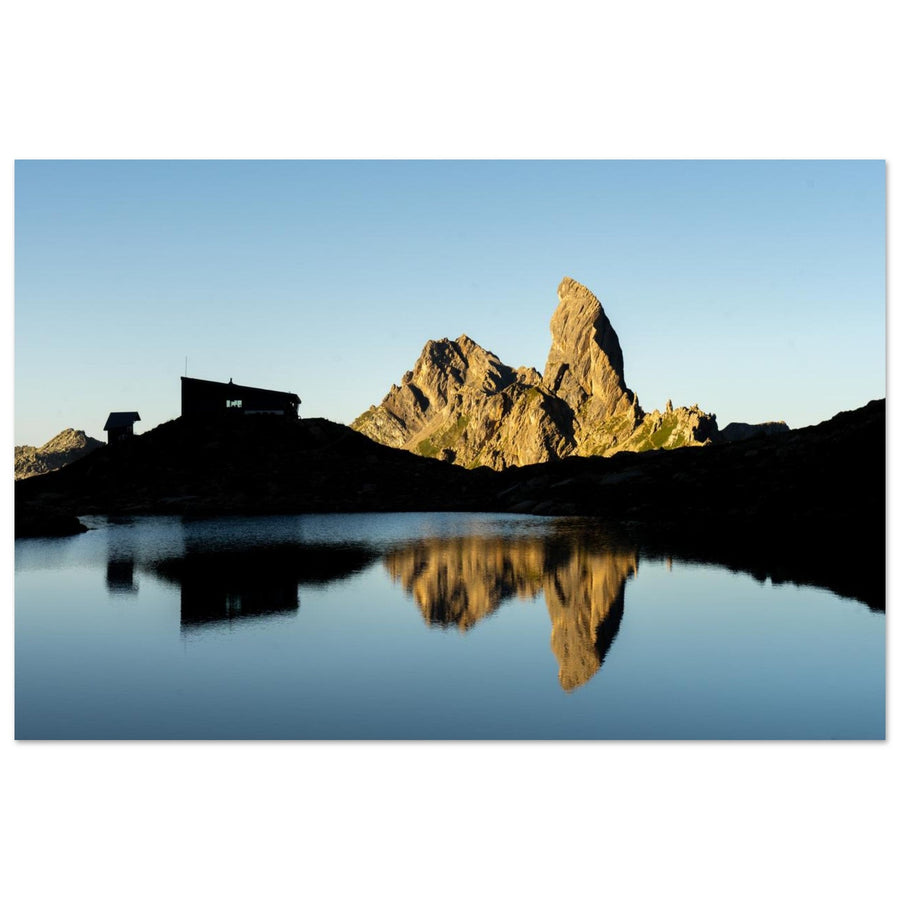
Lac de Presset et Pierra Menta au lever du jour, dans le Beaufortain.

Beaufortain | Photographing the Presset area

Presset operates as a three-tiered landscape: the lake, the refuge, and the Pierra Menta. Official sources gather them within the same site, and this is also what gives the area its photographic strength. One can let the water take center stage, use the refuge as a scale reference, or narrow the image around the Pierra Menta without leaving the same intention.

This coherence does not make photography automatic. The most obvious composition—lake in the foreground, refuge in the middle, Pierra Menta behind—can become repetitive if all elements always maintain the same weight. A series gains depth when each image assumes a clear hierarchy: water dominates, the building provides structure, or the relief becomes the true subject.

Presset also requires more serious preparation than a roadside viewpoint. The FFCAM documents several walking access points and clearly distinguishes between snow-free data and winter conditions. A night at the refuge can facilitate work at dawn or dusk, but it remains a logistical option subject to the refuge's terms and current conditions.

Header photo: Bel Cassandra — Lake Presset and Pierra Menta at sunrise.

The essentials in 30 seconds

  • A single system: lake, refuge, and Pierra Menta interact within the same basin.
  • Reference access: from Treicol, the FFCAM indicates approximately +750 m and 2h30 ascent when snow-free; two other official access points exist.
  • Lake: it doesn't need a perfect reflection; a shoreline, a strip of water, or a color break can suffice.
  • Refuge: it functions as a scale reference without needing to become the main subject.
  • Pierra Menta: it can gain more weight when the panorama is too busy or the lake no longer provides enough structure.
  • Winter: access regulations change; the FFCAM indicates avalanche-prone areas on winter routes.
  • Preparation: no universal time, season, or focal length is imposed; check actual conditions.

Understanding the Presset system

The Presset refuge is located at 2,514 meters according to the FFCAM. Official presentations of the refuge and the Tourist Office directly associate it with Lake Presset and the Pierra Menta. This geographical relationship invites viewing these three elements as a single landscape unit: understanding how they are organized within the basin is more useful than considering them separately.

The lake forms the lower level of the scene. It can occupy a large part of the frame, become a simple strip, or disappear entirely. The refuge introduces an immediately recognizable human presence. The Pierra Menta closes or dominates part of the horizon and gives the site its most identifiable mineral character.

The photographic interest precisely comes from the variation in these proportions. If the lake takes up a lot of space, it creates a strong depth between the shore and the relief. If the refuge becomes more prominent, it gives a measure to the landscape. If the Pierra Menta dominates, the Presset basin can be reduced to a few clues: a portion of water, the building, or a landline.

The first decision is therefore not "where to stand?", but "what should carry the image?". Moving around the site then helps achieve the right relationship between the three levels.

Choosing image hierarchy

Three main interpretations allow structuring a series without repeating the same photograph.

Interpretation Dominant element Role of other elements When to simplify
Dominant lake Shore, water, depth Refuge and Pierra Menta structure the background Reduce water if it becomes a directionless surface
Refuge as a scale Legible but secondary building Lake and relief provide context Slightly change position if the refuge blends with a slope
Dominant Pierra Menta Mineral relief A portion of water, the refuge, or the terrain is enough to maintain Presset's identity Tighten when the panorama or sky disperses the image

These interpretations are complementary, not mandatory. Two images with genuinely different hierarchies are often more valuable than a series of almost identical framings where only the viewpoint changes slightly.

Comparing official access points

The FFCAM documents three approaches to the refuge. The figures below concern snow-free conditions and serve only as preparation benchmarks.

Starting point FFCAM elevation gain FFCAM ascent time Key takeaway
Treicol +750 m Approx. 2h30 GR5, Col du Bresson sector then refuge; road access to be checked
Chapelle St Guérin +930 m Approx. 3h More significant elevation gain; route to be prepared separately
Cormet de Roselend +700 m Approx. 2h30 Seasonal road access to the pass to be checked before departure

From Treicol, the itinerary presented by Arêches-Beaufort joins the GR5, heads towards the Col du Bresson, then branches off towards the refuge. On the final approach, the refuge appears on a promontory; the lake then reveals itself behind it. This arrival is interesting for the photographer: the complete view of the basin is not given at once.

Official times and elevation gains never guarantee the actual duration. Pace, equipment weight, trail condition, weather, and snow cover can significantly alter the approach. Also, verify road access to the chosen starting point.

For an initial preparation of the area, Treicol provides a clear reference because the itinerary is explicitly described and naturally leads to the Col du Bresson before the Presset basin. This does not mean it is always the best choice: the decision depends on conditions and the desired route.

Photographing the lake without relying on a reflection

The lake immediately draws the eye, but it should not be treated as a constraint. A perfectly calm surface is never guaranteed, and a full reflection of the Pierra Menta is not necessary to obtain a structured photograph.

Start by observing the shoreline. A diagonal, a curve, or a change in texture can give direction to the foreground. If the surface becomes uniform or too prominent, reduce the water's presence rather than waiting for a symmetry that may not appear.

The lake can also play a more discreet role. A strip of water is sometimes enough to separate the nearby terrain from the refuge. In a tighter shot, a few meters of shoreline or a small colored area maintain the connection with the basin without pushing the Pierra Menta further away.

The classic pitfall is to assume that the water must always occupy the bottom third of every image. At Presset, the lake is a compositional tool among three strong elements. It gains interest when its surface has a clear function: depth, breathing room, contrast, or direction.

Using the refuge as a scale reference

The refuge is not just scenery added to the landscape. It is part of the site and immediately gives a human scale to the relief. This is a valuable quality when the Pierra Menta and the slopes appear abstract or difficult to measure within the frame.

In a wide composition, the building can remain small while playing an important role. It becomes an anchor point amidst the mineral masses and water. In a tighter framing, it can visually approach the relief and reinforce the contrast between architecture and mountain.

Superposition deserves particular attention. If the refuge's silhouette merges with a slope or exactly touches an important line of the Pierra Menta, the image may lose legibility. A small shift can be enough to create a sharper separation.

The place remains a mountain refuge. Shots must respect occupants, circulation, and the building's operation. A photograph does not justify blocking access, setting up equipment in a passageway, or transforming the surroundings into a private set.

Giving more weight to the Pierra Menta

Pierra Menta gives the site its most recognizable mineral shape. It can become dominant while keeping the Presset basin identifiable, provided an indication of the site is maintained: refuge, shoreline, water, or nearby terrain.

A tighter crop is particularly useful when the panorama becomes too busy. By removing part of the sky, the lake, or the foreground, the relationship between the refuge and the rock becomes more direct. A telephoto lens can help visually bring the planes closer; its main interest is to simplify, not to seek magnification for its own sake.

Conversely, a wide view remains relevant when the basin, shoreline, and relief form a clear progression. The goal is not to systematically favor wide-angle or telephoto, but to choose the scale that gives the main element the right weight.

Pierra Menta is also a mountaineering and climbing objective documented by the FFCAM. This guide deals with its presence in the Presset landscape; it does not describe its ascent and should not be read as an access route to the summit.

Dawn, dusk, and night on site

Presset does not have a "best time" valid for all compositions. Orientation, date, cloud cover, and relief significantly alter the light. A sunrise photograph shows a real condition at a given moment; it does not transform this condition into a general rule.

However, a night at the refuge can simplify logistics. It allows one to be already on site before dawn or after sunset without making the entire approach in the dark. This organization is particularly interesting if you want to work with several framing scales within the same light sequence.

The day before, identify at least two options: a wide view if the sky, lake, and relief work together, then a tighter solution if the panorama becomes flat, cloudy, or unclear. This preparation makes the outing more robust than relying on a single composition and a proclaimed ideal time.

Guarding periods, reservations, and reception arrangements change. Consult the current information directly from the refuge before organizing an overnight stay or bivouac.

Presset in winter: different access regulations

Winter transforms the image, but above all, the way to reach the site. The FFCAM specifies that winter access routes cross avalanche-prone areas. The times and elevations published for snow-free conditions are therefore not sufficient benchmarks for planning a trip in the snow.

Photographically, snow can simplify the basin's forms. The refuge stands out more clearly, and the relationship with Pierra Menta sometimes becomes more graphic. The lake may be less visible or no longer play the same role in the composition; the building and slopes then gain more prominence.

This visual simplification should never underestimate the terrain. Local information, the avalanche risk assessment bulletin, appropriate skills, and equipment take precedence over any photographic objective. This guide is not a winter travel guide.

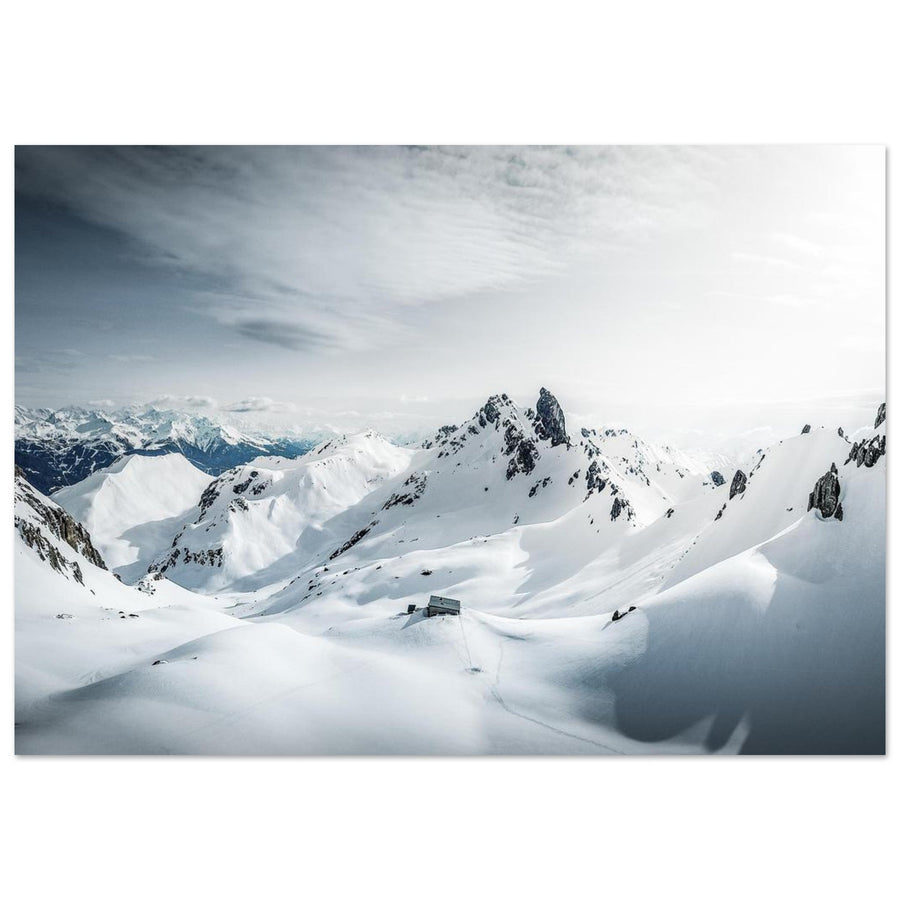
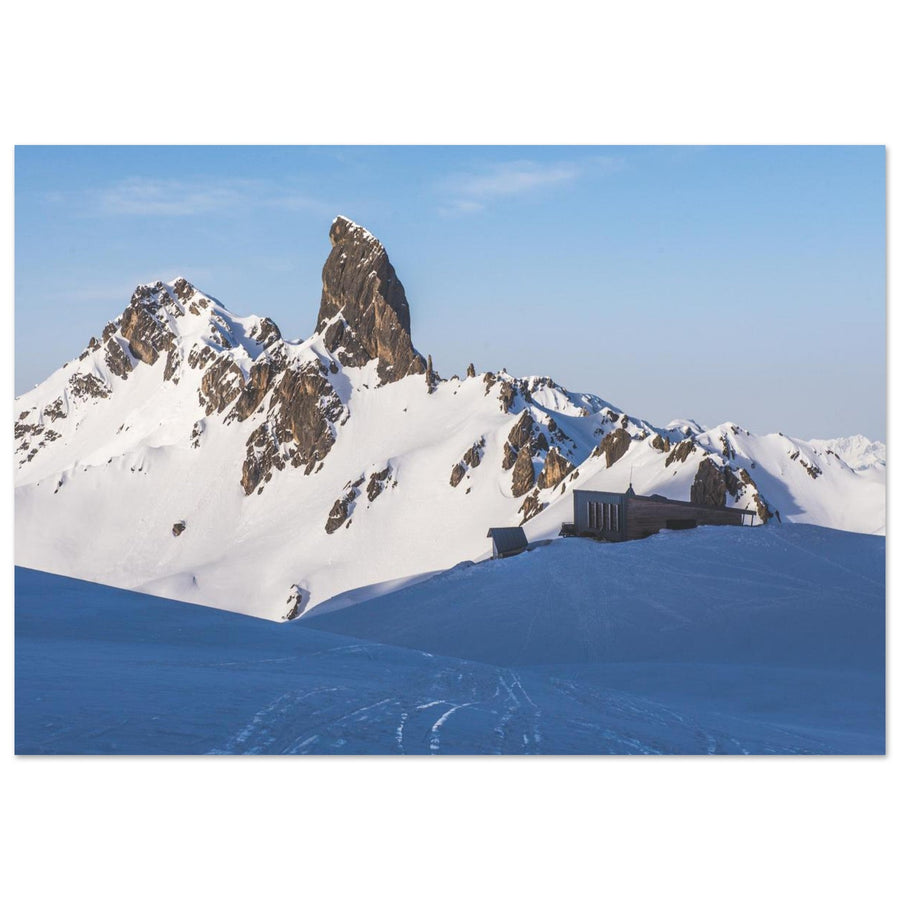
Tableau photo de la Pierra Menta et du refuge de Presset en hiver dans le Beaufortain
Presset in winter

Pierra Menta and Presset Refuge

The refuge becomes a tiny landmark in the snow-covered valleys dominated by Pierra Menta, without requiring the lake to carry the foreground.

Photography: Pierre Thiaville

Discover the Pierra Menta and Presset Refuge print

Wide-angle, standard or telephoto

  • Wide-angle: when the shoreline, water, or nearby terrain genuinely add depth. If the foreground has no function, widening simply reduces the size of the refuge and Pierra Menta.
  • Standard framing: to balance the three levels without exaggerating the foreground. It is suitable when the lake, refuge, and relief must remain simultaneously legible.
  • Telephoto: to simplify a busy scene, visually bring the refuge closer to Pierra Menta, and significantly reduce the lake's prominence.

Regardless of the framing, keep an eye on the edges. An unintentionally cut shoreline, a refuge blending into a slope, or an unnecessary portion of water can be enough to weaken an otherwise solid photograph.

Access, pastoralism, refuge, and drone

The route from Treicol crosses alpine pastures. Stay on the marked trails, respect fences, herds, and local customs. The search for a foreground does not justify leaving a path or interfering with pastoral activity.

Refuge arrangements vary seasonally. For an overnight stay, bivouac, or the presence of an animal, verify the current rules directly with the refuge and relevant authorities. A factsheet or old page should not be treated as a permanent rule.

In winter, the FFCAM warning about avalanche zones must be treated as a change in regime: do not transpose a summer program to snow conditions.

For drones, no general authorization should be assumed. Verify the exact area, temporary restrictions, presence of people, wildlife, and local rules on official tools before each flight.

Practical sources to check before your trip

Mistakes that diminish a series at Presset

  • Giving the same weight to all three elements: if the lake, refuge, and Pierra Menta compete for attention, choose a dominant one.
  • Waiting for a perfect reflection: the lake can structure the frame without becoming a mirror.
  • Confusing wide view with depth: a wide-angle can simply push the subject further away if the foreground doesn't serve the composition.
  • Reducing the refuge to a mere backdrop: the building is a place of welcome and passage, with its uses and occupants.
  • Presenting dawn as a guarantee: interesting light depends on real conditions and the viewpoint.
  • Treat winter as an aesthetic variant: risk and access change even before composition.
  • Transform Pierra Menta into a hiking route: its presence in the landscape does not indicate access to the summit.

Frequently Asked Questions about Photography at Presset

How to get to Presset refuge from Treicol?

The FFCAM indicates, without snow cover, approximately 750 meters of positive elevation gain and 2h30 of ascent from Treicol. The route joins the Col du Bresson area before branching off towards the refuge. Check road access, trail conditions, and weather before departure.

What are the other official accesses to Presset?

The FFCAM also documents accesses from La Chapelle St Guérin and Cormet de Roselend. Without snow cover, it indicates approximately +930 m / 3 h and +700 m / 2 h 30 respectively. These benchmarks do not make the routes interchangeable: their terrain and access must be prepared separately.

Do I need to sleep at the refuge to photograph at dawn or dusk?

No. An overnight stay mainly simplifies logistics if you want to be present before daybreak or after sunset without making the entire approach in the dark. Check the current booking and warden arrangements.

Can Presset be photographed without reflection on the lake?

Yes. A bank, a strip of water, the refuge, or a terrain line can be enough to build depth. A full reflection is neither guaranteed nor necessary.

Which focal length to use at Presset?

No specific range is imposed. A wide frame retains more of the lake and terrain; a standard frame balances the three levels; a telephoto lens simplifies the scene and can reinforce the Pierra Menta or the refuge.

Can Presset be photographed in winter?

Yes, but access changes in nature. The FFCAM indicates that winter routes cross avalanche-prone areas. Conditions, risk bulletins, appropriate skills and equipment must be assessed before any outing.

Can a drone be flown at Presset?

No general authorization should be assumed. Check the exact area, temporary restrictions, and applicable rules at the time of flight.

Continue exploring the Beaufortain

To place Presset among the other landscapes of the massif, consult the guide: What to photograph in the Beaufortain? →

To discover the landscapes currently offered in the gallery, see Beaufortain photo prints on matte Dibond aluminum →

About the Author

Pierre Thiaville has been photographing mountains since 2017. He is the founder of AluArtMountains, a gallery specializing in Alpine landscapes and mountain photography, founded in 2024.

Through these guides, he shares an approach centered on reading the landscape, light, composition, and preparing for outings.

Discover Pierre Thiaville and his journey →