

Where to photograph La Grande Casse from Courchevel, Saulire and Dent de Burgin?
Updated July 23, 2026
Photographing the Grande Casse from Courchevel, La Saulire, and Dent de Burgin reveals a very different facet of Vanoise. After the wilder itineraries of Pralognan, La Valette, or Aussois, this area offers a higher, more wintry, and more graphic perspective: high-altitude resorts, sculpted ridges, snow, ski lift lines, distant peaks, Aiguille du Fruit, and a panorama of the Vanoise mountains.
This page is a detailed photo guide to prepare for an outing around Courchevel, La Saulire, Dent de Burgin, and Aiguille du Fruit. The goal is not to create a ski guide, but to understand how to photograph this area: where to find the best viewpoints of the Grande Casse, how to use ridges as compositional lines, when to favor winter light, and how to prevent resort elements from dominating the image.
From Courchevel, the challenge is to preserve the power of the landscape without letting infrastructure take over. The most compelling images rely on simple ridges, well-shaped snow, and a clearly identifiable Grande Casse. This more contemporary interpretation of Vanoise continues in our collection of Vanoise photo prints, printed on matte Dibond aluminium.

The Essentials in 30 Seconds
- Best main subject: the Grande Casse viewed from the heights of Courchevel.
- Best secondary subjects: La Saulire, Dent de Burgin, Aiguille du Fruit, the ridges, and the Avals valley. Best atmosphere: winter, fresh snow, low-angle light, clear sky after disturbance, or sea of clouds.
- Best atmosphere: winter, fresh snow, raking light, clear skies after a weather front, or a sea of clouds.
- Best light: cold morning, late afternoon, side light on the ridges.
- Useful focal length: 24–70 mm for wide views, 70–200 mm to isolate the Grande Casse, La Saulire, and the ridges.
- Key tip: use ridge lines and snow to compose the image, without letting infrastructure dominate the composition.
Explore Photo Guides Around Vanoise
This guide is part of the Vanoise mini-cluster. The pillar page presents the major sectors of the massif, while detailed guides help prepare each photo outing with a more precise angle.
Table of Contents
- Why photograph the Grande Casse from Courchevel?
- Practical summary of the photo outing
- Access from Courchevel, Saulire and Dent de Burgin
- Photographing the Grande Casse from Courchevel
- Photographing La Saulire
- Photographing Dent de Burgin and Croix des Verdons
- Photographing Aiguille du Fruit and the Avals valley
- Photographing snow and winter ridges
- Best times for light
- Ideas for photo compositions
- Recommended photo equipment
- Regulations and safety
- Photo prints related to Courchevel and Vanoise
- FAQ
Why photograph the Grande Casse from Courchevel?
Courchevel offers a very different perspective on the Vanoise. From the heights of the resort, the Grande Casse appears in a more distant, panoramic, and wintry light than from Pralognan. It becomes a powerful background peak, often surrounded by snow, clouds, ridges, and ski lift lines.
Photographically, this area is interesting because it allows you to play with successive planes: foreground resort, ridge, ski lift, sea of clouds, distant peak. If the composition is well-controlled, the image tells a story of altitude, winter, Vanoise, and the Courchevel universe all at once.
The risk is to produce an overly documentary resort image. To avoid this, you need a clear intention: isolate the Grande Casse, use the ridges as diagonals, subtly integrate ski lifts as a scale, or conversely, compose a purer image around snow and peaks.
Practical summary of the photo outing
| Sector | Photo interest | Best light | Useful focal lengths | To prioritize |
|---|---|---|---|---|
| Courchevel / high points | Grande Casse, resort, snow, Vanoise mountains | Clear morning, late afternoon, after disturbance | 24–70 mm, 70–200 mm | Compression, resort + peak reading |
| Saulire | Limestone ridges, snow, panorama, mineral lines | Side light, winter, clear sky | 24–70 mm, 70–200 mm | Ridges, volumes, sculpted terrain |
| Dent de Burgin / Croix des Verdons | Arêtes, silhouettes, high mountain atmosphere | Morning, late afternoon, soft backlighting | 70–200 mm | Silhouettes, ridge lines, rocky details |
| Aiguille du Fruit | Graphic peak, Avals valley, wild atmosphere | Low-angle light, winter, late afternoon | 24–70 mm, 70–200 mm | More natural interpretation of Vanoise |
| Avals Valley | Alpine pastures, wild valley, Vanoise entrance | Morning, autumn, changing sky | 24–70 mm | Softer, less resort-like atmosphere |
Access from Courchevel, Saulire and Dent de Burgin
Access largely depends on the season. In winter, some viewpoints are tied to the ski area, slopes, lifts, and snow conditions. In summer, hiking trails around La Saulire, Col du Fruit, Croix des Verdons, and the Avals valley offer a more pedestrian and natural approach.
The Saulire sector provides access to very wide views of Courchevel, Méribel, and the Vanoise mountains. The Arête de la Saulire — Col du Fruit itinerary, in particular, allows you to experience a high-mountain atmosphere and wild landscapes at the gates of the Vanoise National Park.
Dent de Burgin / Croix des Verdons requires more caution: the area is rocky, airy, and some itineraries are via ferrata. For a photo approach, it's therefore necessary to distinguish between viewpoints accessible without technical commitment and areas that require proper equipment and adapted experience.
Useful official links before your outing
Photographing the Grande Casse from Courchevel
From Courchevel, the Grande Casse is often a background subject. It is not photographed as it is from Pralognan, where it sometimes fills the entire landscape. Here, it needs to be given presence by playing with compression, intermediate ridges, ski lifts, clouds, and snow.
A telephoto lens is particularly useful. At 70–200 mm, you can visually bring the peak closer, isolate the arêtes, and prevent the Grande Casse from appearing too distant. Resort elements can then serve as a scale rather than visual pollution.
Photo tips for the Grande Casse from Courchevel
- Use a long focal length to give the peak more presence.
- Wait for clearings after disturbances: low clouds and fresh snow enhance depth.
- Integrate the resort sparingly to provide scale without dominating the scene.
- Prefer simple skies: too much detail weakens the readability of the peak.
- In winter, look for contrasts between slopes, dark ridges, and snow-covered peaks.
Photographing La Saulire
La Saulire is one of the most graphic subjects in the Courchevel area. Its arêtes, couloirs, windslab snow areas, and limestone volumes offer a very clear interpretation of the mountain. It's a strong subject if you like structured, cold, mineral, and contemporary images.
The challenge is not to produce a mere photo of a peak. You need to look for lines: main ridge, couloir, shadow on snow, secondary arête, contrast between rock and sky. In winter, snow simplifies the forms and makes La Saulire more readable.

Photo tips for La Saulire
- Favor side lighting to reveal volumes.
- Use a medium or long focal length to simplify the composition.
- Avoid overly wide shots if infrastructure becomes too visible.
- On snow, expose precisely to retain detail in highlights.
- Under an overcast sky, look for the graphic lines rather than color.
Photographing Dent de Burgin and Croix des Verdons
Dent de Burgin and Croix des Verdons lend a more airy atmosphere to the area. We leave the "resort" interpretation to enter a world of ridges, arêtes, rocks, and silhouettes. The area can be spectacular, but it also requires caution: some sections are via ferrata and should not be approached as a simple photo walk.
Photographically, Dent de Burgin works very well in detail: dark arêtes, wind-blown snow, couloirs, cut-out forms. A telephoto lens transforms the peak into a graphic subject rather than an element lost in a panorama.
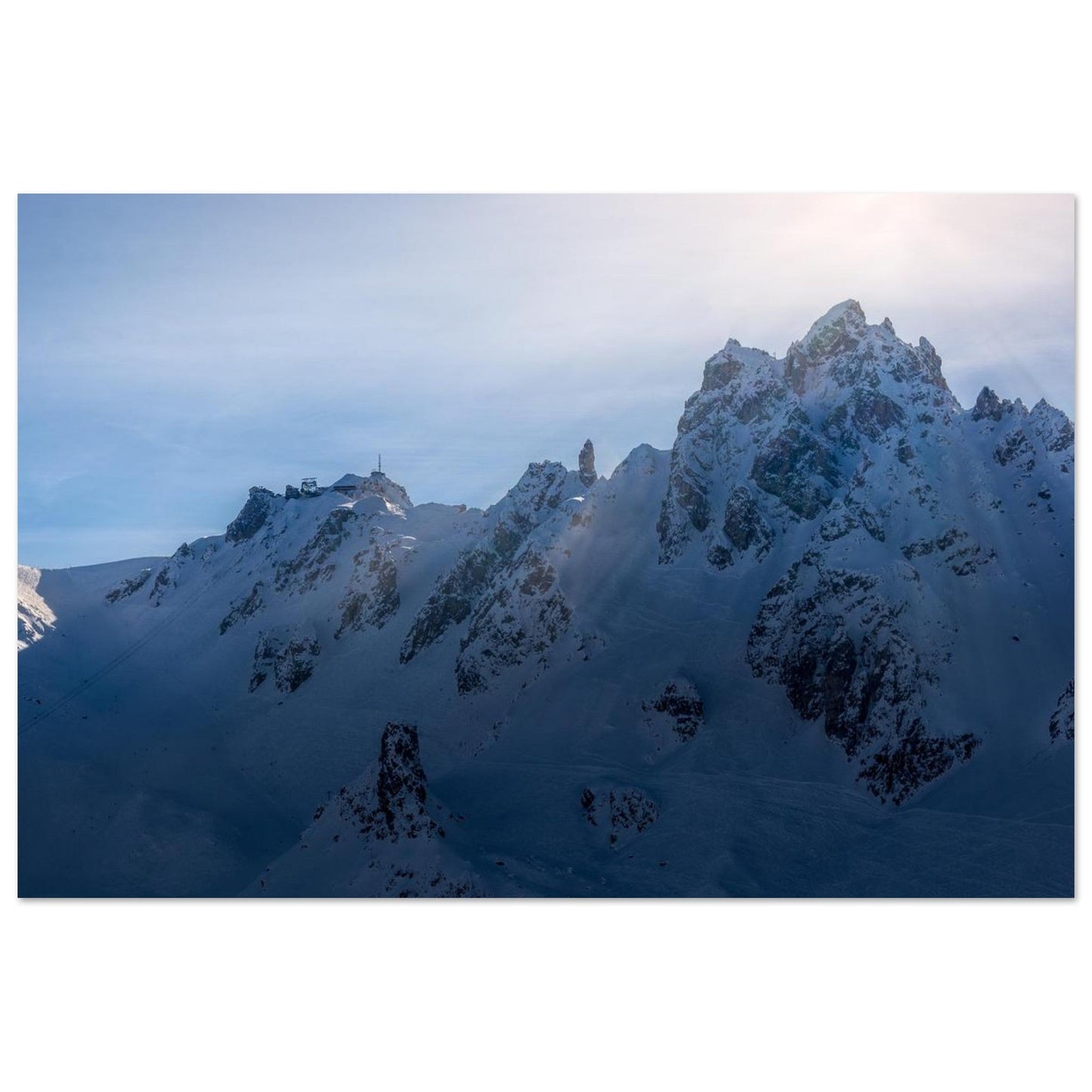
Photo tips for Dent de Burgin
- Work with a telephoto lens to isolate arêtes and couloirs.
- Look for ridge silhouettes rather than overly descriptive views.
- In soft backlighting, exploit rocky contours and snow projections.
- Avoid exposed areas if weather or snow conditions are not safe.
- If photographing near an equipped route, never obstruct other users.
Photographing Aiguille du Fruit and the Avals valley
Aiguille du Fruit brings a wilder dimension to this N4. It connects Courchevel to a more natural interpretation of the Vanoise: Avals valley, Col du Fruit, Lacs Merlet, limestone terrain, alpine pastures, and high valley atmosphere.
This is a good subject to prevent the page from being too "resort-focused." With Aiguille du Fruit, we find a more raw, mineral mountain, closer to the spirit of photo hiking. The area works well in low-angle light, when slabs and arêtes gain relief.

Photo tips around Aiguille du Fruit
- Use the limestone lines as the main structure.
- Work in low-angle light to reveal textures.
- Keep the composition simple: peak, snow, ridges, sky.
- In black and white, the area can become very graphic.
- Avoid mixing too many peaks: Aiguille du Fruit should remain clear.
Photographing snow and winter ridges
The Courchevel / Saulire / Dent de Burgin area is particularly stunning in winter. Snow simplifies forms, conceals some details, and transforms ridges into very clear lines. This also makes the images more suitable for premium wall decor: few elements, lots of air, a cold palette, and clear volumes.
The risk, however, is to produce an image that is too white or too harsh. You need to monitor exposure, avoid flat areas without relief, and wait for side light to reveal the volumes of snow.
Winter photo tips
- Expose to retain detail in the snow.
- Wait for side shadows to give relief to the slopes.
- Use tracks, slopes, or ridges as lines of reading.
- Avoid framing with too many technical elements if the goal is a decorative image.
- After a snowfall, look for clean ridges before the landscape becomes too marked.
Best times to photograph Courchevel, La Saulire, and Grande Casse
Winter morning
Morning is often excellent after a cold night or snowfall. Shadows remain long, ridges are sharp, and the Grande Casse can stand out in clear light. It's a good time for sober, alpine images.
Late afternoon
Late afternoon is very interesting for the Grande Casse, La Saulire, and Dent de Burgin. The last light can highlight the arêtes, warm the peaks, and create a more premium, almost cinematic atmosphere.
After disturbance
After a disturbance, residual clouds, breaks in the light, and fresh snow can create the best conditions. It is often at this time that the Vanoise takes on the most relief from Courchevel.
Summer and autumn
In summer and autumn, the interest shifts more towards hiking, the Avals valley, Aiguille du Fruit, the ridges, and the contrasts between alpine pastures and rock. The resort is less snowy, so you have to compose with more texture and more details.
Ideas for photo compositions
1. Grande Casse + resort as scale
Use resort elements sparingly: they can provide scale, but should not become the main subject.
2. Saulire Ridge Diagonally
Use the ridge as a leading line. The snow and rock create a natural path towards the summit.
3. Dent de Burgin with a Telephoto Lens
A tight frame isolates the ridges and transforms the Dent de Burgin into a graphic subject.
4. Aiguille du Fruit as a Wild Subject
For a less "resort" image, use the Aiguille du Fruit and the Avals valley as a gateway to a more natural Vanoise.
5. Grande Casse with Compression
With a long focal length, visually bring the Grande Casse closer to the mid-ground. This is one of the keys to giving it presence from Courchevel.
6. Minimalist Snow
On clear days or in soft light, reduce the elements: snow, ridge, summit, sky. The simpler the image, the more elegant it can become as a wall print.
What photo equipment should you bring?
- 24–70 mm: Versatile for resort views, ridges, slopes, relief, and wide compositions.
- 70–200 mm: Essential for isolating the Grande Casse, the Saulire, the Dent de Burgin, and the Aiguille du Fruit.
- Wide-angle: Useful for very wide views, but use with caution to avoid making the summits appear too small.
- Polarizing filter: Useful with caution at altitude, especially on snow and blue sky.
- Weather protection: Important in winter, with wind, cold, and snow.
- Extra batteries: Necessary in cold temperatures.
- Microfiber cloth: Useful for snow, fog, splashes, and condensation. Appropriate mountain equipment: Depending on the season, access, skiing, hiking, snow, and conditions.
- Suitable mountain equipment: according to the season, access, skiing or hiking conditions, snow, and terrain.
Regulations and safety
The Courchevel / Saulire / Dent de Burgin area may seem accessible due to lifts and infrastructure, but it remains a mountain environment. In winter, snow conditions, cold, wind, piste areas, and off-piste sectors require caution. In summer, ridge routes and via ferratas require appropriate equipment and experience.
Before you go, check official information: lift openings, weather, snow conditions, authorized routes, trail conditions, Vanoise National Park regulations, protected areas, and any drone restrictions.
The right photo reflex: never block a slope, a lift, a ridge, or an equipped route to take a picture. A good composition is not worth a dangerous situation or inconvenience for other users.
Photo prints related to Courchevel, La Grande Casse and Vanoise
This area is very strong for wall decoration because it combines premium alpine aesthetics with powerful subjects: Grande Casse, Courchevel, Saulire, Dent de Burgin, Aiguille du Fruit, snow, ridges and winter light. The photographs below directly extend the atmosphere of this outing.
See in the gallery
- Photo of La Saulire & Dent de Burgin — Courchevel, Savoie — the most directly related image to this page, with high-altitude resort, snow and major Vanoise summit.
- Photo of La Saulire and Dent de Burgin, Courchevel — a graphic scene of ridges, snow and relief of the 3 Valleys.
- Photo of La Saulire & Dent de Burgin — Courchevel, Savoie — perfect for a mineral and contemporary reading of the mountain.
- Photo of Aiguille du Fruit, Vanoise Park — for a wilder atmosphere on the Avals valley side.
- Photo of a sunset over La Grande Casse and the Vanoise refuge — a warmer, more alpine vision of the iconic summit.
You can also explore:
- Vanoise photo prints
- Courchevel photo prints
- mountain snow photo prints
- mountain sunset photo prints
- Alpine landscape photo prints for chalets
- the gallery selection
Continue your exploration of the Vanoise
To prepare for other photo outings in the massif, you can continue with the other guides of the Vanoise mini-cluster:
- Where to photograph the Vanoise? Photo spots and field tips
- Where to photograph Lac des Vaches, Col, and Vanoise Refuge?
- Where to photograph the Valette Refuge and the Grand Marchet?
- Where to photograph the Dent Parrachée from Aussois and Plan d'Amont?
FAQ — Photographing the Grande Casse from Courchevel
Where to photograph the Grande Casse from Courchevel?
The heights of Courchevel, La Saulire and the areas near the ridges offer good viewpoints towards the Grande Casse. The interest is to compose with the snow, the ridges, the middle grounds and sometimes the resort elements.
Is La Saulire interesting for photography?
Yes. La Saulire is very interesting for its ridges, couloirs, limestone volumes and its graphic appearance in winter. It works particularly well in side light or with fresh snow.
How to photograph the Dent de Burgin?
The Dent de Burgin photographs well with a telephoto lens, isolating the ridges, couloirs and ridge silhouettes. Caution is advised, as some routes in the area involve via ferrata or an exposed environment.
What focal length to use to photograph the Grande Casse from Courchevel?
A 70–200 mm lens is very useful to give the Grande Casse presence. A 24–70 mm lens allows for a broader view including the resort, snow, ridges and Vanoise relief.
What is the best time to photograph this area?
Winter mornings, late afternoons, and periods after bad weather are often the most interesting. Fresh snow, residual clouds, and side light enhance the volumes.
Can you photograph the Aiguille du Fruit from Courchevel?
Yes. The Aiguille du Fruit can be photographed from the Courchevel side, particularly in the context of the Avals valley, Col du Fruit, and areas close to the Vanoise National Park.
Does this page also concern Méribel?
Indirectly yes, because La Saulire and Dent de Burgin are located between the Courchevel and Méribel sectors. But the main focus of this page remains photography from Courchevel and the high points of Vanoise.
Should resort infrastructure be avoided in compositions?
Not necessarily. Infrastructure can provide scale and tell the story of Courchevel, but it should remain secondary if the goal is an elegant and timeless mountain image.