Où photographier le Refuge de la Valette et le Grand Marchet ? - Tableaux photo Alpes | Alu Art Mountains

Where to photograph the Valette Refuge and Grand Marchet?

Updated July 8, 2026

The Refuges de la Valette and Grand Marchet reveal another side of the Vanoise. Following the more iconic excursion to Lac des Vaches and Col de la Vanoise, this area above Pralognan-la-Vanoise offers a more intimate, wilder, and often more graphic ambiance: high-altitude chalets, snow, pristine slopes, dark ridges, cold light, changing skies, and powerful relief around the Grand Marchet.

This page is a detailed photo guide to prepare for an outing around the Refuges de la Valette, Grand Marchet, and the peaks overlooking Pralognan. The goal is not just to reach a refuge, but to understand how to photograph this area: which light to prioritize, how to compose with the chalets, when to use black and white, how to work with snow, and how to integrate Grand Marchet or Grande Casse into a legible image.

As a mountain photographer since 2017, I find this area particularly interesting because it allows for less obvious images than the major classic spots of the Vanoise. Here, strength often comes from simplicity: an isolated refuge in the snow, a dark ridge, a storm erasing the scenery, golden light on cold slopes. You can find some of this work in my collection of Vanoise photo prints, printed on Dibond aluminum.

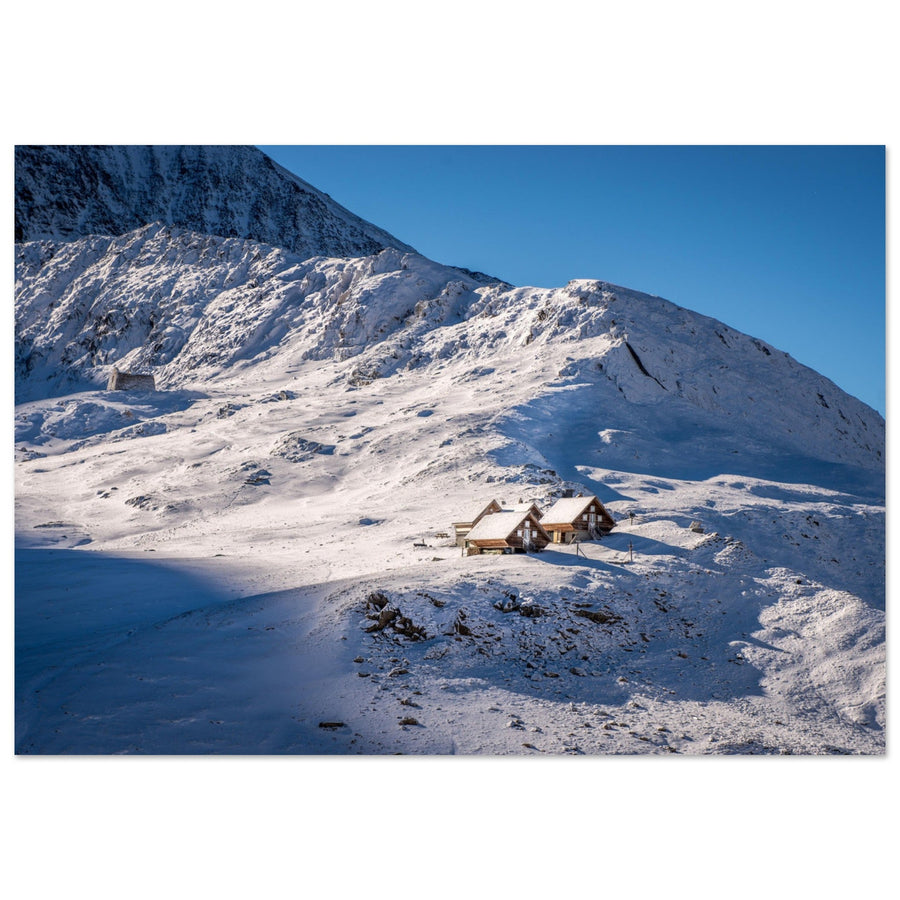
Sunrise over the snow-covered Refuges de la Valette in the Vanoise massif
The Refuges de la Valette work very well in photos when snow simplifies the landscape: high-altitude chalets, luminous slopes, and cold ridges create a clear, alpine composition.

The Essentials in 30 Seconds

  • Best primary subject: the Refuges de la Valette, especially under snow or in raking light.
  • Best secondary subject: the Grand Marchet, for its ridges, volumes, and dark silhouettes.
  • Best atmosphere: winter, fresh snow, storm, fog, sunrise, or end of day.
  • Best light: side light, bright overcast sky, golden hour, and blue hour.
  • Useful focal length: 24–70 mm for the refuge, 70–200 mm to isolate ridges and compress relief.
  • Key tip: this area works very well with simple, minimalist compositions and sometimes in black and white.

Table of Contents

Why photograph the Refuges de la Valette?

The Refuges de la Valette are interesting because they do not function as a simple hiking destination. Visually, they are three high-altitude chalets nestled in an open landscape, with slopes, ridges, and valleys that allow for the creation of a true mountain image.

In summer, the area can offer a very alpine perspective: grasses, relief, chalets, ridges, and depth towards Pralognan. In winter or under snow, it becomes much more graphic. Details disappear, lines simplify, the refuges become the focal point, and the mountain transforms into a minimalist setting.

It is this ability to change atmosphere that makes La Valette powerful for photography. The same place can produce a soft image at sunrise, dramatic during a storm, very minimalist in black and white, or more panoramic with Grand Marchet in the background.

Practical summary of the photo outing

Area Photo interest Best light Useful focal lengths To prioritize
Refuges de la Valette High-altitude architecture, snow, chalets, focal point Sunrise, blue hour, diffuse light 24–70 mm, 70–200 mm Simple and legible compositions
Slopes around the refuge Snow, curves, shadows, softened relief Morning, overcast sky, snowstorm 24–70 mm, 70–200 mm Minimalism and textures
Grand Marchet Ridges, dark volumes, silhouettes, sunset End of day, bright cloudy sky 70–200 mm Compression, ridges, layers of planes
Grande Casse / Pointe du Grand Marchet Iconic peaks, depth, limestone lines Golden light, side light 24–70 mm, 70–200 mm Panoramas and broad alpine reading
Return towards Pralognan Valleys, forests, hamlets, layers of relief End of day, autumn 24–70 mm Descent atmosphere and depth

Access from Pralognan-la-Vanoise

The Refuges de la Valette are located above Pralognan-la-Vanoise. Access requires more commitment than the very accessible viewpoints of the massif: it is a real mountain outing, with significant elevation gain, steep sections, and conditions that need to be seriously checked depending on the season.

The classic itinerary reaches the La Valette area from Pralognan, with a gradual ascent towards Pas de l’Âne then the Tambour pass before reaching the refuge. The return can be made via the Bévériers trail and the hamlet of Les Prioux depending on the chosen route.

The area can also be integrated into a broader approach around the Grand Marchet, with wilder and more alpine sections. For a photographer, this means anticipating: departure time, desired light, weather, fatigue on the return, residual snow, and safety on delicate passages.

Useful official links before the outing

Photographing the Refuges de la Valette

The refuges are the central subject of this outing. Their strength comes from their simplicity: a few wooden chalets, a slope, a ridge behind, sometimes snow or wind. These are very legible elements that work well in photography because they provide a human scale to a mountain setting.

The most important thing is not to photograph them as a mere postcard of a refuge. Look for a structure: a chalet as a focal point, a diagonal slope, a shaded area, a ridge in the background, a sky that creates an ambiance. The simpler the image, the more likely it is to hold up in a large format.

Photo tips around the refuges

  • Keep space around the chalets to show their isolation.
  • Use snowy slopes as leading lines.
  • In harsh light, prioritize graphic compositions or black and white.
  • If the sky is empty, reduce its prominence and give more importance to the relief.
  • Wait for a break in the light to separate the refuge from the background.
  • Avoid over-complicating the image: refuge, slope, ridge, and sky are often enough.
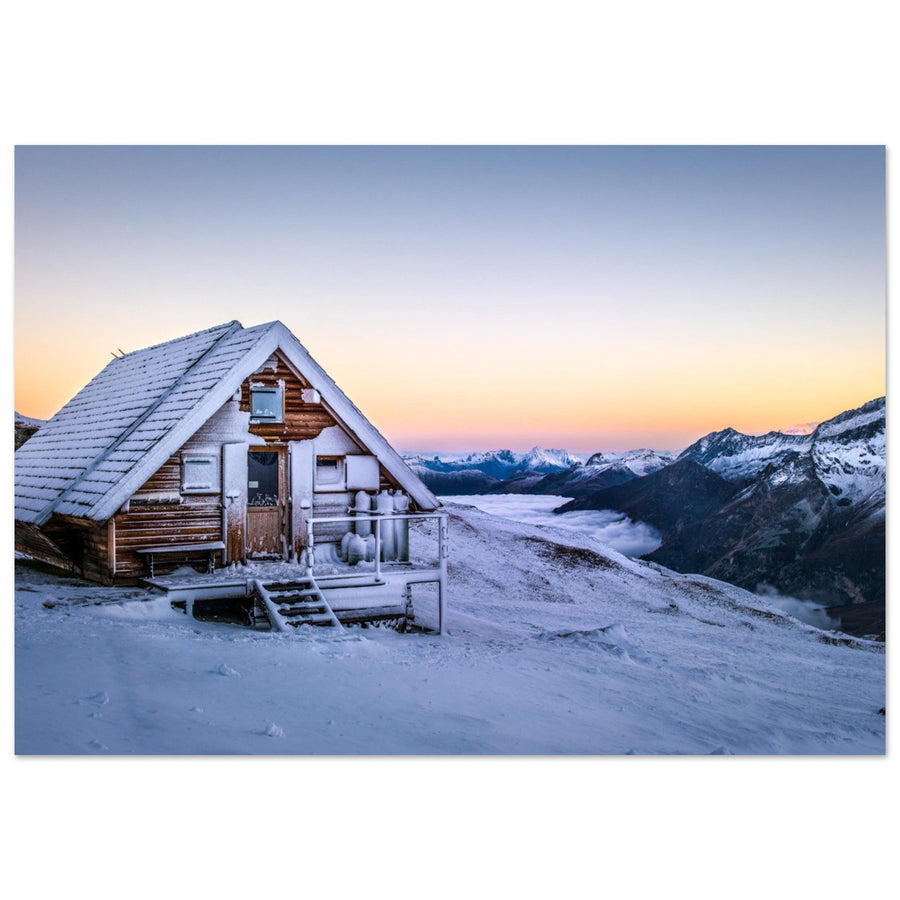
Sunrise over the Refuges de la Valette above Pralognan-la-Vanoise
This image depicts the Refuges de la Valette area: snow, high-altitude chalets, cold light, and a very alpine reading of the landscape.

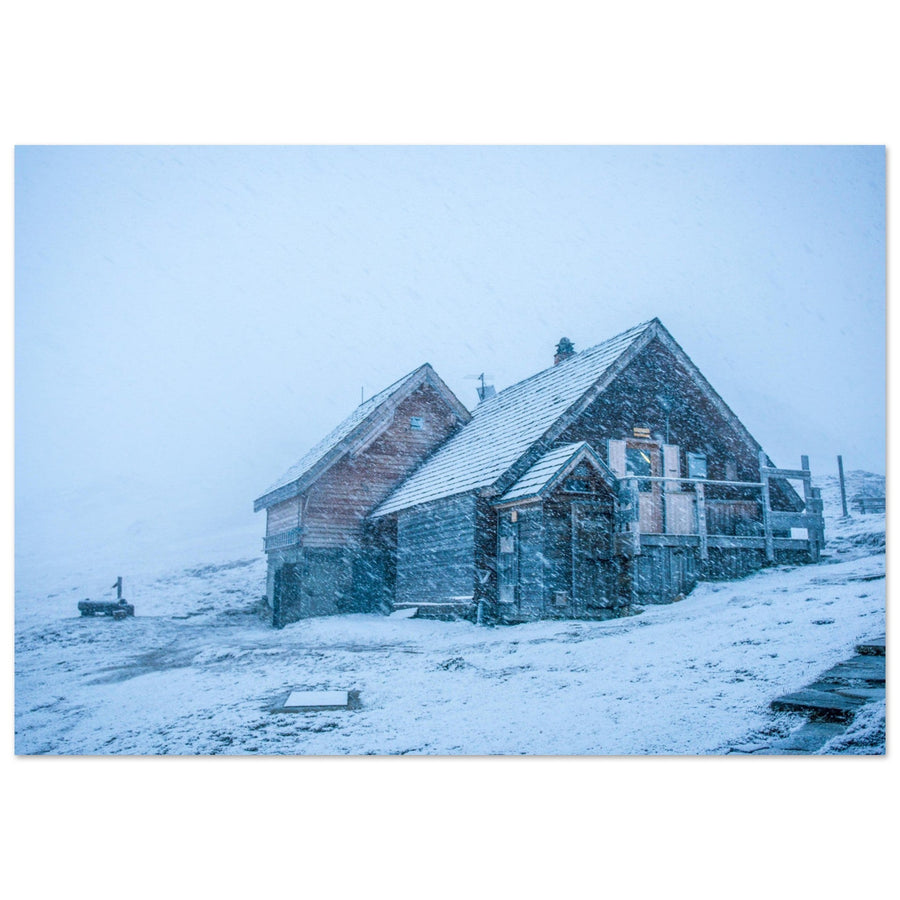
Photographing snow and storms around La Valette

La Valette becomes particularly interesting when snow simplifies the scenery. Details disappear, contrasts are reduced, and the refuge becomes a clear anchor point. In stormy or foggy conditions, the image can become very minimalist: a clear mass, a chalet, a few lines, almost nothing more.

This is an area where you shouldn't necessarily seek a blue sky. Imperfect weather can be more powerful: blowing snow, reduced visibility, erased ridges, cold colors, flat but very soft light. This type of ambiance lends itself well to sober and elegant wall prints.

Refuge de la Valette in a snowstorm in the Vanoise National Park
Under snow, the refuge becomes a minimalist subject: few elements, a cold atmosphere, and a very graphic reading of the mountain.

Photo tips in snow or storm

  • Protect your camera and batteries from cold and humidity.
  • Monitor exposure: snow can easily become gray or overexposed.
  • Use the chalets as a focal point to avoid an overly empty image.
  • Accept low contrasts: the ambiance comes precisely from the softness.
  • Don't try to show everything: a very simple image can be more powerful.

When to choose black and white?

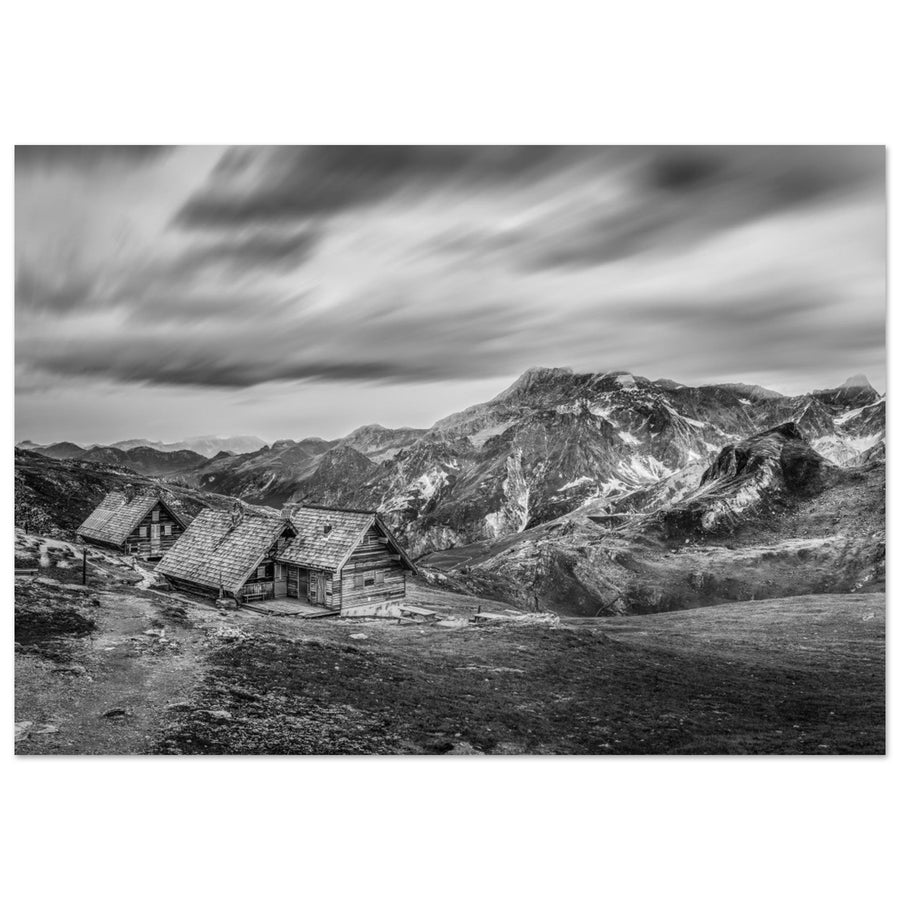
Black and white works very well around the Refuges de la Valette because the area offers simple shapes: chalets, slopes, ridges, clouds, snow, rocks. When color doesn't add much, monochrome can enhance lines, volumes, and the feeling of isolation.

This is particularly true under overcast skies, harsh light, snow, or foggy conditions. Black and white avoids the dull effect of weak color and transforms the scene into a more graphic, timeless image.

Refuges de la Valette in black and white in the Vanoise massif
Black and white highlights the refuges, slope lines, and ridges: a more graphic approach, very suitable for this area of the Vanoise.

Tips for a successful black and white image

  • First look for lines and contrasts, not colors.
  • Expose to retain detail in the snow and clouds.
  • Maintain a strong focal point: refuge, ridge, silhouette, or slope.
  • Avoid overly flat scenes without graphic structure.
  • Work with textures: wood, snow, rocks, clouds, and high-altitude grasses.

Photographing the Grand Marchet

The Grand Marchet offers another interpretation of the area: more mineral, darker, more structured by the ridges. It works well when light carves out the relief, especially late in the day or under a cloudy sky that allows luminous areas to pass through.

To photograph it, a telephoto lens is often more effective than a wide-angle. A long focal length allows simplifying the scene, isolating the ridges, and compressing the planes. The Grand Marchet then becomes a graphic mass in the landscape, rather than a simple peak lost in an overly wide view.

Photo tips for the Grand Marchet

  • Prioritize side light or late afternoon light.
  • Use a 70–200 mm lens to isolate ridges and couloirs.
  • Compose with layers of relief to create depth.
  • With a colorful sky, reduce the foreground and let the atmosphere breathe.
  • In winter, utilize dark silhouettes against the snow.
Sunset over the Grand Marchet and Vanoise peaks from Pralognan-la-Vanoise
The Grand Marchet works very well at sunset: dark ridges, colorful sky, and successive reliefs create a deep and legible image.

Photographing the Grande Casse and Pointe du Grand Marchet

From certain points in the area, the Grande Casse and Pointe du Grand Marchet can interact in the same image. This is an interesting angle because it connects two strong markers of the Vanoise: the emblematic peak of the massif and a more local, more graphic point above Pralognan.

This type of scene works very well with golden or side light, when ridges, couloirs, and limestone slabs stand out. The goal is to create a progressive reading: foreground, valley, point, peak, sky.

Grande Casse and Pointe du Grand Marchet above Pralognan-la-Vanoise
Grande Casse and Pointe du Grand Marchet: a broad view of the Pralognan area, between an emblematic peak, a limestone point, and alpine light.

Best moments to photograph La Valette and Grand Marchet

Sunrise

Sunrise is ideal if you are sleeping at the refuge or already on site. The light gradually reveals the slopes and chalets, often starting with a cold ambiance then turning golden. This is the best time for a calm, alpine image.

End of day

The end of the day is very powerful for the Grand Marchet and the relief around Pralognan. Ridges stand out, shadows lengthen volumes, and skies can bring precious color to an otherwise very mineral composition.

Overcast or snowy weather

Unlike many spots, La Valette can work very well in bad weather. Fog, snow, light storms, or diffuse light allow for creating more subdued, less touristy images, very consistent with an authorial photographic approach.

Winter and early season

Snow radically transforms the area. It erases details, simplifies planes, and makes the refuges much more graphic. However, it also makes access more serious: conditions, equipment, timings, and safety must be rigorously checked.

Photo composition ideas

1. Isolated refuge in the snow

Place the refuge slightly off-center, with plenty of space around it. The snow should create a feeling of isolation, not just fill the frame.

2. Three chalets as visual rhythm

The Refuges de la Valette can be seen as a repetition of shapes. Look for an angle where the buildings create a simple rhythm, without overlapping confusingly.

3. Dark ridges of Grand Marchet

Use the Grand Marchet as a dark mass in a late-day image. A colorful sky or cold snow can enhance the contrast.

4. Graphic black and white

When color is muted, look for lines: slopes, roofs, clouds, ridges. Black and white then creates a more timeless image.

5. Storm and reduced visibility

In difficult conditions, don't necessarily try to see far. An image with very few elements can tell more: a refuge, a curtain of snow, a slope, a white sky.

6. Telephoto compression

With a long focal length, you can bring planes closer together and give more presence to the relief. This is very useful for the Grand Marchet and the Grande Casse.

What photo equipment to bring?

  • 24–70 mm: the most versatile focal length for refuges, slopes, and wide views.
  • 70–200 mm: very useful for isolating the Grand Marchet, the Grande Casse, ridges, and snow details.
  • Wide-angle: useful if you want to integrate the refuges into a very open landscape, but use with caution so as not to make them too small.
  • Tripod: recommended for sunrise, blue hour, long exposures, or very clean compositions.
  • Weather protection: essential in snow, wind, or storm.
  • Spare batteries: important in cold weather.
  • Headlamp: essential if you're aiming for sunrise, sunset, or late return.
  • Adapted mountain equipment: depending on the season, conditions, snow, and level of commitment of the itinerary.

Regulations and safety

The Refuges de la Valette sector is located in a mountain environment, in the heart or on the outskirts of a regulated natural area. Access can become serious depending on the season: snow, fog, Tambour pass, wet ground, cold, short daylight hours, and fatigue on return.

Before leaving, check official information: weather, snow conditions, trail status, refuge opening and guardianship, conditions of the Tambour pass, rules of the Vanoise National Park, and bivouac regulations.

Bivouacking near the refuge is regulated: an area exists near the refuge, but its use is regulated and reservations are mandatory. So don't assume you can pitch your tent freely.

The good photo reflex: prepare the shot, but agree to give up if conditions are not safe. La Valette is very photogenic in snow or bad weather, but these are precisely the conditions that require the most caution.

Photo prints related to the Refuges de la Valette and the Grand Marchet

This area is particularly interesting for understated wall prints: snowy refuges, black and white, storms, dark ridges, golden light, Grand Marchet, and the atmosphere of Vanoise. The images below directly extend the atmosphere of this outing.

See in the gallery

You can also explore:

Continue your exploration of the Vanoise

To prepare for other photo outings in the massif, you can continue with the other guides of the Vanoise mini-cluster:

FAQ — Photographing the Refuges de la Valette and the Grand Marchet

Where are the Refuges de la Valette located?

The Refuges de la Valette are located above Pralognan-la-Vanoise, in the Vanoise massif. They are accessible by a mountain hike that requires careful checking of conditions.

What is the best time to photograph the Refuges de la Valette?

Sunrise, late afternoon, blue hour, and snowy conditions are the most interesting times. Snow and low-angle light simplify the landscape and reinforce the graphic nature of the refuges.

Why are the Refuges de la Valette interesting for photography?

They offer a very clear composition: mountain chalets, slopes, ridges, and a wild atmosphere. Under snow or in black and white, the area becomes particularly graphic.

What camera equipment should I bring for La Valette?

A 24–70 mm is very versatile for refuges and wide views. A 70–200 mm is recommended for isolating ridges, the Grand Marchet, the Grande Casse, and snow details.

Does black and white work well at the Refuges de la Valette?

Yes. Black and white is very suitable for the area, especially when the light is harsh, the sky is overcast, or the snow simplifies the landscape. It highlights lines, volumes, and textures.

Where to photograph the Grand Marchet?

The Grand Marchet can be photographed from the areas around Pralognan and La Valette, favoring views where its ridges stand out clearly. Late afternoon is often the best time.

Can you bivouac near the Refuge de la Valette?

Bivouacking is regulated. An area exists near the refuge, but reservations are mandatory and the number of places is limited. Always check official information before planning an overnight stay.

Is this outing suitable in winter?

Photographically, winter is very interesting, but access becomes much more serious. Snow, cold, fog, and tricky passages require checking conditions and having appropriate equipment.

Back to blog

Tableaux photo de la Vanoise et de la Savoie

Une sélection de photographies prises dans le massif de la Vanoise : Grande Casse, Dent Parrachée, refuges, lacs d’altitude, crêtes enneigées et paysages de Savoie, imprimées sur aluminium Dibond en France.