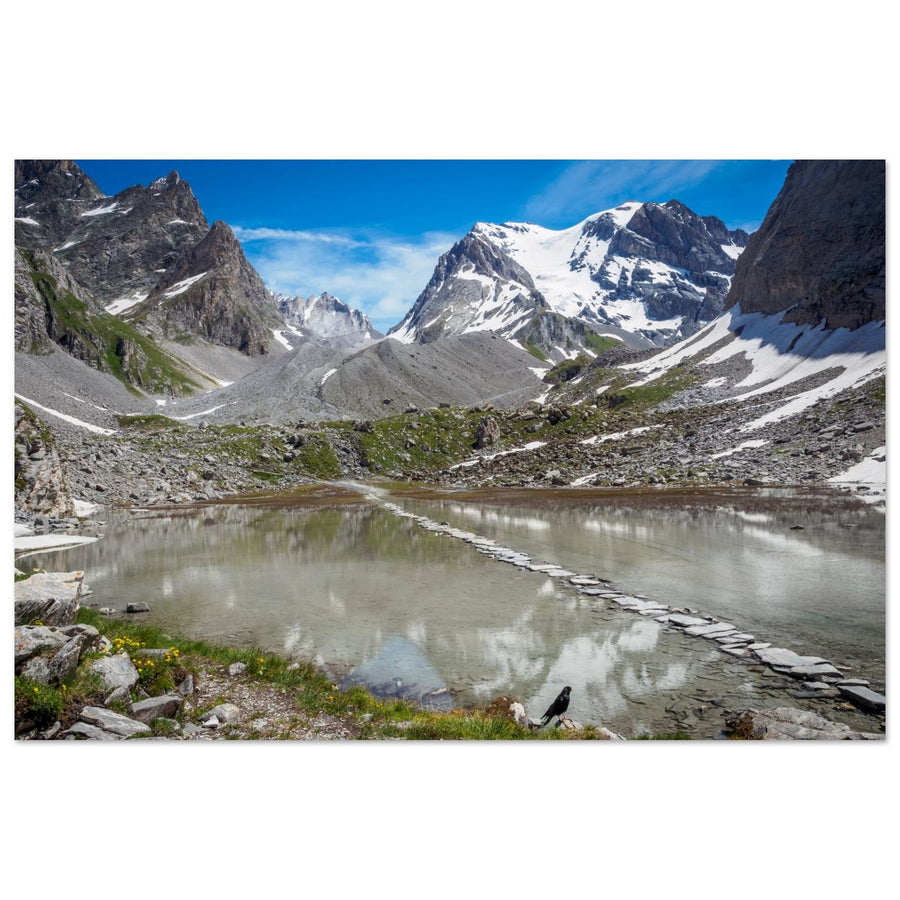
Où photographier le Lac des Vaches, le Col et le Refuge de la Vanoise ? - Tableaux photo Alpes | Alu Art Mountains

Where to photograph the Lac des Vaches, the Col de la Vanoise, and the Refuge de la Vanoise?

Updated July 8, 2026

Lac des Vaches, Col de la Vanoise, and Refuge de la Vanoise form one of the most comprehensive photo excursions in the massif. Starting from Pralognan-la-Vanoise, the itinerary combines several powerful subjects: stone slabs, high-altitude water, Aiguille de la Vanoise, Grande Casse, a mountain hut, lakes, raking light, and an accessible high-mountain atmosphere.

This page is a detailed guide to prepare for this outing with a photographer's approach: where to position yourself, what time to go, what focal length to use, how to compose with the slabs of Lac des Vaches, how to integrate the hut into the image, and how to exploit the views from the Col de la Vanoise area.

As a mountain photographer since 2017, I seek images in the Vanoise that remain striking when printed in large format: simple lines, a hut beneath a summit, cold snow, illuminated ridges, and the contrast between high-altitude architecture and the mineral massif. You can find part of this work in my collection of Vanoise photo prints, printed on Dibond aluminum.

Sunset over La Grande Casse and the Vanoise Refuge from the Col de la Vanoise area
From the Col de la Vanoise area, La Grande Casse and the refuge form a very clear image: an iconic summit, high-altitude architecture, and golden light.

The essentials in 30 seconds

  • Most graphic spot: Lac des Vaches, thanks to its slab path that creates a strong line in the image.
  • Best subject at the start: Aiguille de la Vanoise, visible from the beginning of the hike, with its very graphic limestone cliffs.
  • Best subject at the pass: La Grande Casse with the Refuge de la Vanoise as an anchor point.
  • Best light: sunrise, late afternoon, and golden hour around the pass.
  • Best season: summer and autumn, depending on snow cover and access conditions.
  • Useful focal length: wide-angle for slabs and lakes, 70–200 mm to isolate La Grande Casse, Aiguille de la Vanoise, and other reliefs.
  • Key tip: don't just photograph the route; use the slabs, the refuge, the lakes, or the summits as image structure.

Summary

Why this outing is significant in the Vanoise

The Lac des Vaches — Col de la Vanoise — Refuge de la Vanoise outing is one of the most compelling in the massif because it combines several types of subjects in a single progression: a limestone needle visible from the start, a graphic slab passage, high-altitude lakes, a very photogenic mountain hut, views of La Grande Casse, and a high-mountain atmosphere without becoming too technical.

For a photographer, this is a very rewarding outing: the subjects change as you ascend. The Aiguille de la Vanoise works with mineral lines and relief contrasts. Lac des Vaches works with slabs and water. The Col de la Vanoise works with space, lakes, and ridges. The refuge provides human scale. La Grande Casse brings alpine power.

The difficulty, therefore, isn't finding something to photograph. The difficulty is choosing a clear intention: a graphic image with slabs, a wide landscape with a hut and summit, mineral detail, a hiker's silhouette, a sunset atmosphere, or a more decorative composition intended for a large wall print.

Practical summary of the photo outing

Area Photo interest Best light Useful focal lengths To prioritize
Aiguille de la Vanoise Limestone cliffs, alpine pastures, hike start, graphic relief Morning, side light, autumn 24–70 mm, 70–200 mm Mineral and vertical compositions
Lac des Vaches Slabs, leading line, water, Grande Casse Morning, late afternoon, overcast sky 16–35 mm, 24–70 mm Graphic compositions and silhouettes
Ascent to the Col Moraine, reliefs, change of scale Side light 24–70 mm, 70–200 mm Textures, trail, layers of planes
Col de la Vanoise Lakes, openness, wide views, alpine atmosphere Golden hour, blue hour 16–35 mm, 24–70 mm Balanced landscapes and panoramas
Refuge de la Vanoise High-altitude architecture, focal point, Grande Casse Sunrise, sunset, blue hour 24–70 mm, 70–200 mm Legible images for large format
Grande Casse Iconic summit, ridges, snow, reliefs Sunrise, raking light, sunset 70–200 mm Compression, details, illuminated ridges
Grand Marchet Dark reliefs, layers of summits, late afternoon light Sunset, bright cloudy sky 70–200 mm Graphic atmospheres and ridge silhouettes

Access from Pralognan-la-Vanoise

The classic access is from Pralognan-la-Vanoise, often via the Fontanettes and Barmettes sectors. The itinerary then follows the GR55, climbs towards Lac des Vaches, crosses the slab passage, continues towards Lac Long, and then reaches the Col and Refuge de la Vanoise area.

At the beginning of the hike, the Aiguille de la Vanoise already offers a strong subject: limestone cliffs, vertical relief, alpine pastures, high-altitude buildings, and a contrast between meadow and rock. It's a good reminder that a photo outing doesn't just start at the lake or the hut: the first interesting compositions can appear right from the approach.

In season, depending on the opening of the lifts, the Genépi chairlift can shorten the approach. This is useful if your goal is to devote more energy to photography around Lac des Vaches or the refuge, rather than the full climb from the valley.

For a classic photo outing, two options stand out:

  • Round trip via Lac des Vaches: the most direct choice to photograph the slab passage, then climb towards the refuge.
  • Loop via Les Arollets: more demanding, but interesting if you want to vary the viewpoints on the ascent or descent.

Before you go, always check official conditions: lift opening, snow cover, weather, schedules, trail conditions, and Vanoise National Park regulations.

Useful official links before the outing

Photographing the Aiguille de la Vanoise at the start of the hike

The Aiguille de la Vanoise is an important subject of this outing because it appears even before the best-known parts of the itinerary. Its limestone silhouette offers a very different reading of the Vanoise: less glacial than La Grande Casse, more mineral, more vertical, almost sculptural.

This area is interesting for composing with contrasts: prairie and rock, alpine pastures and cliffs, warm light on trees or slopes, clear sky behind the wall. It's also a good subject if you're looking for a more understated image, less "famous spot," but very representative of the Vanoise National Park.

Aiguille de la Vanoise in Savoie at the beginning of the hike to Lac des Vaches and Col de la Vanoise
The Aiguille de la Vanoise can be photographed from the approach: limestone cliffs, alpine pastures, and vertical lines offer a very mineral first impression of the massif.

Photo tips for the Aiguille de la Vanoise

  • Use a medium focal length to prevent the needle from appearing too distant.
  • Work with contrasts between alpine pastures, buildings, forest, and limestone cliffs.
  • In autumn, look for warm colors at the base of the mountain.
  • Avoid overly descriptive framing: give the image a clear structure with a foreground.
  • If the light is harsh, try black and white to enhance the graphic quality of the cliffs.

Photographing Lac des Vaches

Lac des Vaches is the most immediately recognizable passage of this outing. Its photographic strength comes from the slab path that crosses the water: it creates a natural, almost graphic leading line, capable of guiding the eye towards La Grande Casse and the reliefs at the back of the valley.

The trap is to photograph the place only as a hiking curiosity. To obtain a strong image, you need to treat the passage as a structure: lines, rhythm of the stones, silhouettes, balance between water and mountain, relationship between foreground and summit.

Photo tips for Lac des Vaches

  • Position yourself low to give more presence to the slabs and reinforce the vanishing point.
  • Wait for a hiker to be well-placed on the path to provide scale without cluttering the image.
  • Avoid centering everything: slightly offset the line of slabs to create more tension.
  • In calm weather, look for partial reflections in areas of still water.
  • If the sky is empty, reduce its space and give more importance to the stones, water, and reliefs.
  • Use an intermediate focal length if the wide-angle makes La Grande Casse appear too small.

This spot is particularly interesting for working on mountain reflection photography and mountain landscape composition.

Photographing the Col and Refuge de la Vanoise

The Col de la Vanoise offers a more open view of the massif. After Lac des Vaches, the image becomes less graphic and more alpine: lakes, meadows, moraine, refuge, summits, vast spaces. It's a perfect area for constructing balanced compositions, especially if you like calm and clear images.

The Refuge de la Vanoise and the views from its surroundings are very strong subjects: the refuge gives a human scale to the landscape, while the summits around the pass allow for building compositions that are more open to the massif.

Photo tips around the refuge

  • Use the refuge as an anchor point rather than just a documentary subject.
  • Wait for side or raking light to separate the building from the relief.
  • Compose horizontally if you want to integrate the refuge, lakes, and summit into the same image.
  • Also try tighter framing with a telephoto lens to bring La Grande Casse closer to the refuge.
  • During blue hour, use a tripod to retain detail in the refuge and reliefs.
Sunset over the Grand Marchet and the Vanoise summits from the Refuge de la Vanoise area
From the Refuge de la Vanoise area, the view also opens towards the Grand Marchet and the massif's summits: a broader atmosphere, perfect for capturing the Vanoise at sunset.

Photographing La Grande Casse from the area

La Grande Casse is the iconic summit of this outing. From the Lac des Vaches and Col de la Vanoise area, it appears in a very rich context: slabs, lakes, moraines, refuge, snow lines, ridges, and raking light.

A wide-angle lens is useful for showing the context, but a telephoto lens quickly becomes indispensable if you want to give power to the summit. A 70–200 mm lens allows isolating snow lines, compressing planes, and making the reliefs more prominent.

Photo tips for La Grande Casse

  • Photograph it early or late, when the light reveals the volumes.
  • Use a long focal length to prevent the summit from appearing too distant.
  • Integrate a scale element: refuge, hiker, ridge, lake, or moraine.
  • In overcast weather, look for breaks in the light on the face or ridges.
  • In cold or snowy conditions, try more minimalist compositions.

For a broader view of the massif, also consult the pillar guide: where to photograph the Vanoise?

Photographing the Grand Marchet from the refuge area

The Refuge de la Vanoise area is not limited to La Grande Casse. In the late afternoon, the views towards the Grand Marchet and neighboring summits allow for constructing more atmospheric images: dark ridges, colored sky, snow masses, successive reliefs, and a quieter atmosphere.

This is an interesting angle if you are looking for a less obvious image than the refuge under the Grande Casse. Le Grand Marchet works very well with sunset light, especially when the sky retains its color as the mountains gradually fall into shadow.

Photo tips for Grand Marchet

  • Work with a medium or long focal length to isolate the ridges and simplify the image.
  • Wait for the sky to provide a real atmosphere: clouds, gradients, warm light or blue/orange contrast.
  • Don't always look for detail: mountain silhouettes can be enough.
  • Keep a simple composition, with few elements and clear readability.

Best times to photograph Lac des Vaches and Col de la Vanoise

Morning

Morning is often the best time to work with the soft light, fresh air, and tranquility of the site. At Lac des Vaches, the slabs become more legible if the sun stays low. Around the refuge, the first lights on the reliefs can create a clear separation between the foreground and the summit.

Late afternoon

Late afternoon is very interesting around the Col de la Vanoise. The light becomes more lateral, the volumes stand out better, and the refuge can become a very strong anchor point in a warmer image. It's also a good time for panoramas and decorative compositions.

Blue hour

Blue hour works best if you sleep at the refuge or if you are perfectly organized to descend safely. Contrasts become more subtle, details in the snow and reliefs simplify, and the refuge can take on an almost graphic presence.

Autumn

Autumn is often excellent in Vanoise: lower light, clearer air, warmer colors, first snowfalls possible at altitude. It's a very interesting period for sober, elegant images suitable for premium wall decoration.

Photo composition ideas

1. Aiguille de la Vanoise at the start

Use the needle as a vertical and mineral subject. A framing with mountain pastures, forest or high-altitude building in the foreground helps to give a more human scale to the wall.

2. The line of slabs of Lac des Vaches

Place the slabs as the main line of the image. The goal is to guide the eye towards the massif, not simply to show the passage. A well-placed silhouette can reinforce the scale.

3. Refuge + Grande Casse

This is the most naturally "wall art" composition in the sector. The refuge gives a human presence, the Grande Casse brings alpine power, and the light links the two elements.

4. Lakes and summits in respiration

Around the Col de la Vanoise, look for calmer compositions: lake, shore, grass, refuge or summit in the background. These sober images often age best in large format.

5. Material details

Don't limit yourself to wide views. Stones, water, snowfields, high-altitude grasses and moraine textures can produce more abstract and personal images.

6. Telephoto compression

With a long focal length, you can visually bring the Grande Casse closer to the refuge or isolate the reliefs of Grand Marchet. This is very effective in giving more density to the scene.

What photo equipment to bring?

  • 16–35 mm: useful for the Lac des Vaches slabs, foregrounds and wide landscapes.
  • 24–70 mm: the most versatile for this outing.
  • 70–200 mm: essential for isolating the Grande Casse, the Aiguille de la Vanoise, ridges, snow details and refuge/summit relationships.
  • Tripod: recommended if shooting at dawn, blue hour or in low light.
  • Polarizing filter: useful with caution to manage certain reflections, but to be avoided if the sky rendering becomes irregular with a wide-angle.
  • Extra batteries: important in cold weather or if you sleep at the refuge.
  • Headlamp: essential for a very early start or a late return.
  • Warm clothing: even in summer, waiting for the light at the pass can quickly get cold.

Regulations and safety

This outing takes place in a mountain environment and in the Vanoise National Park area. Conditions can change rapidly: late snow, thunderstorms, fog, wind, wet trails, fatigue on return. Even if the itinerary is known, it should not be treated as a simple photo walk.

Before leaving, check the official daily information: weather, possible opening of lifts, trail conditions, snow cover, refuge opening hours, National Park regulations, rules on bivouacking, dogs, drones, waste, fauna and flora.

The Col de la Vanoise refuge explicitly states that bivouacking is prohibited on site. More broadly, the Vanoise National Park reminds us that bivouacking in the heart of the Park is regulated and only authorized near certain refuges, with mandatory reservation when the area exists. Always check official information before planning an overnight stay.

The good photo reflex: prepare the image, but accept to give up if conditions are not safe. Beautiful light never justifies putting oneself in danger or disturbing a fragile environment.

Photo prints related to Lac des Vaches, Col and Refuge de la Vanoise

This outing perfectly summarizes the aesthetic of the Vanoise: a vast, elegant, balanced mountain, where refuges, lakes and summits naturally compose powerful images. The photographs below are directly related to the approach of the itinerary, the sector of the Refuge de la Vanoise and its late afternoon views.

To see in the gallery

You can also explore:

Continue your exploration of the Vanoise

To prepare for other photo outings in the massif, you can continue with the other guides of the Vanoise mini-cluster:

FAQ — Photographing Lac des Vaches, Col and Refuge de la Vanoise

When is the best time to photograph Lac des Vaches?

Morning and late afternoon are the best times. The light is softer, the slabs are more legible and the attendance may be lower than in the middle of the day.

Where to photograph the Aiguille de la Vanoise on this outing?

The Aiguille de la Vanoise can be photographed from the beginning of the hike, in the approach sector towards Lac des Vaches and Col de la Vanoise. It works very well with the mountain pastures, high-altitude buildings and limestone walls in the background.

Where is the best viewpoint at Lac des Vaches?

The slab passage is the most graphic point. Position yourself so as to use the stones as a guideline towards the Grande Casse, without over-centering the composition.

Are the Col de la Vanoise and the Refuge de la Vanoise part of the same outing?

Yes. From Pralognan, Lac des Vaches, Col de la Vanoise and Refuge de la Vanoise are integrated into the same coherent photo outing, with several successive atmospheres.

What focal length to use to photograph the Grande Casse?

A wide-angle is useful to show the context, but a telephoto lens like a 70–200 mm allows you to give more presence to the Grande Casse and isolate the lines of the summit.

Can you photograph the area without sleeping at the refuge?

Yes, but sleeping at the refuge makes sunrise, sunset and blue hour lights easier. Without an overnight stay, you need to carefully organize your schedule and return.

What is the best season for this photo outing?

Summer facilitates access, while autumn often offers lower light, clearer atmosphere and sometimes the first snows at altitude. Conditions should always be checked before departure.

Do I need a tripod?

It is not essential in the middle of the day, but it becomes very useful at dawn, sunset, blue hour or if you want to work with very clean compositions in low light.

Can you bivouac near the Refuge de la Vanoise?

No, not directly at the Refuge du Col de la Vanoise: the refuge indicates that bivouacking is prohibited there. In the Vanoise National Park, bivouacking is regulated and only authorized near certain refuges when an area exists, with mandatory reservation.

Back to blog

Tableaux photo de la Vanoise et de la Savoie

Une sélection de photographies prises dans le massif de la Vanoise : Grande Casse, Dent Parrachée, refuges, lacs d’altitude, crêtes enneigées et paysages de Savoie, imprimées sur aluminium Dibond en France.