

Where to photograph the Mer de Glace? Photo spots, access, and lighting tips
The Mer de Glace is one of the most powerful places to photograph around Chamonix. From Montenvers, the gaze plunges into a spectacular glacial landscape: glacier tongue, moraines, granite walls, Drus, Grandes Jorasses, needles and reliefs of the Mont-Blanc massif.
But photographing the Mer de Glace requires a different approach than a lake or a classic panorama. The subject is mineral, graphic, sometimes austere. The beauty of the place comes less from a perfect reflection than from the textures, vanishing lines, contrasts between ice and rock, and the almost documentary dimension of the landscape.
This guide helps you prepare a photo outing to the Mer de Glace: access by the Montenvers train, best viewpoints, lighting tips, composition ideas, mistakes to avoid, safety, and useful links to explore the rest of the photo cluster around Chamonix and Mont-Blanc.

Table of Contents
- Explore the Mont-Blanc photo cluster
- Mer de Glace in photos: quick summary
- Why is the Mer de Glace a major photo spot?
- Access to the Mer de Glace: Montenvers train and practical info
- The best viewpoints for photographing the Mer de Glace
- When to photograph the Mer de Glace? Light and seasons
- Photo composition ideas
- Field photography tips
- Mistakes to avoid
- Safety, weather and respect for the site
- Which Mer de Glace photo to choose for a wall print?
- FAQ: photographing the Mer de Glace
Explore the Mont-Blanc photo cluster
This article is part of the mini-cluster dedicated to the best photo spots around Chamonix and the Mont-Blanc massif. The Mer de Glace is a child page of the cluster: it delves into the Montenvers sector, while the Mont-Blanc and Chamonix guides give a broader view of the valley.
- Complete Guide: Where to photograph Mont-Blanc?
- See all Mont-Blanc photo guides
- Where to photograph Chamonix?
- Where to photograph Lac Blanc?
- Where to photograph Aiguille du Midi?
- Where to photograph the Mer de Glace? (current guide)
- See all Alps photo guides
Mer de Glace in photos: quick summary
| Criterion | Recommendation |
|---|---|
| Main spot | Mer de Glace, Montenvers, Chamonix-Mont-Blanc |
| Strong photo subject | Glacier, moraines, Drus, Grandes Jorasses, Montenvers train, ice textures |
| Best light | Clear morning, side light, partially cloudy sky, autumn |
| Ideal season | Spring, summer, autumn, winter depending on conditions and site opening |
| Photo difficulty | Medium: strong contrast, complex subject, need to simplify compositions |
| Terrain difficulty | Easy from Montenvers, more demanding if you continue on marked trails |
| Useful equipment | Telephoto lens, wide-angle, polarizing filter with caution, warm clothes, extra battery |
| Ideal print type | Black and white, vertical format, glacial landscape, graphic or documentary print |
Why is the Mer de Glace a major photo spot?
The Mer de Glace is a major photo spot because it tells another facet of Chamonix. Where Lac Blanc plays on reflection and balance, the Mer de Glace plays on matter: ice, rock, strata, moraines, crevasses, flow lines, and vertical walls.
The place is also interesting because it carries a strong emotional dimension. Photographing the Mer de Glace is not just about photographing a beautiful landscape: it's also about capturing a glacier, its presence, its visible retreat, its fragility, and the relationship between the mountain, time, and light.
Photographically, the site requires simplification. The glacier can quickly become confusing if everything is included in the image. The best photos are often those that isolate a line, a texture, a moraine curve, a wall, a silhouette, or a detail of ice.
Access to the Mer de Glace: Montenvers train and practical info
The classic access to the Mer de Glace is by the Montenvers train, departing from Chamonix. It is one of the easiest ways to reach a spectacular viewpoint of the glacier without embarking on a long hike.
Once at Montenvers, several options are available depending on the season, the opening of the site, and conditions: viewpoints from the terraces, access to facilities, observation of the glacier, possible visit to the ice cave when it is open, or departure for certain hiking routes.
For a photo outing, don't just check the schedule of the first train: also check the time of the last return, the weather, the opening status of the facilities, and the expected light. The site is accessible, but it remains a mountain environment.
Before you go, always consult official information:
- Official Access Montenvers - Mer de Glace
- Official Montenvers train timetables and prices
- Chamonix Tourist Office: Mer de Glace and Montenvers train
The best viewpoints for photographing the Mer de Glace
1. The Montenvers terraces for the classic view of the glacier
The Montenvers terraces offer a direct view of the Mer de Glace. This is the obvious starting point to understand the place: glacier below, surrounding walls, valley depth, and reliefs of the Mont-Blanc massif.
The trap is to frame too wide. An overall view is useful, but it can quickly lack strength if the glacier becomes a simple strip in the landscape. Look for a guiding line: glacier curve, moraine, wall, light on a summit, or contrast between snow and rock.
2. The Montenvers train for a more narrative image
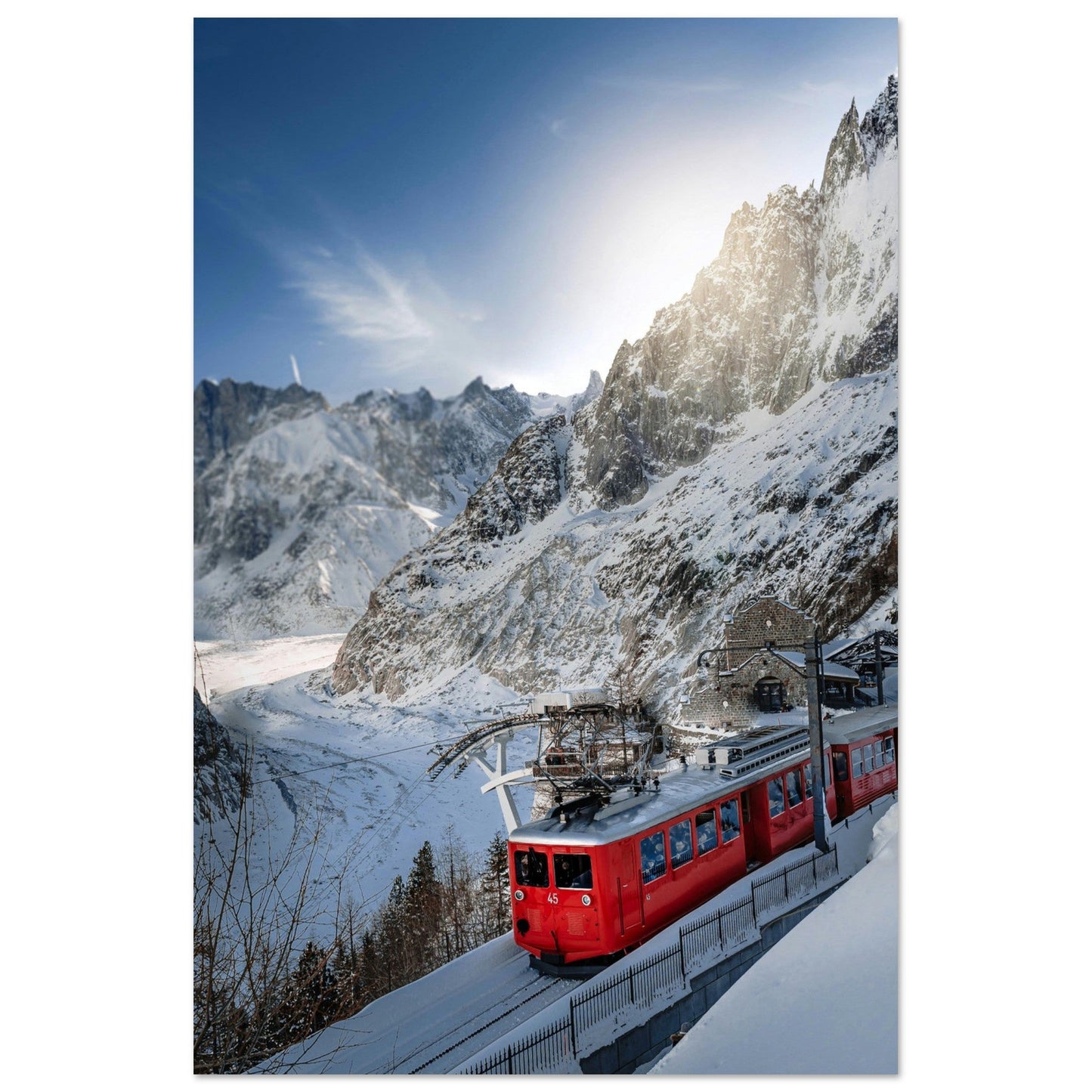
The red Montenvers train is a very strong subject. It brings a human scale and a graphic touch to a mineral setting. It allows telling the story of access to the Mer de Glace, not just the glacier itself.
This type of image works particularly well when the train is on the slope, with the mountain in the background. The red color contrasts with the snow, rock, and cold tones of the massif.
3. Frames towards the Drus and granite walls
From the Montenvers sector, the Drus and surrounding walls give a very strong vertical dimension. Even if the glacier attracts the eye, the summits and needles can become the true subjects of the image.
A telephoto lens allows isolating ridges, rock textures, clouds clinging to the summits, or contrasts between dark granite and luminous snow.
4. Textures of ice, moraines, and seracs
The Mer de Glace is a very graphic subject when focusing on its details. Crevasses, seracs, moraines, flow lines, and transition zones between rock and ice offer abstract compositions, almost monochrome.
This type of framing works well in black and white or with soft light. The goal is no longer to show "where we are," but to reveal the glacier's material.
5. Marked trails around Montenvers for varying angles
Depending on conditions and your level, some marked trails around Montenvers allow varying viewpoints. They can offer more open angles on the valley, the needles, and the Mer de Glace.
Do not embark on a longer itinerary without preparation. Check the weather, your equipment, train schedules, and your ability to return with a comfortable margin.
When to photograph the Mer de Glace? Light and seasons
Morning: clarity and relief on the glacier
Morning is often a good time to photograph the Mer de Glace. The air can be clearer, contrasts are sometimes cleaner, and the glacier's reliefs are better defined if the light comes from the side.
Side light: ideal for revealing textures
The Mer de Glace is a subject of material. Side light better reveals crevasses, moraines, ridges, and volumes. Too much frontal light can flatten the glacier and make the image less readable.
Clouds: often an asset
A perfectly blue sky is not always the best choice. Clouds can cling to the needles, filter the light, create luminous breaks, or enhance the dramatic atmosphere of the site. The Mer de Glace handles darker and more contrasted atmospheres very well.
Autumn: contrast between larches, granite, and ice
Autumn is a very interesting period. The warm colors of the larches contrast with the grays of the granite and the cold tones of the ice. For a wall print, this season often brings a warmer image that is easier to integrate into an interior.
Winter: graphic design, snow, and high mountain atmosphere
In winter, snow simplifies the landscape. Contrasts become more graphic, the red train stands out strongly, and the walls take on a more austere dimension. However, you must be very careful with exposure to avoid burning the whites.
Photo composition ideas
The glacial valley in depth
Use the curve of the glacier or moraines as a vanishing line. This type of composition gives an impression of depth and naturally guides the eye towards the back of the massif.
The contrast of the red train and the glacial landscape
The Montenvers train can become the main subject. Its color and shape provide a very legible focal point in a landscape often dominated by gray, white, and blue.
Ice textures in tight framing
With a telephoto lens, you can isolate areas of ice, seracs, or moraines. These images are often more personal than wide views, and they work very well in black and white.
The Drus and the walls in the background
The Drus give a vertical strength to the site. In tight framing, they allow constructing more graphic, less touristy images, where the natural architecture of the massif becomes the main subject.
The human silhouette to show scale
A discreet silhouette can help give scale to the glacier and the walls. Use it with caution: it should reinforce the immensity of the landscape, not transform the image into a simple souvenir photo.
Field photography tips
Use the telephoto lens more than expected
At the Mer de Glace, a telephoto lens is often more useful than a wide-angle. It allows isolating the glacier's textures, the walls' details, the moraine lines, and the ridges. It also helps avoid overly busy compositions.
Simplify your subject
The site is complex: glacier, rocks, train, buildings, cables, visitors, summits, clouds. A good image requires a clear intention. Choose your main subject before shooting.
Expose to preserve snow and ice
Ice and snow can quickly lose their details if the exposure is too strong. Preserve highlights, especially in winter or under clear skies. It is better to retain texture in bright areas than to produce an overly bright but flat image.
Think in black and white
The Mer de Glace is an excellent subject for black and white photography. The textures, contrasts, lines, and mineral dimension of the landscape lend themselves very well to it. If the colors are weak, black and white can enhance the image instead of artificially saving it.
Wait for changes in light
The best images can appear in a few seconds: a cloud opening up, light on the Drus, a shadow on the glacier, a ray on the train. Take the time to observe rather than just photographing upon arrival.
Mistakes to avoid
Photographing everything with a wide-angle lens
A wide-angle lens can give an overall view, but it sometimes makes the glacier too small and the image too empty. Alternate with longer focal lengths to produce stronger images.
Only taking "souvenir" photos from the viewpoint
The initial viewpoint is useful, but it's not enough. Also look for details, textures, lines, and light. That's often where the most personal images are found.
Ignoring human elements
The train, installations, stairs, silhouettes, and belvederes are part of the site's history. When used well, they give scale and narrative to the image.
Underestimating the cold and weather
Even though train access is easy, Montenvers remains a mountain site. Wind, cold, clouds, and weather changes can quickly alter the outing. Prepare your equipment as you would for a real alpine excursion.
Safety, weather and respect for the site
The Mer de Glace is a glacial environment. Even if tourist viewpoints are accessible, the glacier itself remains dangerous and constantly changing terrain. Do not leave authorized areas, do not descend onto the glacier without appropriate supervision, and respect local instructions.
Before any outing, check the weather, train schedules, facility openings, and site conditions. Schedules can change depending on the season, weather, or ongoing work.
Also respect the area: stay on authorized paths, leave no waste, and avoid crossing barriers to find a photo angle. A strong image never justifies unnecessary risk-taking.
Which Mer de Glace photo to choose for a wall print?
The Mer de Glace works very well as a wall print when treated as a graphic image. The textures of ice, moraines, walls, and contrasts between snow and granite create a strong, sober, and contemporary presence.
For a modern interior, vertical or black and white images can provide great elegance. For a chalet or a warm alpine atmosphere, autumn images, with golden larches and granite, bring more softness. For an office or professional space, the Montenvers train can bring a very strong narrative and heritage dimension.
Photo prints related to the Mer de Glace and Montenvers

Mer de Glace — crevasses, seracs & high mountains
A graphic and mineral image of the Mer de Glace, featuring ice, rock walls, and the depth of the Mont-Blanc massif.
Ideal for: contemporary interiors, offices, understated alpine decor.

Montenvers Train & Mer de Glace
The red Montenvers train in a snowy high-mountain setting, with a strong narrative dimension.
Ideal for: chalets, hallways, offices, graphic souvenirs of Chamonix.

Mer de Glace #5 — glacier tongue & moraines
A more graphic interpretation of the glacier, featuring curves, moraines, and glacial textures.
Ideal for: minimalist decor, black and white, contemporary mountain ambiance.

Mer de Glace in autumn
A warmer version of the site, with golden larches, granite, and glacier in a bright alpine atmosphere.
Ideal for: living rooms, modern chalets, warm mountain decor.
You can also explore related collections: Chamonix photo prints, Mont-Blanc photo prints, Alpine glacier photo prints, Mont-Blanc & Chamonix photo prints, and mountain autumn photo prints.
Continue your exploration around Chamonix
The Mer de Glace is one of Chamonix’s great glacial spots. To prepare for a more complete discovery of the Mont-Blanc massif, continue with the other guides in the mini-cluster.
Related photo guides
- Where to photograph Chamonix?
- Where to photograph Mont-Blanc?
- View all Mont-Blanc photo guides
- Where to photograph Lac Blanc?
- Where to photograph Aiguille du Midi?
- Where to photograph the Aiguilles Rouges?
- View all Alpine photo guides
Related photo collections
FAQ: Photographing the Mer de Glace
What is the best time to photograph the Mer de Glace?
Mornings and side lighting are often the most interesting. They allow for better perception of the glacier's relief, moraines, and the rock walls around Montenvers.
How do I get to the Mer de Glace from Chamonix?
The classic access is via the Montenvers train, departing from Chamonix. You should check the schedules, the site's opening, and weather conditions before heading out.
What are the best viewpoints for the Mer de Glace?
The Montenvers terraces offer the most direct viewpoint. Framing towards Les Drus, the granite walls, moraines, the Montenvers train, and the glacier's textures also allow for varied images.
Do I need a telephoto lens to photograph the Mer de Glace?
Yes, a telephoto lens is very useful. It allows you to isolate ice textures, moraine lines, wall details, and the glacier's relief. A wide-angle lens is still useful for overall views.
Is the Mer de Glace interesting in black and white?
Yes, it is one of the best subjects around Chamonix for black and white photography. The contrasts between ice, rock, snow, and shadows create very graphic images.
Can one go down onto the Mer de Glace for photography?
One should not venture onto the glacier without appropriate supervision. The Mer de Glace is a dangerous glacial environment, with crevasses, rockfalls, and changing conditions. Stay in authorized areas and follow local instructions.
Which season should I choose to photograph the Mer de Glace?
Autumn is very interesting for the colors of the larches and the contrast with the ice. Winter provides more graphic and snowy images. Spring and summer allow for more work on the glacier's textures and mineral reliefs.
Can a drone be used around the Mer de Glace?
Local regulations must be checked before any flight. The Chamonix sector includes sensitive, tourist, and natural areas where overflights may be restricted or prohibited.


