Photographier la Mer de Glace depuis le Montenvers - AluArtMountains

Photographing the Mer de Glace from Montenvers

Updated July 23, 2026

From Montenvers, the Mer de Glace is not a classic panorama. The gaze first follows the moraines, the curves of the glacier, and the walls enclosing the basin. Les Drus stand above the site, the Grandes Jorasses appear further away, and the red train adds an almost fragile human presence to this mineral landscape.

Photographing the Mer de Glace also means photographing a changing place. The glacier's retreat is visible, access points evolve, and the same composition tells a different story from one year to the next. An image can be spectacular, graphic, or documentary; it gains strength when it clearly embraces one of these registers.

This guide helps you prepare your visit from Chamonix, choose viewpoints from Montenvers, and work with ice textures without losing the depth of the massif. It complements the guides Photographing Chamonix and Photographing Mont-Blanc.

The Mer de Glace in a few key points

Criterion Recommendation
Main spot Mer de Glace, Montenvers, Chamonix-Mont-Blanc
Strong photo subject Glacier, moraines, Drus, Grandes Jorasses, Montenvers train, ice textures
Best light Clear morning, side light, partially cloudy sky, autumn
Ideal season Spring, summer, autumn, winter depending on conditions and site opening
Photo difficulty Medium: strong contrast, complex subject, need to simplify framing
Terrain difficulty Easy from Montenvers, more demanding if you extend onto marked trails
Useful equipment Telephoto lens, wide-angle lens, polarizing filter with caution, warm clothing, extra battery
Ideal print type Black and white, vertical format, glacial landscape, graphic or documentary print

What the glacier brings to the image

The Mer de Glace is a major photo spot because it tells another side of Chamonix. Where Lac Blanc plays on reflection and balance, the Mer de Glace plays on matter: ice, rock, strata, moraines, crevasses, flow lines, and vertical walls.

The place is also interesting because it carries a strong emotional dimension. Photographing the Mer de Glace is not just photographing a beautiful landscape: it is also capturing a glacier, its presence, its visible retreat, its fragility, and the relationship between the mountain, time, and light.

Photographically, the site requires simplification. The glacier can quickly become confusing if everything is included in the image. The best photos are often those that isolate a line, a texture, a moraine curve, a wall, a silhouette, or a detail of ice.

Photographing a changing landscape

The Mer de Glace carries a documentary dimension not found in the same way at Lac Blanc or the Aiguille du Midi. The moraines, stairs, installations, and markers left by old glacier levels concretely show the site's evolution. Systematically removing them from the frame sometimes means erasing an important part of what is being photographed.

A documentary image does not have to be cold or demonstrative. A silhouette on a staircase, a level sign, a moraine curve, or the train crossing the slope can give scale and date to the landscape. The choice of framing then becomes a stance: to show only the mineral beauty, or to embrace the relationship between the glacier, tourism, and passing time.

We recommend making both interpretations during the same outing. Start with wide views to understand the basin, then isolate the details that tell the story of the transformation. This variety will be more useful than a series of almost identical panoramas.

Access by Montenvers train

Classic access to the Mer de Glace is by the Montenvers train, departing from Chamonix. It is one of the simplest ways to reach a spectacular viewpoint of the glacier without embarking on a long hike.

Once at Montenvers, several options are available depending on the season, site opening, and conditions: viewpoints from the terraces, access to installations, glacier observation, possible visit to the ice cave when open, or departure for certain hiking routes.

For a photo outing, don't just check the first train's schedule: also check the last return time, the weather, the status of installations, and the expected light. The site is accessible, but it remains a mountain environment.

Before you go, always consult official information:

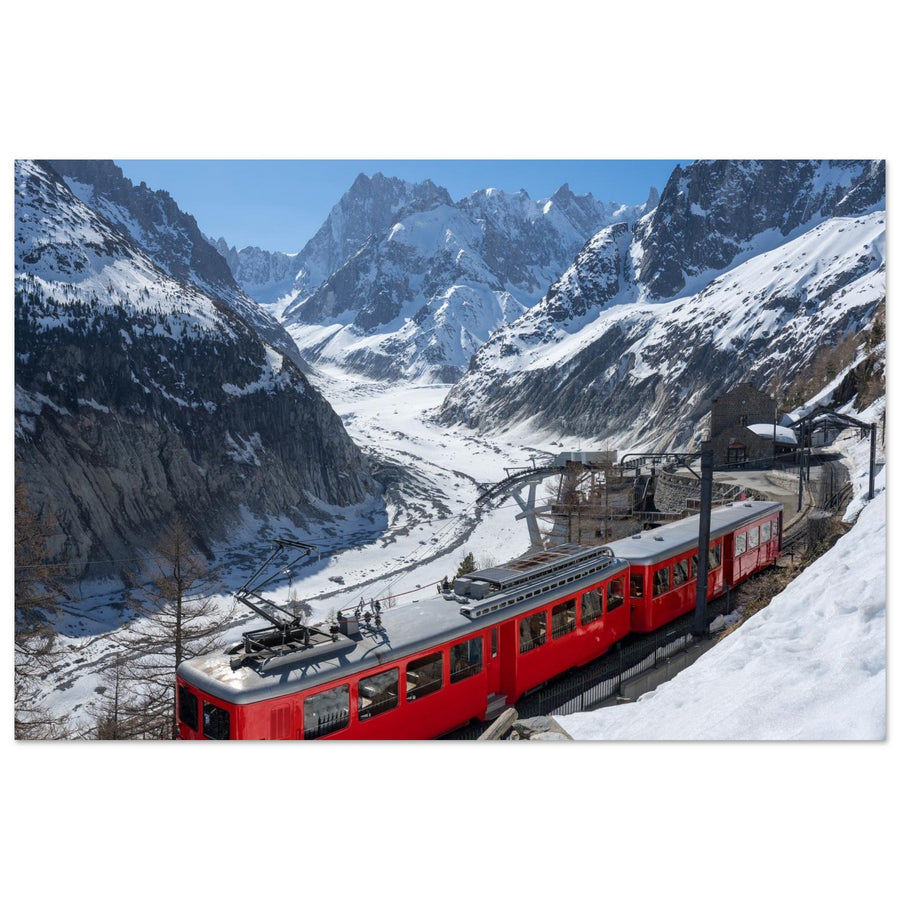
Red Montenvers train in the snow facing the Grandes Jorasses
The red train in the landscape

Photo of the Montenvers train facing the Grandes Jorasses

The snow simplifies the slopes, and the red of the train becomes the entry point of the image. The Grandes Jorasses remain legible in the background, but the scene primarily tells how one reaches Montenvers.

Photography: Francois Roux

View this photo print on aluminum Dibond →

The best viewpoints around Montenvers

1. The Montenvers terraces for the classic glacier view

The Montenvers terraces offer a direct view of the Mer de Glace. It's the obvious starting point to understand the location: the glacier below, surrounding walls, valley depth, and the Mont-Blanc massif's contours.

The pitfall is to frame too wide. An overview is useful, but it can quickly lack impact if the glacier becomes a mere strip in the landscape. Look for a guiding line: glacier curve, moraine, wall, light on a summit, or contrast between snow and rock.

2. The Montenvers train for a more narrative image

The red Montenvers train is a very strong subject. It adds a human scale and a graphic touch to a mineral setting. It allows telling the story of access to the Mer de Glace, not just the glacier itself.

This type of image works particularly well when the train is embedded in the slope, with the mountain in the background. The red color contrasts with the snow, rock, and cold tones of the massif.

3. Framing towards Les Drus and the granite walls

From the Montenvers area, Les Drus and the surrounding walls provide a very strong vertical dimension. Even if the glacier draws the eye, the summits and needles can become the true subjects of the image.

A telephoto lens allows isolating ridges, rock textures, clouds clinging to the summits, or contrasts between dark granite and bright snow.

4. Ice textures, moraines, and seracs

The Mer de Glace is a very graphic subject when focusing on its details. Crevasses, seracs, moraines, flow lines, and transition zones between rock and ice offer abstract, almost monochrome compositions.

This type of framing works well in black and white or with soft light. The goal is no longer to show "where you are," but to reveal the glacier's material.

5. Marked trails around Montenvers to vary angles

Depending on conditions and your fitness level, certain marked trails around Montenvers allow for varying viewpoints. They can offer more open angles on the valley, the needles, and the Mer de Glace.

Do not embark on a longer itinerary without preparation. Check the weather, your equipment, train schedules, and your ability to return with a comfortable margin.

Light and seasons at the Mer de Glace

Morning: clarity and relief on the glacier

Morning is often a good time to photograph the Mer de Glace. The air can be clearer, contrasts are sometimes cleaner, and the glacier's relief is better revealed if the light comes from the side.

Side light: ideal for revealing textures

The Mer de Glace is a subject of material. Side light better reveals crevasses, moraines, ridges, and volumes. Light that is too frontal can flatten the glacier and make the image less legible.

Clouds: often an asset

A perfectly blue sky is not always the best choice. Clouds can cling to the needles, filter light, create light breaks, or enhance the dramatic atmosphere of the site. The Mer de Glace supports darker and more contrasted atmospheres very well.

Autumn: contrast between larches, granite, and ice

Autumn is a very interesting period. The warm colors of the larches contrast with the grays of the granite and the cold tones of the ice. For a wall photograph, this season often provides a warmer image that is easier to integrate into an interior.

Winter: graphics, snow, and high mountain atmosphere

In winter, snow simplifies the landscape. Contrasts become more graphic, the red train stands out strongly, and the walls take on a more austere dimension. However, great care must be taken with exposure to avoid burning out the whites.

Crevasses, seracs and moraines of the Mer de Glace in the Mont-Blanc massif
Reading the glacier's material

Photo of the Mer de Glace of Mont-Blanc

The crevasses, seracs, and moraines fill the frame without becoming abstract. The photograph retains enough relief around it to situate the Mer de Glace in the Mont-Blanc massif.

Photography: Pierre Thiaville

View this photo print on aluminum Dibond →

Composing with ice, moraines, and walls

The glacial valley in depth

Use the curve of the glacier or moraines as a vanishing line. This type of composition creates an impression of depth and naturally guides the eye towards the back of the massif.

The contrast between the red train and the glacial landscape

The Montenvers train can become the main subject. Its color and shape provide a very legible focal point in a landscape often dominated by gray, white, and blue.

Ice textures in tight framing

With a telephoto lens, you can isolate areas of ice, seracs, or moraines. These images are often more personal than wide views, and they work very well in black and white.

Les Drus and the walls in the background

Les Drus give the site a strong vertical presence. In tight framing, they allow for more graphic, less touristy images, where the natural architecture of the massif becomes the main subject.

The human silhouette to show scale

A discreet silhouette can help to give scale to the glacier and the walls. Use it with caution: it should reinforce the immensity of the landscape, not turn the image into a simple souvenir photo.

Field photography tips

Use the telephoto lens more than expected

At the Mer de Glace, a telephoto lens is often more useful than a wide-angle. It allows isolating glacier textures, wall details, moraine lines, and ridges. It also helps avoid overly cluttered compositions.

Simplify your subject

The site is complex: glacier, rocks, train, buildings, cables, visitors, peaks, clouds. A good image requires a clear intention. Choose your main subject before shooting.

Expose to preserve snow and ice

Ice and snow can quickly lose their details if the exposure is too strong. Preserve highlights, especially in winter or under clear skies. It is better to retain texture in bright areas than to produce an overly bright but flat image.

Consider black and white

The Mer de Glace is an excellent subject for black and white photography. Textures, contrasts, lines, and the mineral dimension of the landscape lend themselves very well to it. If colors are weak, black and white can strengthen the image instead of artificially saving it.

Wait for light variations

The best images can appear in a few seconds: a cloud opening, light on Les Drus, a shadow on the glacier, a sunbeam on the train. Take time to observe rather than just photographing upon arrival.

Mistakes to avoid at Montenvers

Photographing everything with a wide-angle lens

A wide-angle can give an overall view, but it sometimes makes the glacier look too small and the image too empty. Alternate with longer focal lengths to produce stronger images.

Only taking the "souvenir" photo from the viewpoint

The first viewpoint is useful, but it's not enough. Also look for details, textures, lines, and light. This is often where the most personal images are found.

Ignoring human elements

The train, installations, stairs, silhouettes, and viewpoints are all part of the site's history. When used well, they add scale and narrative to the image.

Underestimating the cold and weather

Even if access by train is easy, Montenvers remains a mountain site. Wind, cold, clouds, and changing weather can quickly alter your outing. Prepare your equipment as you would for a real alpine excursion.

Safety, weather, and respecting the site

The Mer de Glace is a glacial environment. Even if tourist viewpoints are accessible, the glacier itself remains dangerous and changing terrain. Do not leave authorized areas, do not descend onto the glacier without appropriate supervision, and respect local guidelines.

Before any outing, check the weather, train schedules, facility opening times, and site conditions. Schedules may change depending on the season, weather, or ongoing work.

Also respect the area: stay on authorized paths, leave no litter, and avoid crossing barriers to find a photo angle. A strong image never justifies unnecessary risk-taking.

AluArtMountains Gallery

Photographs of Montenvers and the Mer de Glace basin

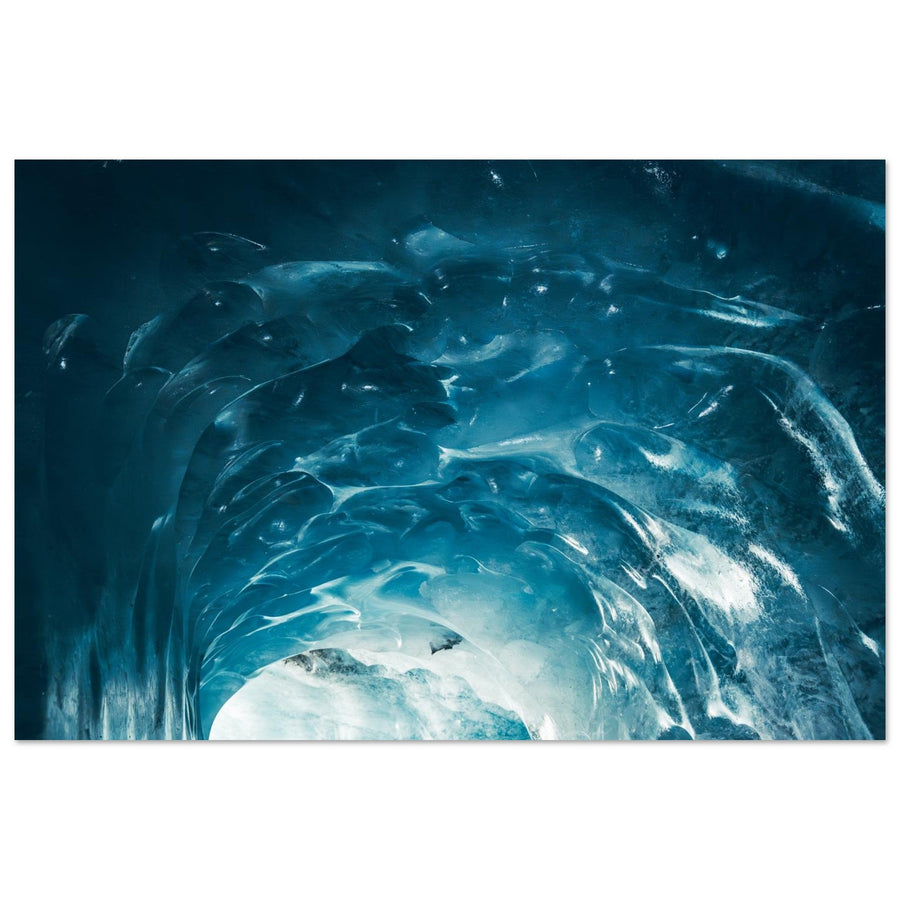
Two images extend the visit beyond the terraces: the almost unreal color of the ice cave and the Couvercle hut above the Talèfre glacier. They show the diversity of a single glacial basin.

View the collection

Alpine Glacier Photo Prints

Mer de Glace, Talèfre, and other Alpine glaciers, selected for their textures and rendering on matte Dibond aluminum.

Explore the glaciers

Frequently Asked Questions about the Mer de Glace

What is the best time to photograph the Mer de Glace?

Mornings and side lighting are often the most interesting. They allow for a better reading of the glacier's relief, moraines, and the surrounding walls of Montenvers.

How to get to the Mer de Glace from Chamonix?

The classic access is via the Montenvers train, departing from Chamonix. You should check the schedules, site opening hours, and weather conditions before leaving.

What are the best viewpoints of the Mer de Glace?

The Montenvers terraces offer the most direct viewpoint. Framing towards the Drus, the granite walls, the moraines, the Montenvers train, and the glacier's textures also allow for image variation.

Do I need a telephoto lens to photograph the Mer de Glace?

Yes, a telephoto lens is very useful. It allows you to isolate ice textures, moraine lines, wall details, and the glacier's relief. A wide-angle remains useful for overall views.

Is the Mer de Glace interesting in black and white?

Yes, it's one of the best subjects around Chamonix for black and white. The contrasts between ice, rock, snow, and shadows create very graphic images.

Can you go down onto the Mer de Glace to photograph?

You should not venture onto the glacier without appropriate supervision. The Mer de Glace is a dangerous glacial environment, with crevasses, rockfalls, and changing conditions. Stay in authorized areas and follow local guidelines.

Which season should I choose to photograph the Mer de Glace?

Autumn is very interesting for the colors of the larches and the contrast with the ice. Winter provides more graphic and snow-covered images. Spring and summer allow for more work on the glacier's textures and mineral reliefs.

Can a drone be used around the Mer de Glace?

Local regulations must be checked before any flight. The Chamonix area includes sensitive, tourist, and natural zones where overflight may be restricted or prohibited.

Back to blog