Where to photograph Lac Blanc, Les Chéserys, and La Flégère?
Updated July 31, 2026
Lac Blanc, the Chéserys Lakes, and La Flégère are located on the Aiguilles Rouges slope, facing the Mont Blanc massif. This position explains their photographic power: the bodies of water, slabs, and slopes serve as the foreground, while Les Drus, Aiguille Verte, Aiguille du Midi, glaciers, and Mont Blanc structure the horizon.
The area is famous, but it's not just about the perfectly symmetrical reflection of Mont Blanc. The wind, clouds, crowds, and choice of shoreline completely transform the image. A secondary pool, a fragmented reflection, or a tight framing of the peaks can produce a more personal photograph than the classic view.
This guide compiles the best elements from our two previous contents dedicated to the area. It complements the main guide Where to photograph the Aiguilles Rouges? and maintains the essential angle: photographing views of the Mont Blanc massif without classifying Lac Blanc within the Mont Blanc massif.
To remember: first choose an area suited to your light and hiking level. On site, never depend on a single reflection: prepare a wide-angle composition, a telephoto reading, and a fallback solution if the wind or clouds obscure the panorama.
The essentials in 30 seconds
- Easiest access: Flégère cable car, then hike to Lac Blanc.
- Most gradual access: Ascent from Argentière or Col des Montets towards Chéserys.
- Best reflection subject: The various bodies of water at Chéserys, more varied than Lac Blanc alone.
- Most iconic view: Lac Blanc facing the Chamonix peaks and glaciers.
- Most reliable light: Before sunrise, at sunrise, or during the blue hour, when the wind remains low.
- Versatile focal length: 24–70 mm; a 70–200 mm becomes crucial if the reflection disappears.
- Common mistake: Arriving with only one composition in mind and ignoring side scenes.
- 2026 Rule: From June 1st to September 30th, bivouacking in designated reserves is regulated and subject to reservation in authorized areas.
Lac Blanc, Chéserys, or Flégère: which area to choose?
| Area | Atmosphere | Access | Light | Ideal for |
|---|---|---|---|---|
| Flégère | Open balcony, trails, valley and massif opposite | Lift then variable walk | Morning, late afternoon, clearings after disturbance | First approach and compositions in depth |
| Lac Blanc | High-altitude lake, slabs, frontal panorama | Approx. 1h45 to 2h from Flégère depending on itinerary and conditions | Sunrise, sunset, structured sky | Iconic image and large format |
| Chéserys | Several small lakes, grass and rocks | From Argentière, Col des Montets or connected to Lac Blanc | Calm sunrise, autumn, blue hour | Varied reflections and more personal images |
| Index / Grand Balcon Sud | Ridges, slope lines and continuous panorama | Depending on lift opening times | Side light and clouds | Telephoto and balcony series |
La Flégère: building the progression towards the lakes
La Flégère is often considered merely a starting point. Photographically, this is a mistake. As soon as you exit the cable car, the landscape allows you to work on the relationship between the slopes of the Aiguilles Rouges, the Chamonix valley, and the Mont Blanc massif. The trail lines and terrain breaks provide a depth that is sometimes lost once you reach the edge of a lake.
Start by observing the cloud cover over Mont Blanc. If the peaks remain hidden, don't mechanically climb expecting a miracle: shafts of light on the valley, boulders, grass, and hiker silhouettes can become the subject. An intermediate focal length avoids reducing the mountains to a thin band at the bottom of the image.
Using the Grand Balcon Sud
The Grand Balcon Sud connects the Flégère and Planpraz sectors. The official route is advertised as a balcony itinerary of approximately 5.5 km, depending on the opening of the lifts. It is useful for narrating the valley in stages: the Argentière glacier, Les Drus, the Chamonix Aiguilles, Les Bossons, and Mont Blanc never present themselves from the same angle.
When the clouds move quickly, work with a telephoto lens and wait for a window on a single summit. A series of coherent details can be stronger than a panorama taken under flat light.
Lac Blanc at a glance
| Criterion | Recommendation |
|---|---|
| Best light | Sunrise, late afternoon, soft light after cloudy spells |
| Ideal season | Summer and autumn, depending on snow cover and access conditions |
| Main subject | Mont Blanc reflections, alpine lake, rocks, peaks, alpine light |
| Photo difficulty | Medium: strong light, crowds, fast-changing weather, wind-dependent reflections |
| Terrain difficulty | Medium to strenuous depending on the chosen route |
| Useful equipment | Wide-angle, light telephoto lens, polarizing filter with caution, tripod for sunrise/sunset |
What makes Lac Blanc so photogenic
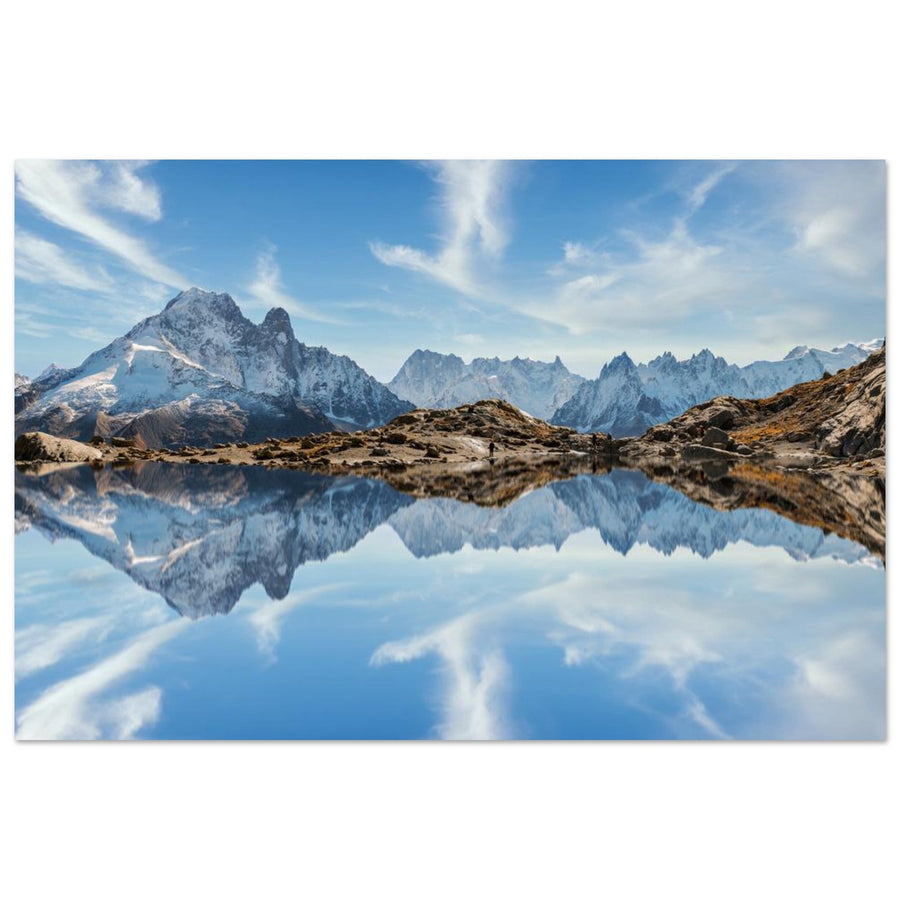
Lac Blanc is famous because it offers a very direct view of the Mont Blanc massif. From the lake's shores, the gaze is naturally drawn to the glaciers, peaks, and summits on the other side of the valley. This opposition between the calm water in the foreground and the high mountains in the background creates immediately striking compositions.
The main photographic interest comes from the reflections. When the wind drops, the lake becomes a natural mirror. The summits, rocks, and sometimes clouds are repeated in the water, allowing for very balanced images to be created. This type of composition works particularly well for wall prints, as the image remains legible even in large format.
Lac Blanc is also interesting because it changes a lot depending on the season. In early summer, residual snow can enhance the high-mountain feel. In autumn, the tones become softer, contrasts are often more subtle, and crowds can be more manageable than in the middle of summer.
Access to Lac Blanc: choosing the right itinerary
The simplest option is to take the Flégère cable car from Les Praz, then continue on foot. The official route is advertised as approximately 7 km, 500 m of positive elevation gain, and 3 hours round trip. These values are indicative: snow cover, weather, crowds, and chosen variations can significantly increase the duration.
The Chéserys lakes are also accessible from Argentière, Tré-le-Champ, or Col des Montets. These starting points offer a more comprehensive progression through the Aiguilles Rouges, but require more effort and a good understanding of conditions. For a first photo outing, choose the itinerary according to your level, the desired light, and your ability to descend safely.
The opening times of La Flégère and access to the trail depend on weather conditions, snow cover, and the lift schedule. A sunrise or sunset may necessitate a night hike: headlamp, warm clothing, spare battery, offline map, and ample time margin are essential.
Before you set off, check the cable car timetable, the condition of the trails, and information from La Chamoniarde. Never plan your return around the last cable car without a backup solution.
Lac Blanc or Chéserys Lakes: two different atmospheres
The two areas overlook the same massif, but they do not produce the same image. Lac Blanc offers a broad and immediately recognizable panorama. Its rocky shore easily guides the eye towards Aiguille Verte, Les Drus, Aiguille du Midi, and Mont Blanc. It is also the most frequented spot, with more elements to manage within the frame.
The Chéserys lakes offer smaller bodies of water and often more flexible compositions. An incomplete reflection can be more interesting there than perfect symmetry. The banks, granite boulders, and small variations in level provide more opportunities to shift the foreground by a few meters without exactly replicating the classic view.
When the wind picks up or Lac Blanc is very crowded, we don't force the expected shot. The Chéserys, a secondary pool, or a tighter composition on Les Drus can yield a calmer, more personal image.

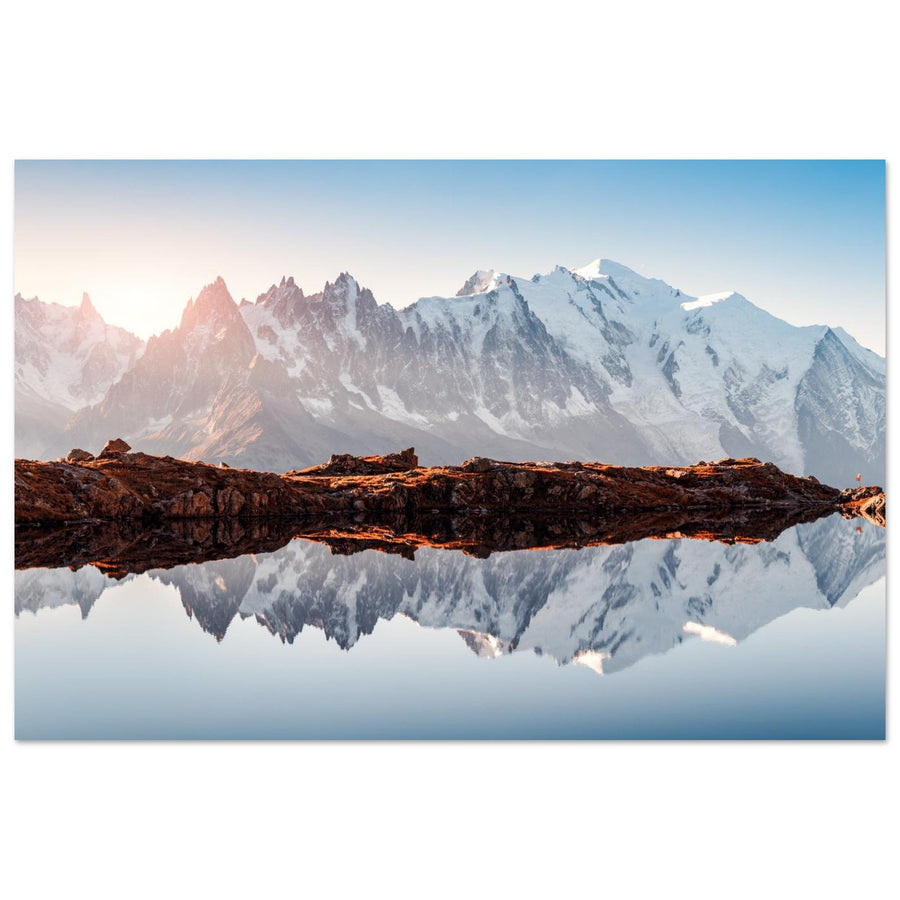
Photo of Mont Blanc's reflection in the Chéserys lakes
At Chéserys, the water surface is smaller and the foreground less monumental. The composition gains simplicity: the reflection, a few rocks, and the massif. This sobriety works particularly well in a horizontal format.
Photography: Smit
View this photo print on aluminium Dibond →When to photograph Lac Blanc?
Sunrise: the most spectacular option
Sunrise is often the most sought-after moment at Lac Blanc. The light can gradually touch the peaks of the Mont Blanc massif, while the lake remains calm. If conditions are met, the reflections can be remarkable.
It is also the most demanding slot. You have to arrive very early, sometimes walk at night, and deal with cold, fatigue, and uncertain weather. It's not the best choice for a first visit if you are unfamiliar with the area.
Late afternoon: soft light and relief
Late afternoon is a good alternative. The light becomes lower, the relief is better defined, and contrasts can be easier to manage than in the middle of the day. This is an interesting slot for working on softer compositions, especially with the rocks and lake shores.
Autumn: probably the most elegant season
Autumn is an excellent time to photograph Lac Blanc. The light is lower, the colors are more nuanced, and the general atmosphere can become more intimate. For an image intended for wall decoration, this is often a very interesting season: the tones are less aggressive, warmer, and blend easily into an interior.
Midday: to be avoided if possible
At midday, the light is often harsh. Whites can be blown out, shadows become very pronounced, and reflections are less clear if the wind picks up. If you arrive at this time, prioritize details, rock textures, water lines, or tighter framing rather than the classic panorama.
Wind, reflections and small pools: don't depend on a single image
The reflection of the massif is often presented as obvious, yet it remains very fragile. A light breeze is enough to break the symmetry, especially on Lac Blanc where the surface is more exposed. Rather than just waiting for perfectly still water, observe the sheltered areas behind boulders, small pools, and shores where the wind arrives less directly.
A partial reflection can be more vibrant than a complete mirror image. A few ripples give texture to the water and prevent a composition from being too rigid. When the reflection disappears completely, change your subject: a line of rocks, a silhouette on the trail, the first snow on Les Drus, or light breaking through the clouds can be enough to build a strong image.
This flexibility is important in such a frequented place. It avoids trampling the banks or desperately seeking the same framing as other photographers. The best viewpoint is often the one that can be reached without damaging the site and without disturbing other visitors.
Building a personal composition at Lac Blanc
1. The classic reflection of Mont Blanc
This is the most obvious image, but also the most difficult to achieve cleanly. Look for an area of calm water, avoid abruptly cutting off reflections, and maintain a simple composition. The trap is wanting to include too many elements: lake, refuge, rocks, summits, sky, hikers. A strong image is often built with less.
2. Rocks in the foreground
The boulders around the lake help structure the image. Use them as a foreground to guide the eye towards the Mont Blanc massif. This approach works well with a wide-angle lens, but be careful not to make the summits too small. If the panorama loses its power, step back or use a longer focal length.
3. Details of the lake and its shores
Lac Blanc should not only be photographed as a grand landscape. Details can produce more original images: ripples in the water, fragmented reflections, light-colored stones, alpine grasses, residual snow, contrast between dark rock and light on the peaks.
4. Telephoto lens on the Mont Blanc massif
A telephoto lens allows you to isolate the glaciers, ridges, and contrasts of the massif opposite. From the Lac Blanc area, this approach can yield very graphic images, less commonly seen than the classic mirror image of the lake.
5. A discreet human silhouette
A silhouette can help show the scale of the landscape. Use it sparingly: a hiker on a trail, a person sitting facing the massif, a small presence in an immense setting. This can enhance emotion without transforming the image into a simple hiking souvenir.
Photo tips and field preparation
Keep your composition legible
Lac Blanc is spectacular, but a spectacular photo isn't necessarily a legible one. Choose a main subject: reflection, summit, shoreline, light, texture, or silhouette. The clearer your intention, the more effective the image will be.
Expose to preserve highlights
Facing the Mont Blanc massif, snow and glaciers can quickly become overexposed. It is better to preserve the highlights and recover shadows slightly in post-processing than to lose details in bright areas.
Beware of polarizing filters
A polarizing filter can enhance colors and reduce some reflections, but at Lac Blanc, reflections are often part of the image's appeal. Use it with caution: too much polarization can remove the mirror effect you came for.
Anticipate the wind
Reflections are highly dependent on the wind. Even a light breeze can break the lake's mirror. The calmest slots are often early in the morning, but nothing is guaranteed in the mountains.
Prepare for the descent
If you're photographing sunrise or sunset, don't just think about the shot. Also think about the return: remaining light, headlamp, cold, fatigue, path, phone signal, and weather. Lac Blanc remains a mountain site.
Nature reserve, bivouac, and regulations
Lac Blanc and a large part of the routes in the sector are located within the Aiguilles Rouges nature reserve. The banks and wetlands are fragile: stay on existing paths, do not move stones, do not trample vegetation to gain a few centimeters in framing, and take all your waste with you.
The reserve's regulations specifically prohibit dogs, swimming, fires, camping, and overflights. Drone use is therefore not permitted in the reserve. The exact limits must be checked on official maps before any outing.
From June 1 to September 30, bivouacking is regulated in the Aiguilles Rouges massif reserves. It is tolerated between 7 PM and 9 AM only in authorized areas, with mandatory reservation and within capacity limits. As rules can change, always check the map and official conditions when preparing your outing.
Official sources to check before departure
Photographs of Lac Blanc and Lacs des Chéserys
We have selected two complementary works: one focuses on the Aiguille Verte and Les Drus; the other favors a wider sunset. They avoid repeating the two photographs already commented on in the guide.

A more intimate framing of the Aiguille Verte and Les Drus, with the Lacs des Chéserys as foreground.
Photography: Pierre ThiavilleDiscover the print
Warm light over the entire massif, designed for a large horizontal format.
Photography: Pierre ThiavilleDiscover the printPhoto prints of mountain lakes
The collection brings together Lac Blanc, Les Chéserys, and other Alpine lakes selected for their reflections, light, and balance in large format.
Frequently asked questions about Lac Blanc, Les Chéserys, and La Flégère
What is the best time to photograph Lac Blanc?
Sunrise is often the most sought-after slot when the water remains calm. However, late afternoon and blue hour offer more flexibility for working with relief, clouds, and less frontal framing.
Which access route should I choose for a first outing?
The route from La Flégère reduces the initial effort, provided the lifts are open. It is still a mountain hike: check snow conditions, weather, schedules, and your ability to descend without relying on the last gondola.
Is Lac Blanc necessarily better than Les Chéserys?
No. Lac Blanc offers the most iconic view, while Les Chéserys provides several bodies of water, more varied foregrounds, and more solutions when wind or crowds make framing difficult.
Do I need a perfect reflection?
No. A partial reflection, light on Les Drus, a break in the clouds over a glacier, or a telephoto composition can produce a more personal and stronger image than perfect symmetry.
Which focal length should I bring?
A 24–70 mm covers most compositions. A 70–200 mm becomes very useful when peaks appear through gaps or when the reflection disappears. Ultra-wide-angle only works if the foreground is truly structuring.
Can I bivouac freely near Lac Blanc?
No. From June 1 to September 30, bivouacking is regulated, limited to authorized areas, and subject to reservation. It is imperative to consult the map and official rules before departure.
Can I use a drone at Lac Blanc?
No, not in the Aiguilles Rouges nature reserve: overflying is prohibited there. Check the official limits of the protected area before any flight preparation in the valley.