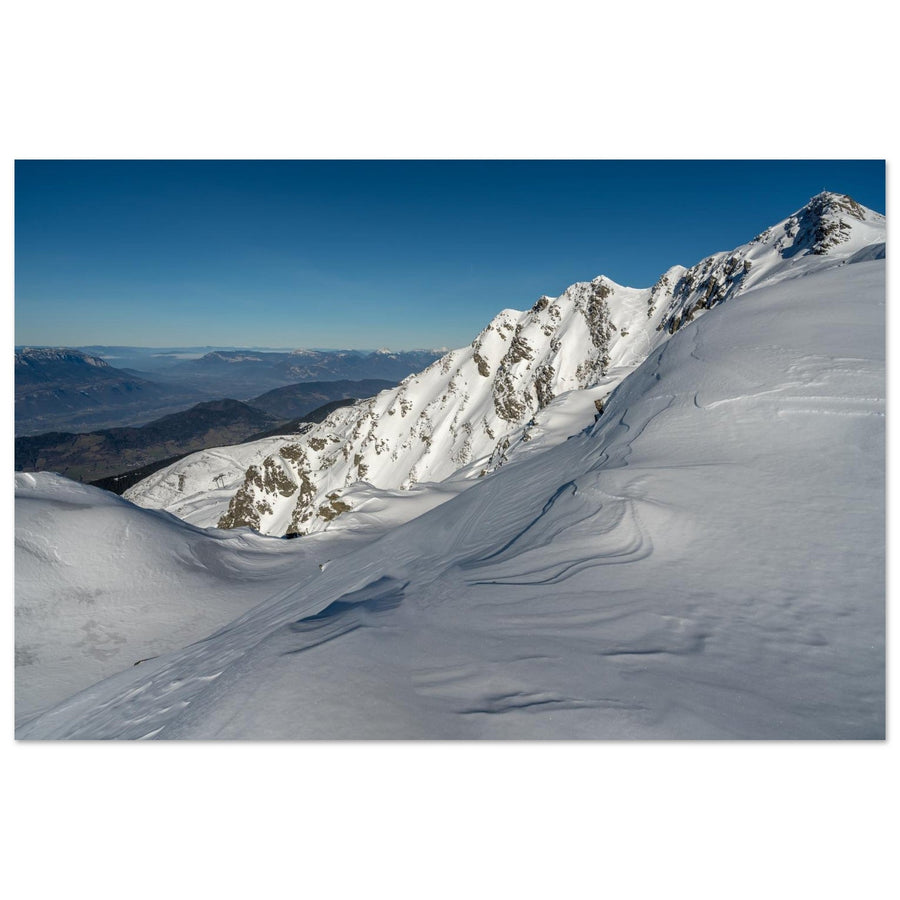
Belledonne | Photographing the Sept Laux lakes
Belledonne · project 03
At the Sept Laux, the subject is not an iconic lake but a system: several waters, structures, slabs and ridges must form a readable sequence.
Lakes Noir, Carré, Motte, Cottepens, Cos, Jeplan, Corne and Sagne cannot all fit into one image. The project is therefore to choose a hierarchy, then repeat a few signs so the series remains coherent.
Initial decision
What structure should make the series intelligible?
The number of lakes forces you to select one dominant relationship before framing.
Look for two or three water surfaces of different sizes, separated by clearly visible slabs or strips of terrain.
Use the route, a shoreline or a succession of structures to lead the eye from one basin to another.
Use the relief as a common frame, but keep enough water for the subject to remain the lake system rather than a chain of summits.
Local signature
A sequence of water, rock and structures
The Sept Laux signature comes from repetition and visible transitions between basins.
Small and large bodies of water create rhythm. Their scales must remain distinct to avoid an undifferentiated blue mass.
Slabs, shores and steps make the succession readable. Without them, several basins can merge visually.
Dams and constructions belong to certain viewpoints. They can create a line of progression if they do not become the only subject.
The relief links the basins and sets the scale of the plateau, provided it remains in service of the series.
Real positions
What each part of the plateau allows you to read
Positions are not interchangeable: they change the number of basins, the presence of structures and the direction of the series.
Composition consequences
Turn repetition into hierarchy
Each frame should designate a first role, a second role and a connection.
Give one clear dominant element
One lake receives the greatest surface or strongest contrast; the others prove the system without competing.
Keep strips of terrain
Slabs, shore or steps must remain visible between waters so their number can be understood.
Repeat one direction
A shoreline diagonal, a structure line or the direction of reflections leads the eye in the same direction.
Limit variations
Keep a consistent focal length or eye level across several frames so differences between basins remain comparable.
Editorial boundary
When is the image still about the Sept Laux?
The system remains central as long as repetition and transitions organize the image.
Two or more basins differ by form, level or role in the composition.
One basin can become the main subject if another water, shoreline or the plateau progression still proves the whole.
An isolated body of water without a visible relationship becomes a single-lake project; a dominant ridge or dam becomes another subject.
Failures and fallbacks
What makes the series unreadable and what to change
Conditions can erase separations, rhythm or even access to the plateau.
The levels merge
Move closer to shores and slabs; use their material to separate basins rather than relying on sky contrast.
Reflection no longer connects the series
Make the repetition of outlines and water colors the constant, without waiting for identical mirrors.
Fallback: reduce the number of roles
Work one main lake and one nearby secondary shore; do not claim depth that visibility no longer proves.
Fallback: do not force access
The route can be difficult outside the season. Change project or postpone the series if conditions exceed available experience.
Terrain and sources
Prepare a long outing on a high-altitude plateau
The access from Le Pleynet is described as difficult and the loop requires genuine time margin. Between autumn and spring, snow and melt can strongly alter the terrain.
A serial project takes longer than a single image. Define in advance how many frames you need and a turnaround time independent of hoped-for light.
Check before the outing
Conditions and services change with the season.
- Weather, wind, storms and visibility on the plateau.
- Residual snow, melt and passage conditions.
- Walking time, turnaround time and group ability.
- Refuge staffing, booking and services.
- Rules related to livestock, dogs and bivouac.
Official sources
The Les 7 Laux pages describe the system, access and seasonal information to recheck.
Other Belledonne projects
Continue the Belledonne project
Useful nearby projects
Move to another page if you prefer a two-act progression or a contrast between two atmospheres.
Return to the territory choice
The massif guide compares series, progression, contrast and the water–summit relationship.