Where to photograph lakes Besson and Noir and the Col de Sarenne?

Where to photograph lakes Besson and Noir and the Col de Sarenne?

Published on July 30, 2026

Above Alpe d’Huez, the high-altitude lakes and the Col de Sarenne offer a very different face from that of the snow-covered resort. Lac Besson is set amidst open alpine pastures, Lac Noir uses darker water to frame the Belledonne mountains, while the Sarenne road crosses a pastoral and mineral landscape facing the Ferrand valley, the Emparis plateau, and La Meije.

These three areas are not photographed in the same way. Around the lakes, success depends on the quality of reflections, the choice of foreground, and the ability to simplify the shorelines. At Col de Sarenne, one must work more on the lines of the road, the snowfields, the alpine pastures, and the succession of slopes. In both cases, the light changes very quickly: a few clouds can add depth to the landscape, while a uniformly blue sky can make compositions flatter.

This guide compiles the most useful methods for photographing Lacs Besson and Noir, the plateau of lakes, and the Col de Sarenne. It complements the guide dedicated to Alpe d’Huez, Pic Blanc, and the peaks of the Écrins, as well as the general guide to Alpe d’Huez and Les Grandes Rousses.

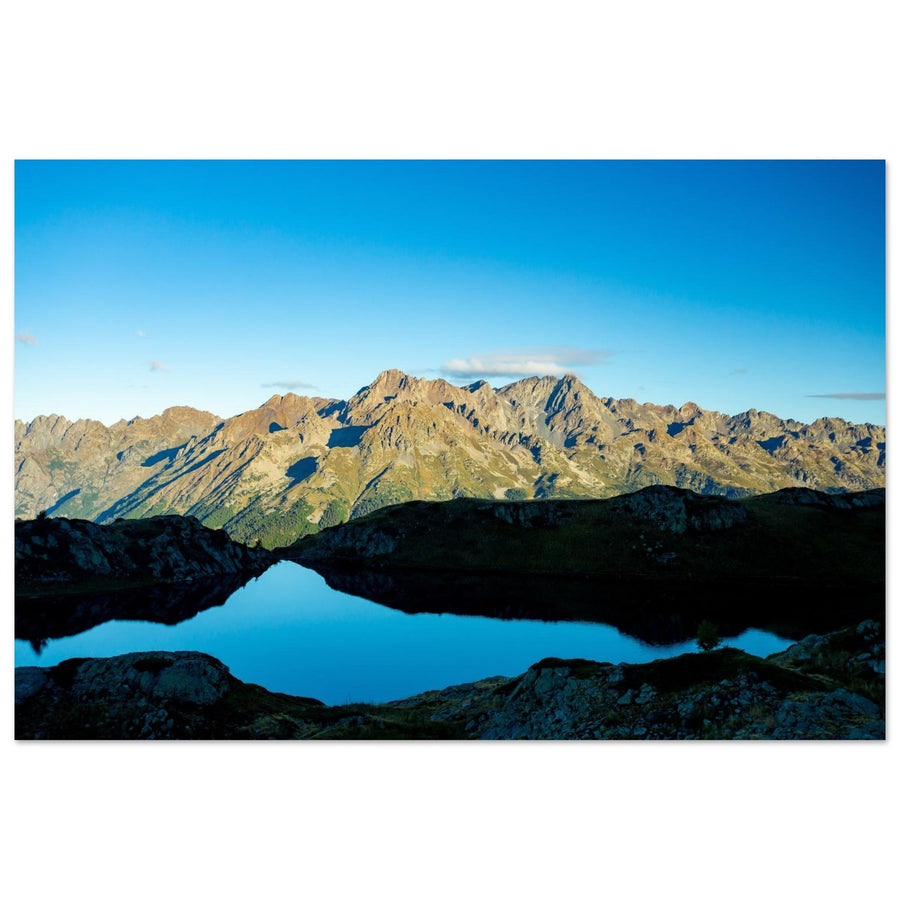
Photo print of Lac Noir facing Grand Pic de Belledonne from the heights of Alpe d’Huez
Lac Noir forms a dark foreground facing the Belledonne ridges and immediately adds depth to the image. Photograph by Florian Augustin. Discover this photo print of Lac Noir.

The essentials in 30 seconds

  • Best area for reflections: Lac Besson and Lac Noir when the wind is low, ideally early morning or during a lull.
  • Most graphic view: Lac Noir with the rocky foreground and the Belledonne ridges in the background.
  • Most open landscape: Col de Sarenne, where the road, alpine pastures, snowfields, and Ferrand valley create broader images.
  • Most useful focal lengths: 24–70 mm for structuring the lakes and col landscapes, 70–200 mm for isolating ridges, snowfields, and the road.
  • Most versatile season: summer for access and reflections, with particular interest in late spring when snow patches persist.
  • Essential tip: don't systematically look for a perfect reflection. A partially rippled surface can add texture if the composition remains simple.

Why photograph the lakes and Col de Sarenne?

The heights of Alpe d’Huez are often associated with skiing, slopes, and the panorama from Pic Blanc. However, the plateau of lakes and Col de Sarenne allow for building a much more natural series. Infrastructure is present in places, but it doesn't necessarily dominate the image. Water, rocks, grasses, snowfields, and the pastoral road become the main compositional elements.

The first photographic interest comes from the variety of scales. At Lac Besson, a photographer can work close to the shore, use a tuft of grass or a stone as a foreground, then let the eye follow the contours of the mountains. At Lac Noir, the contrast between dark water and distant mountains creates a more graphic image. At Col de Sarenne, the landscape opens up: the switchbacks, slopes, and valleys require a broader interpretation, often enhanced by a moderate telephoto lens.

The second interest comes from seasonal changes. Summer provides access to trails, shores, and the col road. Late spring or early summer may still have snow patches that define the slopes. In autumn, the colors of the alpine pastures become muted, and the first snows may reappear. Each period alters the balance between water, rock, and vegetation.

Finally, this area allows one to work without solely depending on a spectacular peak. A cloudy sky, a shoreline, a curve in the road, or an incomplete reflection are enough to create a strong photograph. This approach is particularly useful when the high mountains remain partially obscured.

Which area to choose depending on the desired image?

Area Main Subject Interesting Light Useful Focal Lengths Watch out for
Lac Besson Alpine pastures, clear water, gentle shores and views of the massifs Calm morning, clearings after a disturbance, end of day 24–70 mm, 70–200 mm Cluttered shore and overly central reflection
Lac Noir Dark water, rocks, Grand Pic de Belledonne and perspective Windless morning or side light 24–70 mm, 50–135 mm Shadows too deep and overexposed sky
Plateau des lacs Succession of bodies of water, trails, alpine pastures and mountains Variable sky, low light, cloudy afternoon 24–105 mm Accumulation of subjects without hierarchy
Route de Sarenne Switchbacks, curves, pastures, snowfields and vanishing lines Early or late day, side light 35–150 mm Traffic, parking and cut lines
Col de Sarenne Ferrand valley, Emparis plateau, Meije and open landscape Clear air, fragmented clouds, light after a front 24–70 mm, 70–200 mm Wind, very vast horizon and empty foreground

Access and organizing a photo outing

The plateau of lakes and the Col de Sarenne are close on a map, but they should not be approached as a single parking spot. For the lakes, the Alpe d’Huez Tourist Office indicates that the departure can be from the Lac Besson area, reached on foot, by summer-open lifts, or by free shuttles. Car access to the lakes road is not open to general traffic. Conditions, schedules, and services change according to the season: they should be checked on the day of the outing.

The official lakes trail notably passes by Lacs Besson, Faucille, and Carrelet, offering views towards the Taillefer and Belledonne massifs. For a photographer, the interest is not necessarily to cover the entire loop. It is often better to spend time at two or three shorelines, observe the wind, and wait for better light rather than rushing through all the bodies of water.

Col de Sarenne can be reached from Alpe d’Huez via the col road or from the Ferrand valley. The official pedestrian itinerary from the altiport mainly follows the road and is approximately 7 kilometers round trip with 140 meters of elevation gain. The road is seasonal and depends on snow conditions. The col is at 1,999 meters: even in summer, wind and temperature variations can be significant.

For sunrise or sunset, the main difficulty is logistical. Shuttles and lifts do not always align with the best light hours. Therefore, one must prepare for the return on foot, stay on a known route, and not improvise a cross-country traverse when night falls.

Useful official links before the outing

Road openings, shuttles, lifts and restrictions can change. Always check updated information before you go.

Photographing Lac Besson: reflections, alpine pastures, and soft composition

Lac Besson is the most accessible area for mountain lake photography without seeking a harsh high-mountain ambiance. The grasses, rounded slopes, and shorelines create a gradual transition between the water and the mountains. This visual softness is an advantage, but it can also produce overly scattered images if no element dominates.

Before taking out the wide-angle, visually frame the scene. Look for a shoreline that creates a diagonal, an isolated stone, or a group of grasses capable of leading the eye towards the lake. The reflection does not necessarily have to occupy the exact half of the image. A slightly asymmetrical framing, with more mountain or more water depending on the light, often creates more tension.

In light wind, a focal length between 35 and 70 mm allows you to tighten the landscape while maintaining context. An ultra-wide-angle can be useful if the foreground is genuinely strong, but it quickly pushes mountains into the distance; too tight, and the lake becomes a mere dark band. With a 70–200 mm lens, portions of the shoreline and the mountains become almost abstract compositions, particularly interesting when clouds are reflected in the water.

Midday light should not always be dismissed. A partially cloudy sky can cast shadows on the alpine pastures and separate the planes. In this case, expose for the highlights, then check the histogram. If the water reflects a very bright sky, a polarizing filter can reduce some reflections, but it must be used sparingly: completely removing the reflection sometimes removes the main element of the scene.

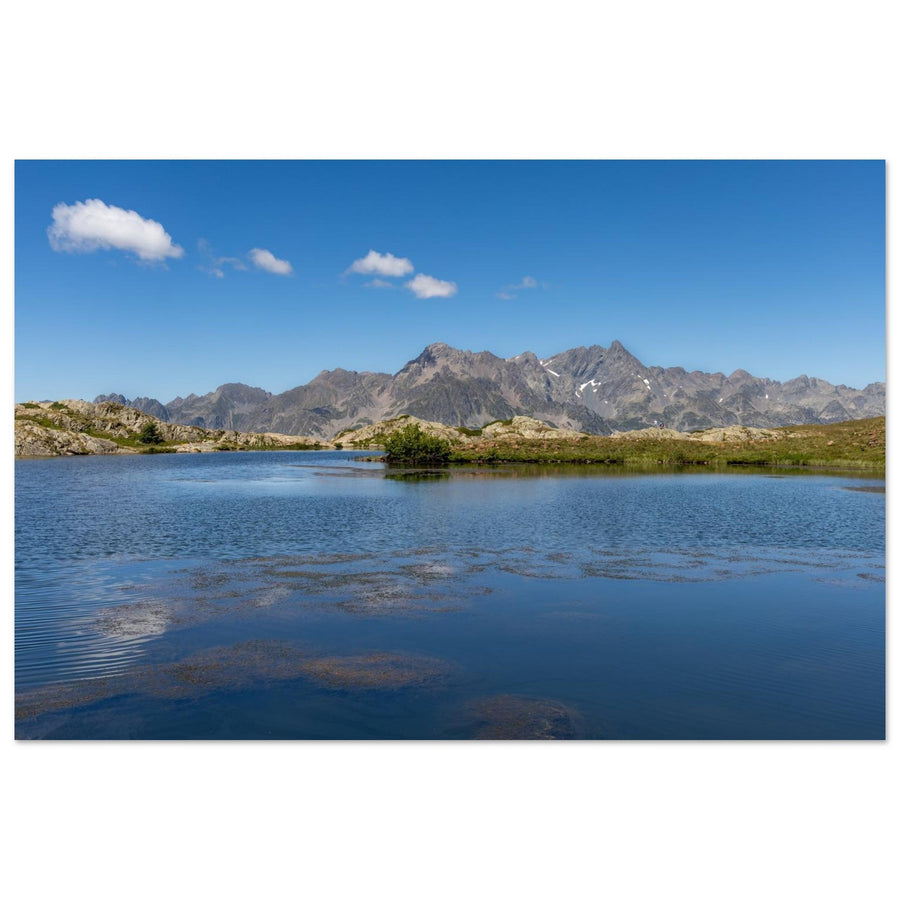
Photo print of Lac Besson in Alpe d’Huez surrounded by alpine pastures in Les Grandes Rousses
Lac Besson shows the summer and pastoral side of the Alpe d’Huez heights. Photograph by olivard. Discover this photo print of Lac Besson.

Building a reflection without falling into automatic symmetry

Perfect symmetry works when the lake's surface is calm and the mountain forms a strong silhouette. But it quickly becomes predictable if both halves of the image tell exactly the same story. To maintain movement, place a stone, some grass, or a curve of the shoreline in the lower third. You can also leave more sky if the clouds are graphic, or more water when the reflections are richer than the direct landscape.

Another choice is to exclude the horizon. With a long focal length, photograph only a portion of the reflection, a shoreline, and some textures. This approach produces more decorative images and avoids depending on perfect visibility of the peaks.

Photographing Lac Noir and the Grand Pic de Belledonne

Lac Noir offers a more mineral ambiance. Its dark water, rocks, and view towards Belledonne produce a more contrasted photograph than Lac Besson. The main challenge is to balance the rocky foreground with the distant mountains without making the image appear cut in half.

Start by looking for a group of rocks rather than a single enormous stone. Several elements of different sizes create a natural progression towards the water. A focal length around 35 or 50 mm maintains a credible relationship between the lake and the Grand Pic de Belledonne. Broadening too much, the range loses its presence; tightening too much, the lake becomes a mere dark band.

Side lighting is particularly useful. It reveals the texture of the blocks and the folds of the slopes, while frontal light can flatten the relief. If the lake remains in shadow while the mountains are in the sun, monitor the dynamic range. Moderate bracketing can be relevant, provided that a natural rendering is maintained and the water is not artificially brightened to the point of losing its character.

Lac Noir also allows for vertical framing. Use the rocks at the bottom of the image, let the water occupy the central part, then place the ridges in the upper third. This format enhances depth and is well suited for mountain prints intended for narrower walls.

Identifying peaks with caution

The direction of Belledonne is discernible from the plateau, but the superposition of ridges can make precise identification more difficult than it seems. A mapping application, an IGN map, or a geotagged photograph can help, but the final caption must remain cautious. The associated product is identified as a view of Lac Noir facing the Grand Pic de Belledonne; for other framings, do not name a peak without verification.

Composing on the plateau of lakes without accumulating subjects

The plateau is not limited to two bodies of water. Official itineraries also cross the areas of Lacs Faucille and Carrelet. This succession makes one want to include everything in a single hike and a single article, but photography requires a stricter selection.

At each lake, ask yourself three questions: what is the main line, what element provides scale, and what background is worth keeping? If no answer is clear, continue rather than filling up the memory card. A small pond with a clean shoreline and a well-placed cloud can produce a stronger image than a large lake photographed in flat light.

Trails can serve as leading lines, especially when hikers provide scale. However, wait until their position is clear and avoid photographing recognizable people without their consent. Herds and pastoral areas also require staying on paths, closing fences, and not approaching animals to compose an image.

The plateau is interesting when the sky changes rapidly. Cloud shadows create patches of light that structure the alpine pastures. A medium focal length then allows you to choose an illuminated area and reduce the space occupied by an uninteresting sky.

Photographing the Col de Sarenne: road, snowfields and Ferrand valley

The Col de Sarenne, at 1,999 meters, marks a transition between the heights of Alpe d'Huez and the Ferrand valley. The landscape is less developed than that of the resort and less enclosed than that of the lakes. The road, pastures, and mineral slopes allow for compositions at multiple scales.

The road is the most obvious graphic line. However, simply framing a hairpin bend is not enough. Look for a curve that genuinely leads towards a relief, a snowfield, or an illuminated area. A focal length of 70-135mm slightly compresses the planes and brings the hairpin bends closer. A 24-70mm is more suitable when a foreground of flowers, grass, or rocks structures the image.

In late spring, snow patches cut across the slopes and add contrast to the alpine pastures. Expose carefully to preserve details in the snowfields. When the light is harsh, an overcast sky or fragmented clouds can be more interesting than full sun. In summer, the road and herds offer a pastoral scene; in autumn, the colors become more mineral and the first snows can highlight the ridges.

From the pass, official tourist information mentions views towards the Emparis plateau, the Meije and its glaciers. A telephoto lens allows these elements to be isolated, but visibility and angle change rapidly with the clouds. Avoid transforming the background into a catalog of peaks: choose a silhouette or a clear relationship between the road and the high mountains.

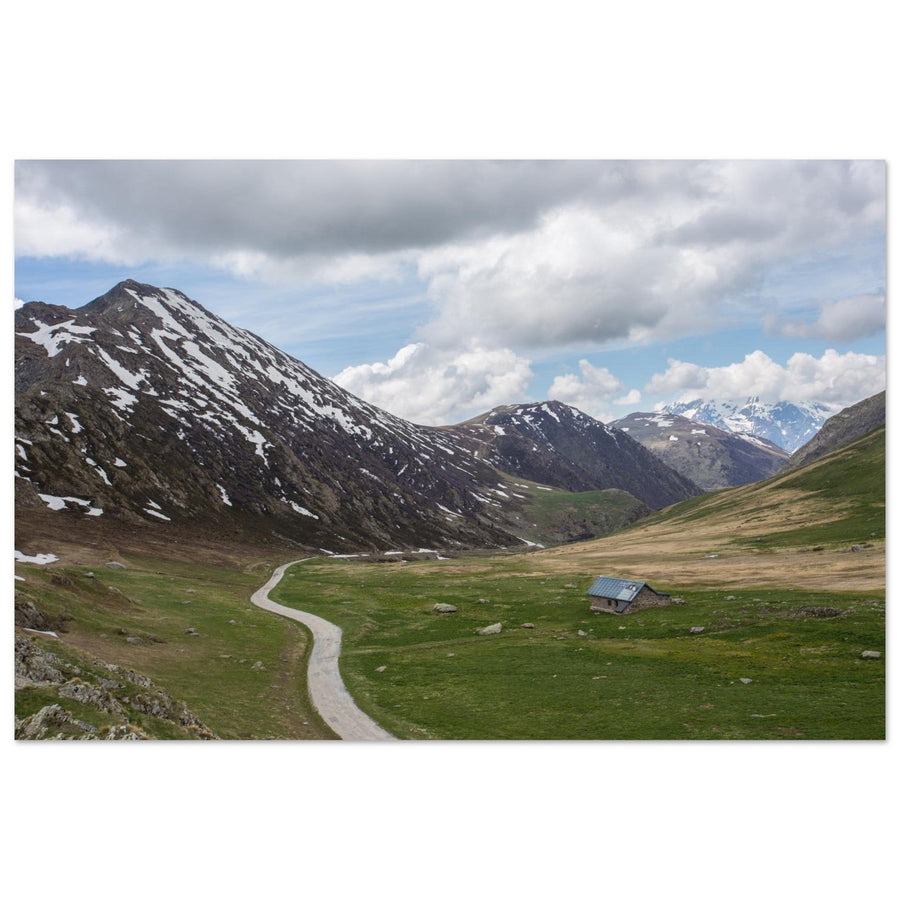
Sarenne pass photo print in spring with alpine pastures and snowfields in the Grandes Rousses
In spring, snowfields and alpine pastures form a transitional landscape around the Sarenne road. Photography by A Athena Images. Discover this photo print of the Col de Sarenne.

Integrating the road without producing a simple road photo

The road must serve the landscape. Avoid placing it exactly in the center if it does not lead to any subject. A curve starting from a corner, an illuminated section, or a very small vehicle can give scale. Conversely, a close-up, cropped car immediately distracts attention.

Safety comes before composition. Use authorized parking spaces, never set up a tripod on the road, and remain visible. The road is narrow in places; low traffic does not mean the absence of cyclists, agricultural vehicles, or other users.

Reflections, weather and light: when to photograph?

For lakes, wind often matters more than the theoretical time of sunrise or sunset. Spectacular light does not necessarily produce a clear reflection if the water surface is choppy. Morning is generally favorable, as the air can be calmer and the shores less frequented. But a lull between two cloud passages can occur at any time.

Lake Besson tolerates soft, diffused light well, which balances the alpine pastures and the sky. Lake Noir benefits from more directional light, capable of revealing the rocks without excessively brightening the water. At the Col de Sarenne, side light highlights the curves of the road and the succession of slopes.

After a disturbance, the air can become more transparent and distant peaks better defined. However, wait until the clouds detach from the relief. A telephoto lens in still humid atmosphere amplifies the haze and reduces contrast. In this case, a closer composition, centered on the banks or snowfields, will often be more effective.

Summer storms pose a real risk at altitude. They can produce impressive light, but you should not stay exposed near a lake or pass to wait for lightning. Consult forecasts, observe the evolution of the sky, and retreat early enough.

Which season to choose for the lakes and the Col de Sarenne?

Late spring: snowfields and transition

When access roads are open and the snow recedes, white patches outline the slopes around Sarenne. The lakes may still be partially covered by ice or surrounded by wet ground. This period is photogenic but highly variable: do not rely solely on the date.

Summer: access, reflections and alpine pastures

Summer offers the greatest flexibility for exploring the plateau. The shores are accessible, the alpine pastures take on color, and official routes are generally passable. The best images are often taken early or late, to avoid harsh light and crowds.

Autumn: muted colors and first snows

The plateau does not offer the large larch forests of the Queyras, but dry grasses, rocks, and early snows can produce a more subdued palette. Days shorten and seasonal services decrease: the return journey should be planned in advance.

Winter: a different territory

In winter, the area belongs to the snow-covered mountain domain and summer access roads are no longer comparable. The road to the pass is closed depending on snow cover, and the shores should not be approached as in summer. The advice in this guide primarily concerns the period without continuous snow.

Eight composition ideas and suitable focal lengths

1. Diagonal shore at Lake Besson

Place the shore from a lower angle and lead it towards an area of light. A focal length of 35 to 50 mm maintains natural proportions.

2. Partial reflection rather than perfect mirror

Frame a portion of a mountain and its reflection, without including the entire lake. A 70–200 mm allows for a more abstract and less descriptive image.

3. Rocks, Lac Noir and Belledonne in three planes

Use the foreground rocks, the dark water in the center, and the ridges in the background. Close the aperture slightly and check the sharpness of the foreground.

4. Vertical format on Lac Noir

The vertical format reinforces the succession of rock, water, and mountain. It is particularly suitable for narrow wall decoration.

5. Trail and hiker on the plateau

A very small hiker gives scale. Wait for a position detached from the background and respect the right to image if the person is identifiable.

6. Sarenne road hairpin bend with a telephoto lens

A 70-200mm brings curves and slopes closer. Look for a repetition of lines rather than a simple turn.

7. Snowfields and alpine pastures in spring

Use the snow patches as graphic shapes. Expose to avoid blowing out highlights and maintain natural vegetation.

8. Col de Sarenne under a fragmented sky

Wait for a patch of light to illuminate the road or a slope. A focal length of around 50 to 100 mm allows you to simplify the sky and concentrate the view.

Three photo outing strategies

Option 1 — Priority reflections around the lakes

Depart early, head to the Lake Besson area, and start by observing the wind. First, work on the lake with the calmest surface, then continue towards Lake Noir. Allow time to return to a framing when the light changes. This strategy is suitable for 24–70 mm and 70–200 mm focal lengths.

Option 2 — Lake plateau in variable light

Choose a partially cloudy day rather than an entirely blue sky. Walk the trail with an intention per body of water: reflection, texture, path or relationship with Belledonne. This option is less dependent on sunrise and more suitable for daytime exploration.

Option 3 — Col de Sarenne and end of day

Locate the hairpin bends and parking areas before the best light. Photograph the snowfields and alpine pastures, then use the telephoto lens when the reliefs towards the Emparis plateau or the Meije become visible. Plan your return without relying on late seasonal services.

What equipment and settings to bring?

Equipment Main use Field advice
24–70 mm Lakes with foreground, plateau and wide landscapes of the pass Start around 35–50 mm before widening
70–200 mm Belledonne, partial reflections, hairpin bends, snowfields and distant details Monitor atmospheric haze and minimum shutter speed
Polarizing filter Manage reflections on water and enhance certain contrasts Do not remove all reflections and avoid uneven effects with wide-angle
Compact tripod Low light, assemblies and precise framing Keep it low in windy conditions and never set it up on the roadway
Lens hood and cloth Limit stray reflections and clean splashes Regularly check the lens near water
Warm clothing and windbreaker Waiting by the lakes and at the pass Do not rely on the resort's temperature

For a scene with a close foreground and a distant mountain, often work between f/8 and f/11, then check the depth of field. A high shutter speed is necessary when the wind moves the grass. To slightly smooth the water, a neutral density filter can be used, but a very long exposure can produce an artificial rendering if the clouds and grass move in different directions.

Bracketing is useful when a clear sky reflects in a dark lake. It should not replace careful exposure: start by protecting highlights, check the histogram, and maintain a natural contrast between the water, shore, and relief.

Safety, drone and respect for the environment

Preparing for a high-altitude outing

Even if the routes appear accessible, the weather can change rapidly. Bring a warm layer, water, sun protection, and an offline navigation tool. Wet banks and rocks can be slippery. Do not approach the edge to gain a few centimeters of reflection.

Respect pastoral areas

The plateau and the Sarenne valley are grazing areas. Stay on marked paths, close gates, keep dogs on a leash and give a wide berth to herds and protective dogs. A photograph does not justify moving an animal or entering a sensitive area.

Do not swim in the lakes

The Tourist Office states that swimming is prohibited on the lake trail. This rule protects the site and also prevents dangerous behavior in cold, high-altitude water.

Check drone regulations before each flight

Drone flight is never automatically authorized just because the landscape appears isolated. Consult the official map of restrictions, check local rules, inhabited areas, aerial activities, and the presence of people. The remote pilot must keep the device in sight, respect authorized altitudes, and give up in case of strong winds or rescue operations.

Discover the lakes and the Col de Sarenne as photo prints

The collection dedicated to Alpe d'Huez brings together winter landscapes, high-altitude panoramas, and summer scenes. Lakes Besson and Noir offer a more natural and contemplative ambiance, while the Col de Sarenne shows the transition between alpine pastures and high mountains.

These photographs are available as photo prints on matte Dibond aluminium, made to order. This medium offers excellent flatness and limits reflections, which is particularly suitable for dark waters, rocky textures, and large alpine landscapes.

Discover the Alpe d'Huez photo print collection.

FAQ: photographing Lakes Besson and Noir and the Col de Sarenne

How to access Lake Besson from Alpe d'Huez?

The Tourist Office indicates access on foot, by lifts open in summer, or by free shuttles depending on the period. The lake road is not open to general traffic. Check schedules and conditions before your outing.

Can you reach Lake Besson by car?

Not directly by general traffic according to current tourist information. The area is reached on foot or via seasonal services. Modalities may change during events or works.

What is the photographic difference between Lake Besson and Lake Noir?

Lake Besson offers a softer atmosphere, with alpine pastures and vegetated shores. Lake Noir is more mineral and graphic, with dark water, rocks, and a view towards Belledonne.

What is the best time to photograph reflections?

Morning is often favorable when the wind is light. However, a lull can appear at any time. Observe the water's surface and prioritize light that retains detail in the sky and shores.

Can you swim in the lakes around Alpe d'Huez?

The Tourist Office specifies that swimming is prohibited on the lake trail. Please respect the signage on site.

How to access the Col de Sarenne on foot?

An official itinerary starts from the Alpe d'Huez altiport and mainly follows the pass road. It is estimated to be approximately 7 kilometers round trip with a 140-meter elevation gain. Check opening times and weather conditions.

Is the Col de Sarenne road open all year round?

No. The road is seasonal and depends on snow cover and conditions. The dates displayed by tourist offices remain indicative and must be confirmed before traveling.

Can I use a drone around the lakes or the Col de Sarenne?

Flight is not automatically authorized. Consult the official map of aerial restrictions, local rules, and current conditions. Avoid people, herds, inhabited areas, and any rescue activity.