Où photographier Saint-Véran et la chapelle de Clausis ? - AluArtMountains

Where to photograph Saint-Véran and the Clausis chapel?

Published on July 30, 2026

Saint-Véran and the Clausis chapel offer a rare photographic series in Queyras: starting from a high-altitude village shaped by wood, stone, and snow, then following the Aigue Blanche valley up to a small religious building set in a much more open landscape. The two subjects are close but require very different approaches.

In the village, the work focuses on rooflines, log house facades, sundials, narrow streets, and the relationship between dwellings and the slope. In Clausis, the image becomes more refined: a chapel, a few alpine curves, ridges, and a light that can isolate the building in the middle of the valley. The challenge is not to accumulate viewpoints but to progressively narrate the transition from inhabited heritage to high mountain.

This guide details framing, focal lengths, lighting, seasons, and how to organize an outing between Saint-Véran and Clausis. It complements our general guide to Queyras, guides on Col d'Izoard and Casse Déserte, and on Ceillac, Lac Miroir, and Lac Sainte-Anne, as well as the selection of Queyras photo prints.

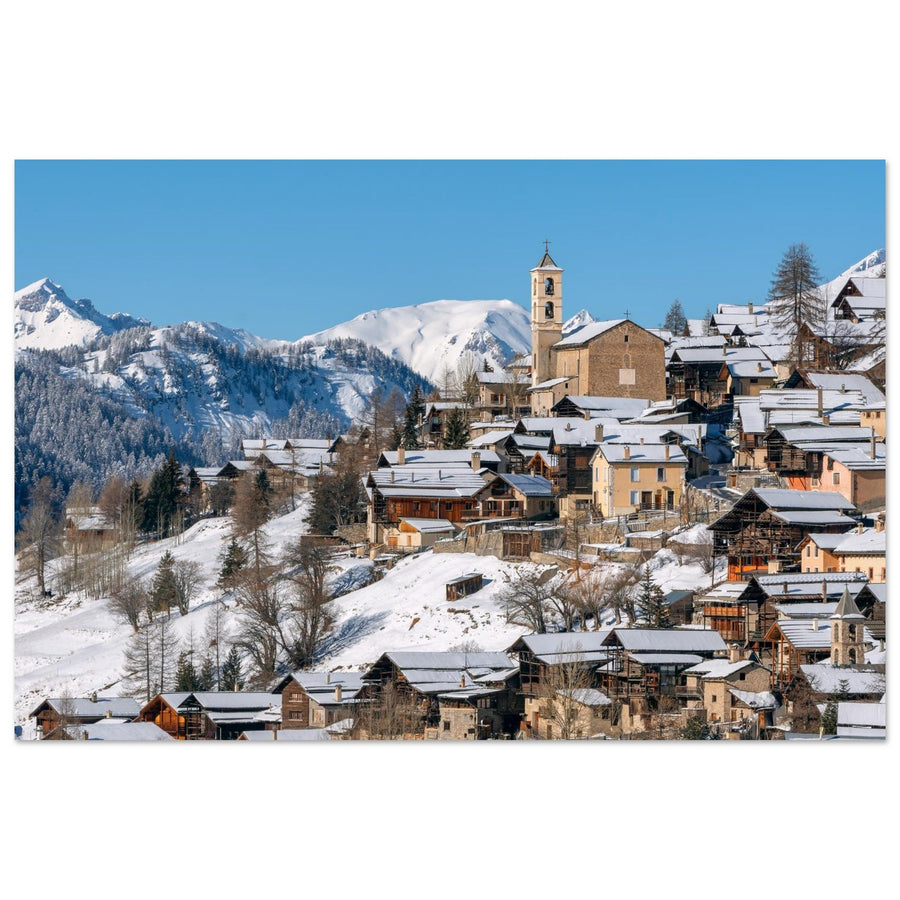
Photo print of Saint-Véran under the snow in Queyras
Under the snow, the chalets of Saint-Véran form a succession of dark and light volumes on the slope. Photography by Francois Roux. Discover this Saint-Véran photo print.

The Essentials in 30 Seconds

  • Two complementary subjects: architecture, narrow streets and chalets in Saint-Véran; isolated chapel, alpine pastures and ridges in the Clausis valley.
  • Best village approach: work with 24–70 mm or telephoto lens to organize facades and avoid overly distorted perspectives.
  • Best winter ambiance: end of day and blue hour, when snow retains detail and village lights begin to appear.
  • Best Clausis approach: seek lateral light, use the curves of the terrain and keep enough space around the chapel.
  • Access: motorized traffic to Clausis is regulated; a seasonal shuttle operates in summer, check schedules before departure.
  • Essential tip: don't photograph Saint-Véran as a static backdrop. Create images that show the relationship between architecture, slope, light, and village life.

Why photograph Saint-Véran and Clausis?

Saint-Véran spreads out on a largely sun-exposed slope, at an altitude of about 2,042 meters. The village stretches along the slope rather than concentrating around a single square. This elongated shape creates several levels of interpretation: roofs overlap, facades appear between wooden volumes, and mountains remain visible in the background. For the photographer, the interest comes less from a unique monument than from the repetition of forms and their adaptation to the relief.

Traditional houses combine masonry parts and wooden structures, often locally referred to as log houses. Sundials, fountains, crosses, narrow streets, and facade details make up many secondary subjects. Their photographic value, however, depends on the context: an isolated dial photographed frontally can become purely documentary, while a dial integrated into a facade, a shadow, and a portion of a street tells more about the village.

Leaving Saint-Véran upstream, the landscape gradually opens up. The Aigue Blanche valley first retains the presence of larches and traces of human activity, then the alpine pastures and reliefs take up more space. The Clausis chapel appears as a white dot in this setting. It offers a simple but demanding subject: if it is too small, it disappears; if it fills the frame, the landscape loses its function.

The strength of the area therefore lies in this opposition. Saint-Véran allows for working on density, details, and layers of constructions. Clausis invites simplification, the use of negative space, and precise measurement of the building's place in the mountain. A good series can connect these two registers without confusing them.

Village or Clausis chapel: which area to choose?

Sector Main subjects Useful light Focal lengths Point of vigilance
Saint-Véran, overview Roofs, slope, chalets, snow, village-mountain relationship Morning or end of day, slightly overcast sky 35–100 mm Avoid confusing stacking of facades
Narrow streets and heritage Log houses, sundials, fountains, doors, wood and stone details Diffuse or soft side light 35–85 mm Respect residents and private property
Aigue Blanche valley Path, torrent, larches, mines, transition to alpine pastures Morning, autumn, changing weather 24–200 mm Do not multiply subjects without hierarchy
Clausis chapel Chapel, alpine pasture curves, ridges, isolated ambiance Side light, cut clouds, end of day depending on the season 24–135 mm Keep enough landscape around the building

For a first discovery, the village offers more subjects and is more flexible in uncertain weather. Clausis becomes more interesting when you can choose the time, follow cloud changes, and dedicate time to specific compositions.

Access and organizing your outing

Access to Saint-Véran requires taking into account the village's organization, parking, and traffic restrictions. The visitor parking is located at the entrance to the village. Depending on the season, local shuttles then allow access to different points of the village and the departure of the Clausis shuttle. It is advisable to check schedules and conditions before planning a tight schedule around specific lighting.

The road to Clausis is subject to municipal regulations. In summer, private vehicles should not be considered authorized on the track. A paid shuttle serves the valley during the summer season, with terms that may change. Off-season, snow, track conditions, and local regulations completely change access. A photographic guide therefore does not replace official daily information.

For a combined outing, three solutions are possible:

  • Village only: two to four hours allow for seeking an overall view, a few street scenes, and architectural details without rushing.
  • Clausis only: the summer shuttle or walking allows for concentrating the session on the valley and the chapel.
  • Village and Clausis: plan for a full day, deciding in advance whether the best light should be dedicated to the village or the valley.

Photographers using a tripod, multiple lenses, or winter equipment must factor this weight into travel time. The return from Clausis should never depend on a hypothetical last shuttle: check the actual schedule and allow sufficient margin.

Photographing the village of Saint-Véran

The first difficulty in Saint-Véran is to find order in abundance. Facades, signs, balconies, vehicles, cables, and passers-by can quickly fill the frame. Before shooting, look for a dominant structure: a diagonal of roofs, a succession of gables, a street leading up to an illuminated facade, or a chalet isolated by snow.

Start with an overview

A general view should show how the village hugs the slope. Too wide a framing reduces the houses to a confusing strip; a moderate telephoto lens, on the contrary, brings the planes closer and accentuates the rhythm of the roofs. Look for a viewpoint where buildings stand out from each other, with a sufficiently simple background.

The 50 to 100 mm is often more effective than an ultra wide-angle. It slightly compresses volumes without removing depth. In winter, this compression reinforces the alternation between dark roof slopes, facades, and bands of snow. In summer or autumn, it helps integrate larches without giving too much importance to the sky.

Use streets as guidelines

In the narrow streets, a line of cobblestones, a low wall, or a succession of facades can guide the eye. Position yourself so that the street doesn't exit the frame too quickly. A single person can provide scale, but they should not obscure the architecture or turn the image into a crowd photograph.

Converging perspectives are inevitable when photographing close to buildings. Keep the camera as horizontal as possible and prefer a slightly longer focal length with sufficient distance. Moderate post-processing correction is preferable to extreme distortion from the moment of capture.

Show the mountain without overloading it

The mountain should support the village, not compete with every facade. A ridge line, a snowy slope, or a summit between two houses can be enough. With a telephoto lens, it's possible to combine a roof detail with a distant relief and directly show the relationship between habitat and altitude.

Log houses, sundials and architectural details

The heritage of Saint-Véran is not photographed only from the front. The wooden parts, assemblies, balconies, and storage volumes benefit from being observed from several angles. Grazing light reveals textures, while an overcast sky reduces contrasts and helps retain detail in dark areas.

Photographing log houses

Avoid reflexively framing an entire facade. Instead, look for a relationship between wood, stone, and a contextual element: a window, a shadow, an accumulation of snow, or a mountain line. Repetitions of beams work well in tight framing, but they must retain a visual anchor point.

Integrating sundials

Saint-Véran boasts numerous sundials, several of which are attributed to the Piedmontese sundial maker Zarbula. To avoid a simple documentary reproduction, place the sundial within the composition of the facade. A roof shadow, a window, or a street fragment provides scale and a relationship with the passage of time.

Direct light can enhance colors, but it also creates significant differences between plaster and wooden parts. Diffuse light or slightly veiled sun often offers more latitude. Do not systematically use a polarizer: it can unevenly darken an already very blue sky at altitude.

Respecting the inhabited character of the village

Houses are not freely accessible sets. Stay on public roads, do not cross a fence to get a better angle, and avoid directly aiming at windows or residents without permission. This constraint often improves photography: it forces you to seek out more minimalist compositions from truly accessible spaces.

Photographing Saint-Véran under the snow

Winter simplifies the village and enhances its graphic character. Snow separates roofs, masks certain secondary elements, and creates clear surfaces capable of reflecting light onto facades. However, it requires more rigorous exposure and preparation adapted to the cold.

Preserving snow texture

Control the histogram and highlights, especially when the sun hits the slopes while the village remains partially in shadow. Slightly gray snow is easier to correct than a completely blown-out area. Work in RAW and use the camera's overexposure alerts.

Enjoying the blue hour

After sunset, the sky and snow retain a diffuse luminosity while windows and lights become visible. This short period allows combining a winter atmosphere with human presence without artificial lights dominating. A tripod, moderate sensitivity, and light bracketing can help manage the luminosity difference.

Avoiding artificial color casts

Snow easily takes on a blue cast in the shade. Do not necessarily try to neutralize it completely: a slight cool tint reinforces the ambiance. However, monitor the mixes between warm street lighting, blue sky, and facades. A consistent white balance must preserve this opposition without making the snow orange or cyan.

Narrating the Aigue Blanche Valley

Between the village and Clausis, the valley provides the narrative transition for the reportage. The path follows or crosses several times the elements that structure the landscape: torrent, larch woods, tracks, old mining areas, and openings towards the peaks. It is not necessary to photograph every step. Choose a few images capable of explaining the progression.

Use the path as a common thread

A track or trail provides clear direction, especially when the valley opens up. Position the line to lead towards a building, a lit area, or a ridge. Avoid systematically centering the path: an off-center curve creates more movement.

Show the transition between forest and alpine pasture

In autumn, larches can form a warm initial sequence before the more stripped landscapes of Clausis. In summer, the greens are more uniform; it then becomes important to differentiate the planes by light, textures, or atmospheric depth. A telephoto lens allows isolating a lit edge or superimposing several slopes.

Do not overload the heritage narrative

The copper mine and marble quarry are part of the valley's history. They can provide a detail or a landmark, but the article remains focused on landscape and heritage photography. A strong image is often enough to evoke this human presence without transforming the series into a historical inventory.

Photographing the Clausis chapel

The Clausis chapel is located upstream of Saint-Véran, shortly after the old mining sites and the marble quarry. Its photographic interest comes from its small size in relation to the valley and the ridges. To maintain this relationship, avoid overly tight framing and seek a precise balance between the building, the terrain, and the sky.

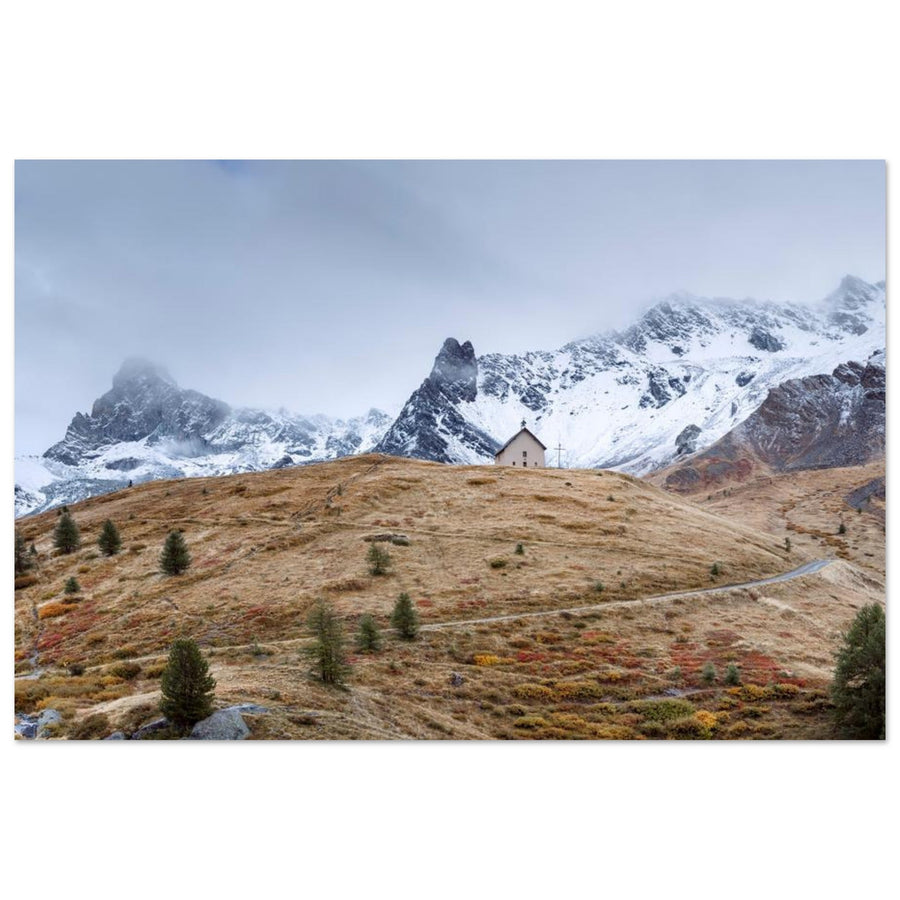
Photo print of the Clausis chapel in Queyras
The Clausis chapel forms a clear landmark in the alpine pastures and relief of the upper Queyras. Photography by G.Barattini-Photography. Discover this photo print of the Clausis chapel.

Keep space around the chapel

The building should remain sufficiently readable, but it should not fill the entire frame. Allow the curves of the terrain, a path, or a ridge band to appear. This breathing space gives scale to the landscape and reinforces the impression of isolation.

Choose a shooting height

A position that is too low can make the chapel disappear behind the relief. A position that is too high flattens the valley. Move around authorized areas and look for a level where the building stands out without the foreground becoming empty. A few meters of difference can be enough.

Use the telephoto lens to simplify

A 70–200 mm lens is useful for bringing the chapel closer to a ridge, isolating light on the alpine pasture, or removing secondary elements. However, the compression of the planes must remain natural. If the chapel appears glued to the mountain, slightly reduce the focal length or change your position.

Wait for localized light

Clouds are particularly interesting at Clausis. A clear patch of sky that touches the chapel or a portion of alpine pasture immediately creates a hierarchy. When the entire scene is uniformly lit, use the lines of the terrain and material contrasts rather than relying solely on light.

Which light to choose?

Morning: calmer details and departure towards Clausis

Morning is suitable for still quiet streets and architectural details. It also allows reaching the valley before the day's main activity. The exact light depends heavily on the season and the relief; observe the orientation of the facades rather than following a single rule.

End of day: village volumes and warmer atmosphere

Lower light enhances volumes and textures, especially when facades or slopes receive side light. It works well for general views, provided there is enough margin for the return and it does not depend on uncertain seasonal access.

Overcast sky: heritage and textures

A uniform sky is not necessarily unfavorable. It reduces contrasts in narrow streets, facilitates sundials, and preserves detail in wood. At Clausis, a completely flat sky can, however, weaken the image; then look for a more graphic composition and limit the sky's prominence.

After a snowfall

Fresh snow is particularly effective when the rooftops are still defined and the wind has not erased all textures. Check road conditions, snow-related risks, and travel conditions before prioritizing aesthetics.

Which season to choose?

Summer: easier access to Clausis

Summer offers the most flexibility to connect the village, valley, and chapel. The seasonal shuttle facilitates organization, but attendance can be high. Leave early and avoid creating images that depend on a completely empty site.

Autumn: woods, larches, and warm palette

Autumn particularly well connects the village and the landscape. The wood tones echo the larches, while the first snows may appear on the relief. Days shorten and seasonal services decrease: check access before planning a late return.

Winter: the village as the main subject

Saint-Véran becomes very graphic under the snow. Clausis then involves a different project, with specific travel and safety conditions. Do not transpose a summer itinerary to winter without appropriate preparation, equipment, and information.

Spring: transition season

Melting snow creates contrasts between snow, wet ground, and rooftops. Tracks and paths can be muddy, snowy, or temporarily fragile. This period offers less expected images but requires more flexibility and precise verification of the terrain.

Compositions and focal lengths

1. The village in successive layers

Use a 70–200 mm lens to superimpose three or four layers of rooftops. Keep space between the main buildings for the image to remain readable.

2. A street leading to a lit facade

Work at 35 or 50 mm and let the street guide you to a bright spot. Check verticals and avoid a cropped element in the foreground attracting all attention.

3. Sundial in context

Frame wide enough to include a window, a fragment of roof, or a portion of street. A normal focal length maintains natural proportions.

4. Chalets and mountain with a telephoto lens

Combine an architectural detail with a distant slope or ridge. This compression directly shows the village's adaptation to altitude.

5. Aigue Blanche valley with the path

Use the path as a curve leading upstream. A 24–70 mm lens generally provides enough context without making the mountains too small.

6. Clausis with negative space

Place the chapel in one-third of the frame and let the alpine pasture or sky convey the atmosphere. This composition works particularly well with localized light.

7. Clausis and compressed ridges

At 100–200 mm, bring the building closer to an identifiable relief without removing all depth. Wait for light values to clearly separate the planes.

8. Winter series at blue hour

Alternate a general view, a rooftop framing, and a detail of warm light. Maintain a consistent white balance for the series to remain coherent.

Three photo outing strategies

Option 1 — Saint-Véran, architecture and blue hour

Arrive in the mid-afternoon, start with facade details in still sufficient light, then look for a general view before sunset. Finish at blue hour with the village under snow or the first lights. This option is best suited for winter.

Option 2 — Village in the morning, Clausis afterwards

Photograph the streets and sundials early, then use the seasonal shuttle or walk to the valley depending on conditions. Dedicate the second part of the day to the valley and the chapel. This option produces the most complete series but requires flexible organization.

Option 3 — Clausis as the main subject

Go directly to the valley and spend several hours at the chapel, the curves of the alpine pasture, and the changes in light. Possibly extend to the Refuge de la Blanche only if the level, weather, and available time permit. The return and shuttle schedules must remain a priority.

Equipment and settings

  • 24–70 mm: main lens for streets, general views, the valley, and framing around Clausis.
  • 70–200 mm: very useful for organizing rooftops, isolating details, and bringing the chapel closer to the relief.
  • 16–35 mm: interesting in certain narrow streets and for foregrounds, but to be used with caution near buildings.
  • Tripod: recommended for blue hour, low light, and precise compositions at Clausis.
  • Polarizer: useful for controlling certain reflections and enhancing textures, but to be used sparingly to avoid an uneven sky.
  • Spare batteries: essential in winter, as cold reduces their autonomy.
  • Weather protection: lightweight cover, cloth, and waterproof bag are useful during rapid weather changes.

Initial settings

For static landscapes, start around f/8, ISO 100 to 200 and adapt the shutter speed to the focal length or tripod. In the village, a wider aperture can isolate a detail, but ensure that important elements remain sharp. At blue hour, work on a tripod and monitor artificial lights rather than automatically increasing ISO.

In winter, check the histogram after each light change. For Clausis, use a sufficient shutter speed if the wind moves grass or branches. Bracketing is useful in high-contrast scenes, but it does not replace well-chosen light.

Respect for the village, safety, and regulations

Saint-Véran is an inhabited village. Photograph from public roads and accessible areas, respect private property, and limit tripod setup in narrow passages. Do not block a street to wait for a shot and ask for the consent of recognizable people when they become the main subject.

Towards Clausis, motorized traffic is regulated. Consult official information on the shuttle, municipal decrees, and track conditions. In winter and during transition periods, snow completely transforms the commitment of the outing. Adapt the itinerary, equipment, and group level.

In the Queyras Regional Natural Park, dogs must be kept on a leash in alpine pastures, forests under forest management, and near flocks. Protection dogs should not be approached or photographed too closely.

Drone use is strictly regulated. The Park imposes distances from wildlife, lakes, refuges, alpine chalets, livestock, and protection dogs. In addition, there are national air rules, local restrictions, and respect for privacy in the village. Never consider takeoff as free without prior verification.

Photo prints of Saint-Véran and Clausis

The two works presented in this guide show the two identities of the area: the village under snow and the chapel isolated in the Queyras landscape. They are offered as a photo print on matte aluminum Dibond, made to order. The medium limits reflections and offers excellent flatness, suitable for architectural details, snow textures, and fine relief lines.

Saint-Véran under snow

The photograph by Francois Roux highlights the chalets, the slope, and the contrast between dark wood and snow.

View the photo print of Saint-Véran under snow

The Clausis chapel

The photograph by G.Barattini-Photography shows the chapel as a clear landmark in the alpine pastures and mountains of the upper Queyras.

View the photo print of the Clausis chapel

Explore the collection

Discover all Queyras photo prints

FAQ — Saint-Véran and Clausis chapel

What is the best time to photograph Saint-Véran?

Autumn highlights the larches and warm wood tones, while winter simplifies the village's forms under snow. Summer facilitates travel to Clausis. The best choice therefore depends on the desired subject and access conditions.

What is the best time of day to photograph Saint-Véran?

The beginning and end of the day generally provide softer light on facades and slopes. In winter, blue hour allows balancing snow, sky, and village lights. During the day, veiled light is useful for sundials and architectural details.

Can you photograph Saint-Véran and the Clausis chapel on the same day?

Yes, provided you define a priority and plan for walking, shuttle, and shooting time. In summer, the seasonal shuttle facilitates access to the Clausis valley. Off-season, organization depends on track opening, snow, and local restrictions.

How to access the Clausis chapel?

The chapel can be reached from Saint-Véran via the road and paths of the Aigue Blanche valley. In the summer season, a paid shuttle serves the area. Modalities change according to the period: consult official schedules and commune information before departure.

Can you drive up to the Clausis chapel?

Private vehicle traffic is regulated on the Clausis road. In summer, it is normally prohibited and replaced by a seasonal shuttle. Do not plan your outing assuming the track will be open: always check current decrees and conditions.

What focal length to use in Saint-Véran and Clausis?

A 24–70 mm lens is the most versatile choice for the village, valley, and chapel. A 70–200 mm lens allows isolating facades, sundials, chalets, and peaks. A 16–35 mm lens can be useful in narrow streets or near Clausis, provided excessive distortion is avoided.

Are dogs allowed towards Clausis?

Dogs are subject to the rules of the Queyras Regional Natural Park and municipal decrees. They must be kept on a leash in alpine pastures, forests under forest management, and near flocks. Check local provisions before the outing.

Can a drone be used in Saint-Véran or around Clausis?

Drone use is strictly regulated in the Queyras Park and near the village, flocks, wildlife, refuges, and buildings. Municipal decrees, national air regulations, and necessary authorizations must be consulted before any takeoff.

Back to blog