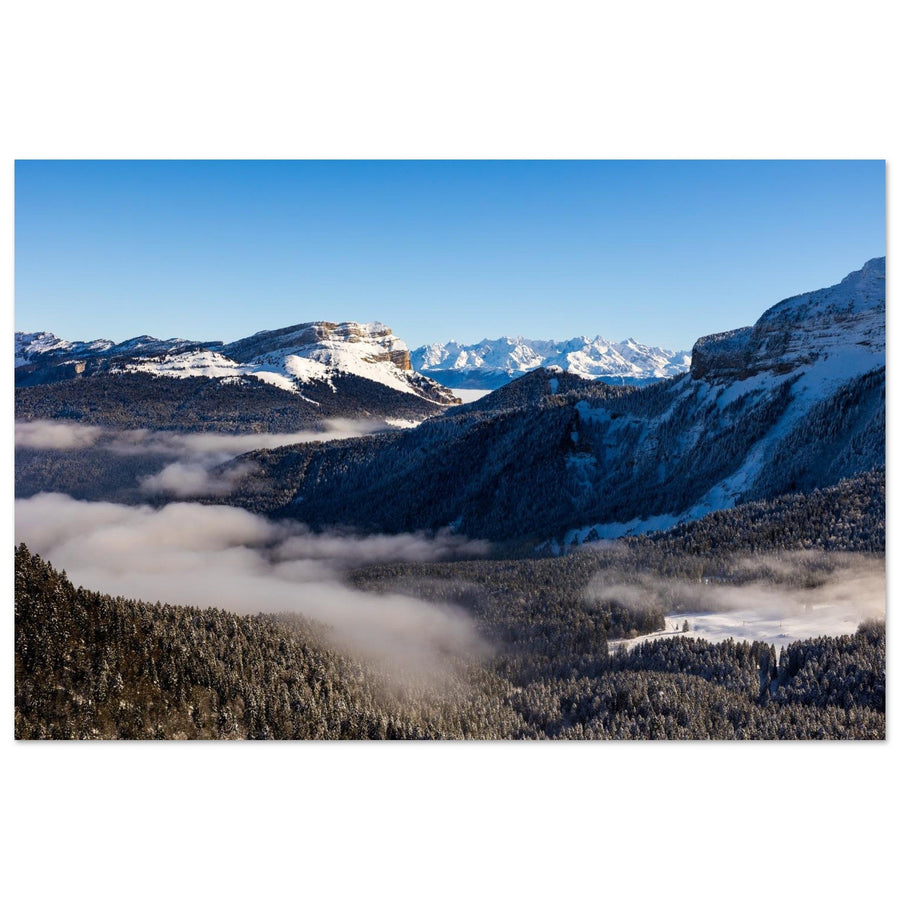
Photographing the Dent de Crolles, the Col du Coq and Les Petites Roches
Updated on July 24, 2026
The Dent de Crolles dominates the Grésivaudan valley with its distinctive large limestone cliff. The Col du Coq provides access to its closest lines, while the Plateau des Petites Roches allows for viewing the cliff facing Belledonne and the vast alpine horizons.
This guide complements the main page Where to photograph the Chartreuse? and focuses on a specific area, to help prepare for a coherent outing rather than just a list of viewpoints.
Dent de Crolles: one cliff, multiple photographic interpretations
The strength of this area lies in its clarity. The cliff contrasts with the dark forests, meadows, and the distant lines of Belledonne. A successful photograph therefore doesn't always aim to enlarge the summit: it shows how the Dent de Crolles organizes the landscape.
From the Col du Coq, the relief appears massive and mineral. From Les Petites Roches, the distance allows for working with successive layers: villages, forest, cliff, sky. Le Charmant Som offers a third, more telephoto-oriented interpretation, where Chartreuse and Belledonne visually draw closer.
Photo of Dent de Crolles and Belledonne from Charmant Som
From the heights of Charmant Som, the view spans the snow-covered peaks of the Chartreuse massif to the Dent de Crolles.
Photography: ldgfr photos
Discover this photo printThe most interesting viewpoints
Col du Coq and Les Ayes parking lot
The Col du Coq is the logical sector for a close approach to the cliff face. The meadows, isolated trees, and slopes beneath the Dent de Crolles provide simple foregrounds. A vertical framing works well when the sky is expressive; a horizontal framing is preferable to tell the story of the relationship with the mountain pastures.
The Plateau des Petites Roches
The plateau offers perspective and an open view towards Belledonne. It's the best choice for a landscape photograph built in multiple planes, especially at sunrise when the valley remains in shadow and the ridges catch the light.
Distant viewpoints from the heart of the Chartreuse
From Charmant Som or certain viewpoints in the massif, a telephoto lens brings the Dent de Crolles and Belledonne closer together. This compression creates graphic images, but requires clear air and very clean framing.
Before taking out your camera, check the separation between the cliff and the background. A few meters of movement are often enough to prevent a ridge, tree, or house from merging with the outline of the summit.
Light, weather, and seasons
The limestone rock gains volume when the light comes from the side. Frontal light flattens the strata; light that is too harsh accentuates white areas without revealing the structure.
- Late winter and early spring: snow highlights the ledges and simplifies the meadows, but access can remain tricky.
- Spring: the green of the plateau contrasts with the still light limestone; the mists of the Grésivaudan add depth.
- Autumn: the forests change color while the first snows may reappear on the ridges.
- Summer: prioritize low light hours and days when the atmosphere remains clear after a disturbed period.
Mist is not necessarily a failure: if the cliff appears in fragments, it can become the main subject. On the other hand, to associate Dent de Crolles and Belledonne, very clear visibility is essential.
Organizing an outing between Col du Coq and Petites Roches
Before sunrise: choose your distance
On the Plateau des Petites Roches, arrive early enough to compare several sightlines before the light touches the cliff. Start by checking the separation between the Dent de Crolles and Belledonne, then look for a simple foreground. At Col du Coq, the priority is different: spot the trees and meadows that can provide scale without obscuring the cliff.
First light: don't chase every shot
When the limestone begins to catch the light, keep one main composition and a tighter variation. Changes are quick, especially if clouds are moving over the Grésivaudan. Constantly switching between wide-angle and telephoto often makes you miss the moment when the strata of the cliff become most legible.
After sunrise: exploit the layers of the landscape
Once the light is higher, the contrast becomes less favorable on the rock, but distant planes sometimes gain clarity. Then use the telephoto lens to combine village, cliff, and Belledonne. A short lateral walk on an authorized path is often enough to make the composition much cleaner.
Photo of a sunset over the snow-covered Chartreuse
Over the Chartreuse massif (between Savoie and Isère), this sunset reveals the snow-covered ridges — Chamechaude, Dent de Crolles, Mont Granier ridge.
Photography: Pierre Thiaville
Discover this photo printComposing a photograph that retains relief
- Working with planes: place meadow or forest edge at the bottom of the image, the cliff in the center, and Belledonne in the background without overloading the sky.
- Keeping space in front of the cliff: a too-tight framing transforms the relief into a simple texture. Negative space gives scale to the summit.
- Using a human line sparingly: a path or a small silhouette can provide scale, provided it doesn't become the main subject.
- Taking advantage of snow: white lines reveal the folds of the rock and allow for almost monochromatic compositions.
Which focal lengths to bring?
- 24–70 mm: for scenes near the Col du Coq and compositions with a foreground.
- 70–200 mm: to isolate the cliff or bring Chartreuse and Belledonne closer from a viewpoint.
- Tripod: useful at dawn, dusk, and to maintain low sensitivity.
- Polarizing filter: use with caution: it can darken the sky, but its effect becomes irregular with wide-angle lenses.
Expose to preserve the bright areas of the limestone and snow. Slight bracketing can help when the valley is dark, but a single well-placed exposure is often enough if you shoot in RAW.
Development and final rendering
Maintain a clear difference between the limestone, the forest, and the distant views. A slight local correction on the cliff is usually sufficient; avoid pushing clarity across the entire image, as trees quickly become dry and the sky fills with halos. In winter, control the blue cast of the snow without completely neutralizing it: it contributes to the feeling of cold and separates the planes.
The mistakes that weaken the image most
- Systematically centering the cliff: the Dent de Crolles becomes massive but static. Offset it when the foreground or the direction of light creates a more natural movement.
- Brightening the entire valley: shadows provide depth. Raising them excessively produces a flat image and makes the relief artificial.
- Confusing proximity and impact: at Col du Coq, too tight a framing removes the meadows and the scale of the site.
- Forgetting the edges of the frame: branches, signs, cars, and cut-off roofs attract the eye more than the summit.
- Approaching a ledge to gain a few meters: no composition justifies leaving a safe path or placing oneself above an unstable slope.
Preparing the outing without sacrificing safety
The Col du Coq is located at 1,434 m and serves as a gateway to the Chartreuse Hauts Nature Reserve. Les Petites Roches offers several viewpoints accessible from the villages on the plateau; the best position depends more on the light than the altitude.
The Dent de Crolles is mountain terrain. Stay on authorized routes, respect the reserve regulations, and turn back if the slopes are icy, visibility drops, or a storm approaches. Dogs are not allowed on several trails in the protected area.
Access conditions, parking, and local rules may change. Consult the official information before departure: Chartreuse Tourisme practical information.
From the field to the photo print
The AluArtMountains selection favors images where the Dent de Crolles remains legible within a broader landscape: snow, raking light, dialogue with Belledonne, or Chartreuse meadows. On matte aluminium Dibond, these contrasts provide a sober rendering that limits reflections without erasing the details of the rock.
Continue in the massif
Frequently Asked Questions
What is the best time to photograph the Dent de Crolles?
Sunrise works particularly well from the Plateau des Petites Roches and the Grésivaudan. From within the massif, late afternoon may better reveal the cliff. The exact orientation and season remain crucial.
What lens should I use at Col du Coq?
A 24–70 mm zoom covers compositions with meadow and cliff. A 70–200 mm becomes useful for isolating the strata, framing a detail, or bringing the Dent de Crolles closer to Belledonne.
Can you photograph the Dent de Crolles in winter?
Yes, but access and slopes can be snowy or icy. Check conditions, necessary equipment, and regulations before going out; photography should never take precedence over safety.
Where can I get the best panoramic view of Belledonne?
The Plateau des Petites Roches offers the most natural perspective. Distant views from the heart of the Chartreuse can also work with a telephoto lens and very clear air.