Where to photograph Lake Presset, its refuge, and the Pierra Menta?
Published on July 30, 2026
Lake Presset, the Presset refuge, and the Pierra Menta form one of the most recognizable landscapes in the Beaufortain region. The lake occupies a small high-altitude basin, the refuge provides a human scale to the scenery, and the Pierra Menta stands out as a mineral monolith above the combes. This relationship between water, architecture, and peak allows for very different images to be constructed without leaving the same area.
However, the site is more demanding than the roadside viewpoints around Roselend. Access requires a real hike, the weather changes quickly, and the first or last light often necessitates a night at the refuge. On site, the composition seems obvious, but the risk is to always reproduce the same image: lake in the foreground, refuge in the center, and Pierra Menta in the background. More precise work on focal lengths, position, and light variations allows one to go far beyond this classic view.
This guide compiles the most useful methods for photographing Presset in summer, autumn, or under snow. It complements the first guide dedicated to Lake Roselend, Roche Parstire, and Saint-Guérin, the main guide to photo spots in the Beaufortain, as well as the selection of Beaufortain photo prints.
The essentials in 30 seconds
- Iconic subject: Lake and Presset refuge facing the immediately recognizable silhouette of the Pierra Menta.
- Best light: Sunrise for colors on the lake and side light to give relief to the monolith.
- Classic access: From Treicol via the GR5 and Col du Bresson, with a sustained climb to the refuge.
- Useful focal lengths: 24–70 mm to connect the lake, refuge, and peak; 70–200 mm to isolate the Pierra Menta and details of the relief.
- Most accessible season: Summer after trails are clear of snow and road access is open.
- Essential tip: Spend a night at the refuge if you are looking for the best light, but book in advance and check current bivouac rules.
Why is Presset a major photographic site?
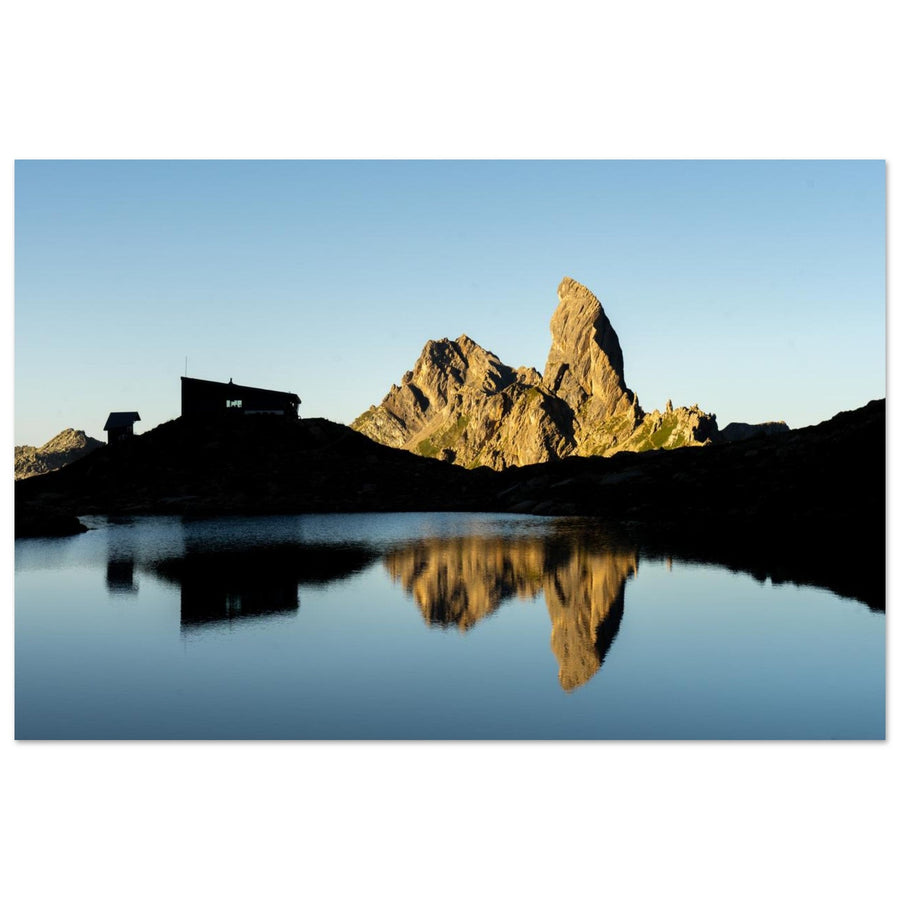
Presset brings together three very strong visual elements in a relatively compact space. The lake provides a dark or reflective surface, depending on the light and wind. The refuge introduces an immediately legible human presence. The Pierra Menta dominates the whole with a vertical silhouette that contrasts with the softer slopes of the basin.
This organization facilitates the reading of the image. In a classic view, the gaze can start from the edge of the lake, pass through the refuge, and then reach the monolith. The three planes are distinct and naturally hierarchical. However, this obviousness is also a trap: if all photographers position themselves in the same place with the same focal length, the images quickly become interchangeable.
The richness of the site comes from the possible movements around the lake and the refuge. A few meters of height or distance modify the relationship between the elements. The refuge can appear at the water's edge, stand out on a slope, or almost disappear under the Pierra Menta. The lake can occupy half of the frame, become a simple dark band, or be completely excluded to prioritize the relationship between the building and the peak.
The sector also allows for working with multiple scales. A wide-angle lens captures the entire basin. A medium focal length tightens the composition around the refuge and the monolith. A telephoto lens isolates the textures of the Pierra Menta, layers of snow, silhouettes of hikers, or ibex observed from a distance.
Which subject to choose depending on the desired image?
| Subject | Atmosphere | Favorable light | Useful focal lengths | Point of vigilance |
|---|---|---|---|---|
| Lake, refuge, and Pierra Menta | Iconic and balanced | Sunrise, partly cloudy sky | 28–70 mm | Overly predictable composition and uninteresting reflection |
| Refuge facing the peak | Human and monumental | Side light, winter or late afternoon | 50–150 mm | Refuge too small or peak cut off |
| Isolated Pierra Menta | Mineral and graphic | Grazing light, mist, or localized clouds | 100–300 mm | Relief flattened by front light |
| Lake and reflections | Calm and contemplative | Windless morning | 24–85 mm | Surface too empty or confused foreground |
| Presset under snow | Isolated and austere | Soft light, clear spell after snowfall | 35–200 mm | Winter access, avalanche risk, and snow exposure |
For a first visit, the overall view remains relevant: it allows one to understand the site and secure an immediately identifiable image. Once this composition is made, move around and change focal length. The most personal images often arise from a detail on the shore, a refuge reduced to a small shape in the snow, or a telephoto shot of the Pierra Menta.
Access to Lake and Presset refuge
Access is a mountain hike and not a simple stroll around a roadside lake. The itinerary presented by the tourist office starts from the Treicol car park, joins the GR5, climbs towards the Col du Bresson, then branches off towards the refuge. The fact sheet indicates approximately 10 kilometers and 830 meters of positive elevation gain. FFCAM data indicates, depending on the exact starting point, about 2 h 30 from Treicol for 750 meters of ascent.
Other access points exist from the Saint-Guérin chapel or the Cormet de Roselend. They are not interchangeable: distance, elevation, exposure, and conditions can vary. The route from Treicol is the most logical for covering the site in a general guide, but each photographer must check the itinerary, road conditions, and weather before departure.
Road access to Treicol passes through the Roselend sector and a passable track. Its usability can change with the season, ongoing works, or weather events. Do not rely solely on a travel time calculated on an application. Check the opening of local roads and allow enough time for the ascent.
The area is at high altitude. Even in summer, a snowfield, a thunderstorm, fog, or strong wind can quickly change the difficulty. A late arrival at the refuge can also complicate settling in and photographic scouting. For a sunrise, the ideal is to ascend early enough the day before to observe the position of the subjects and possible movements around the lake before nightfall.
Photographing Lake Presset
Lake Presset is small compared to the large reservoirs of the Beaufortain. This size is an advantage: it can be fully integrated into the frame without excessively distancing the Pierra Menta. However, its nearby and irregular shores can produce a confused foreground if the position is chosen too quickly.
Start by observing the curves of the edge. A diagonal shore guides the eye better than a perfectly horizontal strip of water. Also look for rocks, grasses, or snow patches that allow you to connect the foreground to the refuge. A nearby element is only useful if it reinforces the direction of the composition.
A full reflection of the Pierra Menta is not always possible or necessary. Wind, sun angle, and the photographer's position can fragment the surface. A simple touch of light in the water or a partial reflection of the refuge is sometimes enough to balance the image. Don't let the expectation of perfect symmetry prevent you from working on other framings.
A long exposure can slightly smooth the surface, but it doesn't create a reflection that isn't there. It also risks erasing useful water textures and giving the lake an artificial appearance. Adjust the duration to your intention: a few tenths of a second to calm small ripples, more only if the movement of clouds or water is truly part of the composition.
Integrating the refuge into the composition
Located at approximately 2,514 meters above sea level, the Presset refuge immediately provides a sense of scale to the landscape. Its geometric form contrasts with the rocks and snow without dominating the whole. It can be treated as a main subject, an anchoring point, or a simple human landmark.
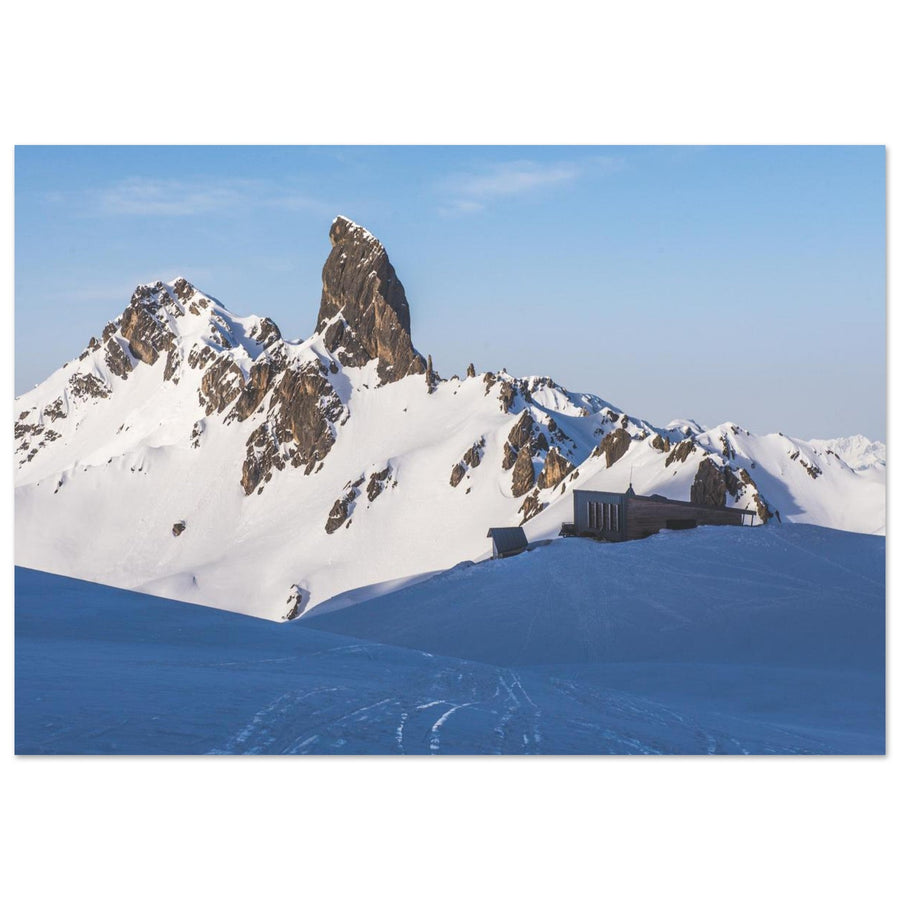
With a medium focal length, visually bring the refuge closer to the Pierra Menta. This proximity accentuates the contrast between the small size of the building and the monolith. Be careful, however, about overlaps: if the roof exactly touches the base of the summit, the two shapes can blend together. A lateral displacement of a few meters is often enough to create a clear separation.
In a wide view, the refuge works well when it is located at the intersection of several lines: shore, path, slope, or shadow. It then becomes the focal point of the composition. Avoid placing it mechanically in the center without any relation to the rest of the image.
Interior lights, when visible during the blue hour, bring a warm presence to a cold environment. Photograph them without disturbing the occupants and without turning the surroundings of the refuge into a studio. The place remains a mountain accommodation and a collective space, not a privatizable set.
Photographing the Pierra Menta
The Pierra Menta culminates at approximately 2,714 meters and is primarily distinguished by its profile. Its visual strength therefore depends not only on its altitude, but on the clear separation between the monolith and the surrounding relief. To preserve this uniqueness, choose an angle where the silhouette remains legible.
Frontal and uniform light reduces the summit to a dark or gray mass. Side light reveals more of the fissures, strata, and textural differences. Clouds can also isolate the monolith, provided they do not completely obscure its summit.
A telephoto lens is particularly suitable. It allows you to reduce the presence of the lake and construct an image around the rock, a layer of snow, or an atmospheric detail. With a person or the refuge in the frame, you get a very strong scale comparison without needing a spectacular foreground.
Avoid excessively saturating warm tones at sunrise or sunset. The Pierra Menta benefits from retaining its mineral quality. Too much color can erase the nuances of the rock and give an artificial appearance to the scene.
Successful sunrise photography at Presset
Sunrise is one of the main reasons to spend the night there. It offers progressive light, colors in the sky, and often a calmer water surface than during the day. Success, however, depends more on scouting than on a particular setting.
The day before, identify at least two positions: a wide view combining the lake, the refuge, and the Pierra Menta, and a tighter framing usable if the sky lacks color. Also check for nearby obstacles, wet areas, and possible movements in the dark.
Start photographing before the sun directly hits the relief. The blue hour allows you to work with the lights of the refuge, silhouettes, and the first colors. As the contrast increases, monitor the histogram and quickly adjust the exposure. Slight bracketing can secure a scene where the sky becomes much brighter than the slopes.
Don't concentrate the entire session on a single composition. The light changes quickly and may become more interesting on the Pierra Menta than on the lake. Alternate wide view, medium focal length, and telephoto without constantly moving the tripod around other people.
Photographing Presset in winter
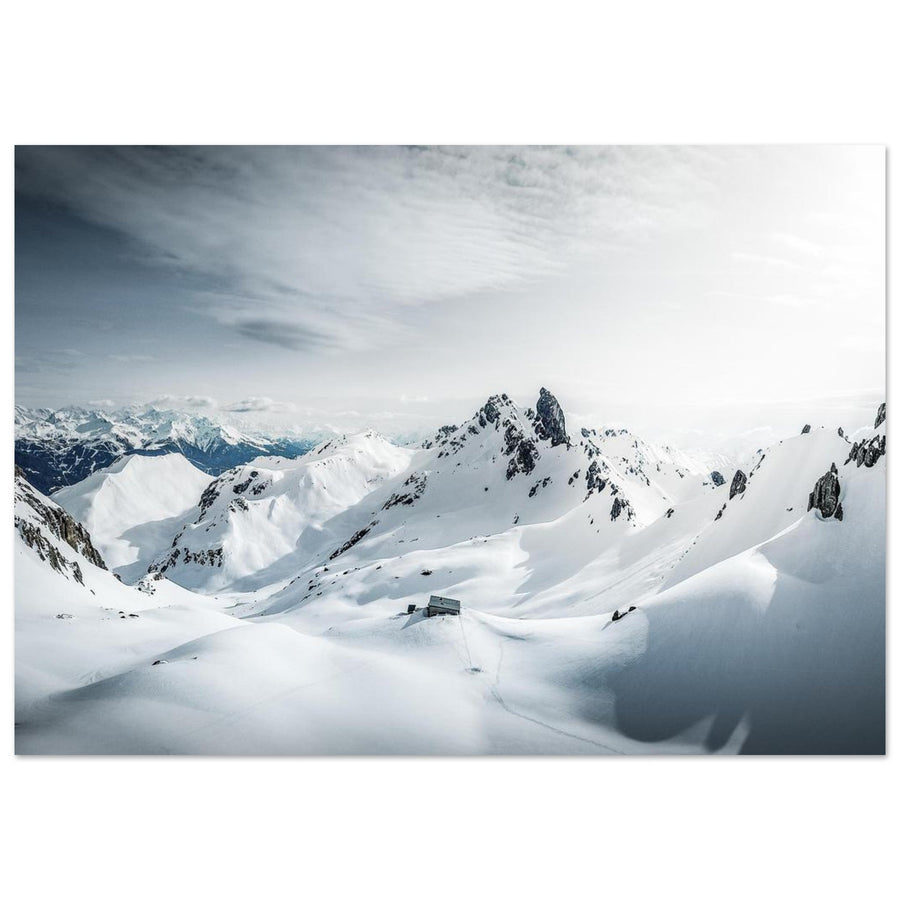
Winter completely transforms the area. The lake partially disappears under the snow, contrasts become more graphic, and the refuge appears even more isolated. The relationship between the building and the Pierra Menta then becomes the main subject.
This period should not be approached as a simple aesthetic variation of a summer hike. Access routes cross avalanche-prone areas and require specific preparation, reading of the avalanche risk assessment bulletin, appropriate equipment, and necessary skills. The FFCAM clearly distinguishes winter access routes and emphasizes this exposure.
In photography, snow requires vigilance regarding exposure. Protect highlights without making everything gray. A positive correction may be necessary depending on the camera's meter, but it must be controlled with the histogram. Bluish shadows and wind-blown reliefs often make better subjects than large, uniform white surfaces.
Cold weather reduces battery life and slows down handling. Keep one battery warm, limit lens changes in the snow, and plan a simple system to protect equipment when returning to a heated environment.
Which season to choose?
Summer is the easiest time to access the lake and the refuge. Trails are generally clear of snow, the refuge is guarded according to its schedule, and days are long. It is also the busiest period.
Early autumn brings lower light and often a calmer atmosphere. Days shorten, and the first snowfalls can quickly change the terrain. Check conditions before you go.
Winter and early spring yield the most striking images but require snow-travel skills and serious avalanche risk management. Refuge guarding varies by season and conditions.
The melting period can be tricky: snowfields, wet ground, and varying crossings complicate access, while the lake and its shores may not always look their best. However, this period can produce original images if approached with caution.
Compositions and focal lengths
24–35 mm to show the basin
This range works when the foreground is useful and you want to maintain space around Pierra Menta. Monitor the size of the peak: if too wide, the monolith quickly loses its impact.
50–85 mm to balance the three subjects
This is often the most effective range for combining the lake, the refuge, and Pierra Menta. It brings the planes closer without completely flattening the depth.
100–200 mm to simplify
The telephoto lens isolates the refuge, the monolith, ibexes, or a series of ridges. It also allows you to work when the sky is bland, by eliminating much of the horizon.
Vertical format
Pierra Menta's verticality lends itself well to this format. Use a shore, a reflection, or the refuge as an entry point, then let the rock guide the eye upwards.
Panoramic format
It suits successions of ridges and the Presset basin but must remain structured. A very wide band encompassing the entire landscape is not automatically more expressive.
Organizing a night at the refuge
To photograph sunset, blue hour, and sunrise, a night at the refuge is the most sensible solution. Check guarding periods and book directly with the refuge. Schedules, capacities, and arrangements may change from one season to another.
Arrive early enough to scout the terrain without pressure. Settle in, identify evening and morning compositions, then check the weather. This preparation reduces unnecessary dark movements and allows you to respect the site's tranquility.
Bivouacking is regulated around the refuge and in the watershed. Refuge information indicates that a reservation and adherence to a specific charter may be required. Therefore, do not pitch a tent near the lake or the refuge without checking the updated rules.
The site welcomes hikers, mountaineers, and people coming to enjoy the refuge. Avoid powerful lights directed at windows, prolonged shooting in high-traffic areas, and installations that block access.
Recommended equipment and settings
- Camera body: a reliable and lightweight camera, protected against humidity and cold.
- Main lens: 24–70 mm or equivalent to cover the landscape and views of the refuge.
- Telephoto lens: 70–200 mm for Pierra Menta, relief details, and distant wildlife.
- Tripod: useful for blue hour, sunrise, and slower exposures on the lake.
- Batteries: at least one spare battery, more in winter.
- Lighting: headlamp with a discreet mode for pre-dawn movements.
For daytime landscapes, f/8 is a good starting point. During blue hour, open up more if necessary rather than excessively increasing exposure time when it's windy. For the lit refuge, ensure interior lights are not blown out.
Focus should follow the actual composition. Automatic hyperfocal distance is not always necessary. When the foreground is distant, focusing on the intermediate relief is often sufficient. For a very close stone on the lake's edge, consider limited focus stacking if conditions are stable.
Safety, wildlife, dogs, bivouacking, and drones
The route crosses active mountain pastures. Stay on marked trails, close fences, and give livestock space. Dogs must be kept on a leash in mountain environments. The Presset hiking sheet indicates that animals are accepted, but this does not exempt you from respecting livestock, wildlife, and any specific refuge restrictions.
The area is known for ibex sightings. Maintain a significant distance, use a telephoto lens, and never change your trajectory to push an animal towards a more photogenic setting. Do not feed them or block their passage.
Swimming in high-altitude lakes and bivouacking around water bodies are regulated locally. General rules published by Arêches-Beaufort specifically prohibit bivouacking within 100 meters of lakes without authorization, while the refuge applies specific rules. Always check the most precise regulations for Presset.
Drones are subject to national restrictions, local rules, and wildlife protection. Consult the official flight restriction map for the exact area and planned date. The presence of aerial photographs from other sectors of Beaufortain does not constitute authorization to take off at Presset.
In winter, consult the avalanche risk assessment bulletin and do not venture out without the appropriate skills and equipment. Photography remains secondary to safety.
Presset and Pierra Menta photo prints
The gallery currently offers several interpretations of the area: sunrise over the lake facing Pierra Menta, a view of the refuge providing scale to the monolith, and a winter scene where the building stands out in the snow-covered combes. These photographs are available in the Beaufortain photo print collection, printed on matte aluminum Dibond and made to order.
To discover a more open and pastoral atmosphere, also consult the guide dedicated to Roselend, Roche Parstire, and Saint-Guérin.
FAQ
How to access the lake and Presset refuge?
The classic access starts from the Treicol car park, joins the GR5 and the Col du Bresson before turning towards the refuge. The official sheet indicates approximately 10 kilometers and 830 meters of positive elevation gain.
How long does it take to climb to Presset refuge?
The FFCAM indicates approximately 2 h 30 from Treicol, excluding snow cover. The actual time depends on pace, backpack weight, breaks, and conditions.
What is the best time to photograph Pierra Menta?
Sunrise is particularly interesting around the lake. Side lighting, in the morning or late afternoon, better reveals the textures of the monolith than front lighting.
Do you need to sleep at the refuge to photograph the sunrise?
It's not an absolute obligation, but it is the safest and most consistent solution for working on sunset, blue hour, and sunrise without a long night walk.
Can you bivouac near Lake Presset?
Bivouacking is regulated in the Presset basin and around the refuge. A reservation and adherence to a charter may be necessary. Rules must be checked directly with the refuge before your outing.
Are dogs allowed on the route?
The official sheet indicates that animals are accepted, but dogs must remain on a leash in mountain environments. Also check the refuge's reception conditions and the presence of livestock.
What focal length should be used to photograph Presset?
A 24–70 mm covers the majority of compositions. A 70–200 mm is useful for isolating Pierra Menta, bringing the refuge closer, and working on relief details.
Can Presset be photographed in winter?
Yes, but access crosses avalanche-prone areas and requires complete winter preparation. Consult the risk bulletin, refuge conditions, and local information before any departure.