Photographing Lyon: The most beautiful viewpoints from Fourvière to Confluence
Photographing Lyon means composing with a city built on several levels. The Saône and the Rhône create two axes, Fourvière and Croix-Rousse provide relief, while Vieux Lyon, the Presqu’île, Part-Dieu, and Confluence bring heritage and contemporary architecture into dialogue.
This guide brings together the most useful viewpoints, lighting, and framing choices to build a coherent series. We also include active works from the gallery to link each ambiance to an actually available photo print of Lyon.
In this guide
Fourvière, Saint-Jean and Saint-Georges: building the city's layers
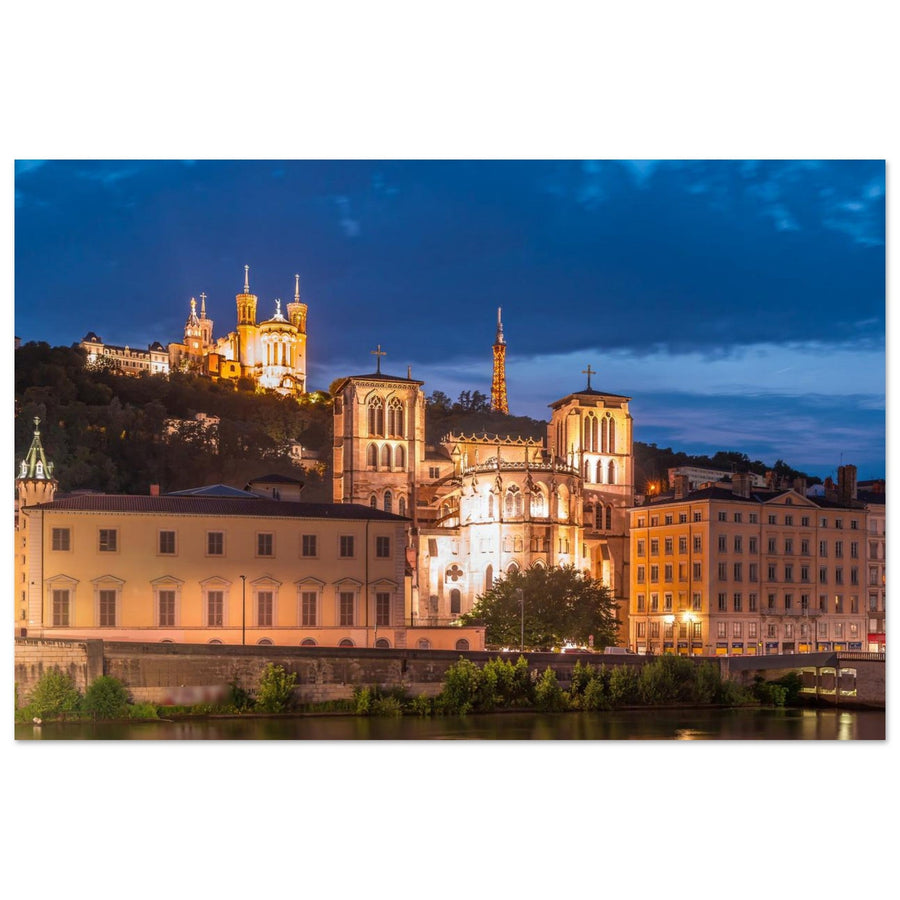
The Fourvière hill gives Lyon an unusual depth for a large city. From the banks of the Saône, the footbridges, or certain high points, the basilica appears above the facades of Vieux Lyon. This superposition allows for an immediately identifiable image without isolating the monument from its surroundings.
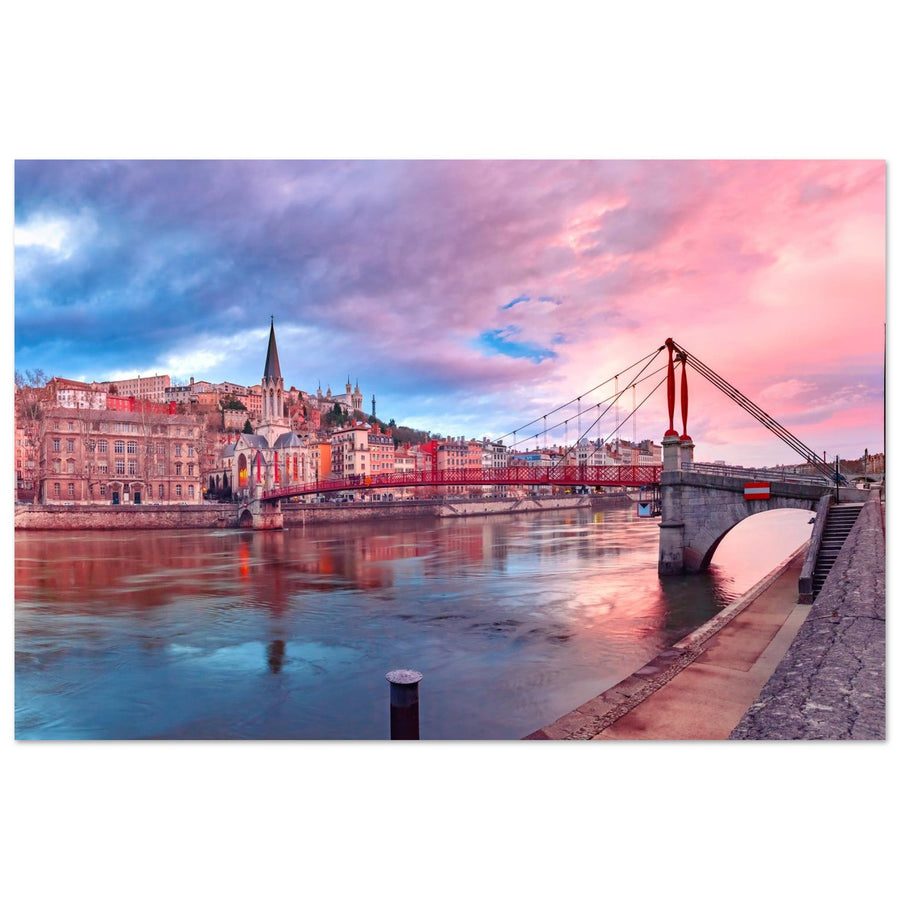
Around Saint-Jean, the cathedral, roofs, old facades, and the hill respond to each other on multiple levels. Further south, Saint-Georges offers a different silhouette, with its church, footbridge, and buildings located at the foot of Fourvière. The view of Saint-Georges and Fourvière at sunset clearly shows how a foreground on the Saône can lead towards the hill.
Composition hint
Check the function of each level before shooting: river or quay in the foreground, facades in the center, Fourvière in the background. If an area provides neither depth nor direction, tighten the frame. This logic aligns with the principles detailed in our guide on depth, lines, and foregrounds.

Saône, footbridges, and Croix-Rousse: using the river's lines
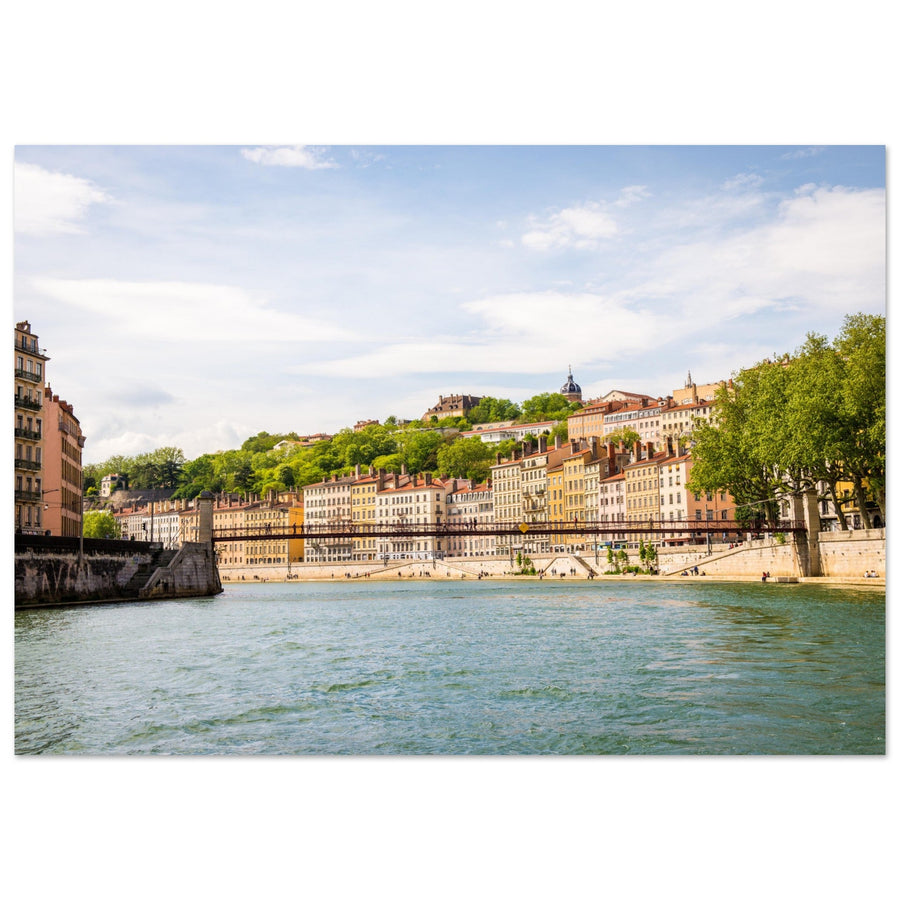
The Saône is one of the best guiding threads for photographing Lyon. Its narrow course brings together the quays, facades, footbridges, and the slopes of Croix-Rousse. The curve of the river naturally creates depth, while a bridge or footbridge can serve as an entry line into the image.
Around the Saint-Vincent footbridge, a medium focal length allows for retaining the scene's proportions without pushing the facades too far back. The photo print of the Saône, Croix-Rousse, and the Saint-Vincent footbridge illustrates this relationship between water, architecture, and urban relief.
Reflections are interesting when the water is calm, but they should not become an obligation. A slightly animated surface often provides a more natural texture. To work on symmetry without confining the composition, the principles of our guide for photographing reflections are directly transposable to the Lyon quays.

Croix-Rousse can also be photographed from its slopes. Stairs, ascents, facades, and openings towards the city favor vertical compositions. From the heights, the Part-Dieu skyline can appear behind the old roofs: the contrast works when the different planes remain legible and the sky does not take up a disproportionate amount of space.
Presqu’île, squares, and heritage: simplifying a dense space
The Presqu’île concentrates several strong scenes: Place des Jacobins, Place des Terreaux, Fontaine Bartholdi, Hôtel-Dieu, and monumental facades. The main challenge is not finding a subject, but simplifying the image in a busy and visually dense environment.
In Place des Jacobins, a slightly offset viewpoint allows combining the fountain with the facades while maintaining a sense of space. Human presence is not necessarily a flaw: a few silhouettes provide scale and anchor the photograph in the city's life, provided they do not cut off the main subject.

At Terreaux, it's better to choose a precise relationship between the Bartholdi fountain, the buildings, and the lines of the square, rather than trying to fit everything into the frame. The Hôtel-Dieu requires a different approach: its long facade and dome are particularly well read from the banks of the Rhône, with the river and the uses of the quay providing depth.
Rhône and Part-Dieu skyline: photographing contemporary Lyon
The Rhône offers a broader reading of the city. The distance between the banks allows for more negative space and combines the bridges, banks, Presqu’île, and the Part-Dieu towers. A focal length between 70 and 200 mm can bring these different planes closer, but it requires monitoring overlaps between buildings and foreground elements.
At dusk, offices, traffic lanes, and reflections form a graphic pattern. An overly bright exposure can lose the atmosphere: it's better to protect highlights and maintain dense shadows. Our guide on settings, ISO, speed, and histogram helps secure this transition between bright and darker areas.

Confluence: glass, metal, bridges and geometry
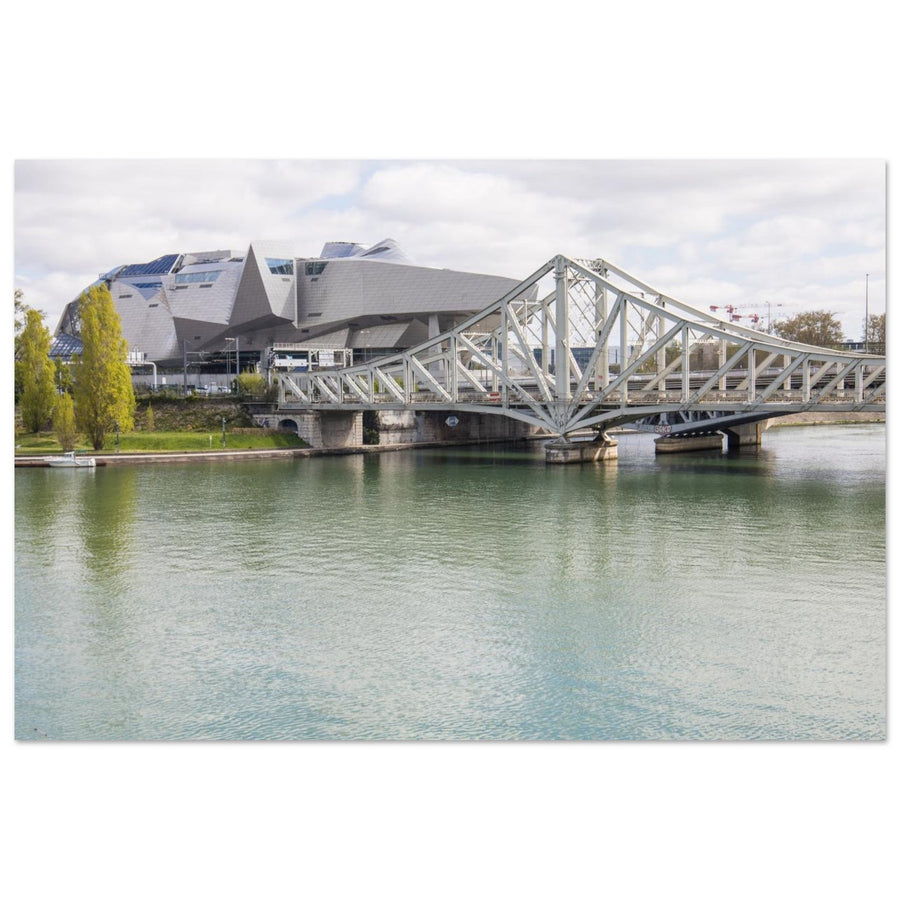
South of the Presqu’île, Confluence offers a very different style. The Musée des Confluences, contemporary buildings, the Raymond-Barre and Pasteur bridges, and the perspectives towards Gerland allow for more geometric images.
The museum works equally well as a wide shot or a tight crop. A wide image places its volumes in the relationship between the rivers and bridges; a closer crop can isolate an edge, a reflection, or an opposition of materials. In both cases, verticals and wide-angle distortions must be controlled.

The curves of the bridges help guide the eye to the background. The photo print of the Raymond-Barre and Pasteur bridges shows how Confluence can maintain a sense of openness despite architectural density. This part of the city complements a series focused on Fourvière and Vieux Lyon by introducing a different scale, other materials, and more contemporary lines.
What light to choose for photographing Lyon?
There is no single light suitable for the entire city. The best time depends on the neighborhood, the orientation of the viewpoint, the weather, and the desired atmosphere.
Morning
Foot traffic is often lighter, and the quays appear calmer. Soft light facilitates managing contrasts in narrow streets and squares.
Late afternoon
Warm tones enhance the stones, roofs, and facades of Vieux Lyon. To anticipate the rapid evolution of this light, consult our guide dedicated to the golden hour.
Blue hour
The sky still retains some color while urban lights become visible. This period is suitable for quays, bridges, Fourvière, and the skyline. Our guide to photographing the blue hour details exposure and stability.
Fog and overcast sky
Fog separates planes and creates a more intimate atmosphere around Saint-Georges, Vieux Lyon, or the slopes of Croix-Rousse. An overcast sky is also suitable for architectural details and black and white photography.

Focal lengths, settings and composition: what equipment to use in Lyon?
16–35 mm: close architecture
The wide-angle is useful when space is limited, in narrow streets or around the Confluence museum. It requires special attention to verticals and elements placed on the edges.
24–70 mm: the versatile range
This range covers most Lyon scenes: squares, quays, bridges, or relationships between several buildings. Around 50 to 70 mm, planes gain presence without losing all their context.
70–200 mm: bringing planes closer
The telephoto lens allows for superimposing Fourvière, roofs, footbridges, or the Part-Dieu towers. It also helps to isolate a portion of a facade or a specific light.
Starting settings
For a sharp urban scene from foreground to background, start around f/8, adapt the shutter speed to any movement, and keep the sensitivity as low as possible. Handheld, shutter speed remains priority; on a tripod, mainly control highlights and vibrations of the support.
The horizontal format suits rivers, bridges, and skylines. The vertical format emphasizes an ascent, a tower, or a narrow street. The panoramic format works when a real continuity connects the quays, facades, and the horizon line; it should not merely serve to retain large empty areas.
Which photo print of Lyon to choose for your interior?
The choice does not solely depend on the represented location. It is also important to consider the image's density, its palette, its orientation, and the available viewing distance.
A heritage ambiance
Fourvière, Saint-Jean, Saint-Georges, and the facades of Vieux Lyon provide an immediately recognizable identity. Warm lights complement wood, stone, and natural tones.
A calm atmosphere
Fog, quiet quays, and muted palettes are suitable for a bedroom, office, or reading nook. A less saturated image can remain present in a large format without dominating the entire room.
A graphic interior
Confluence, bridges, nocturnal views, and black and white work particularly well with contemporary lines, white, grey, metal, or dark furniture.
A large wall
River views, skylines, and horizontal compositions truly shine above a sofa, sideboard, or desk. A well-proportioned artwork is often more impactful than an accumulation of small formats.
The artworks from the gallery are offered on matte aluminium Dibond, made to order in France. This support offers excellent flatness and limits reflections while preserving the precision of architectural details and the depth of colors.
To proportion the artwork to your space, consult the guide What size to choose for a photo print?, then use the wall simulation to check the scale before ordering.
Lyon, a city to photograph through relationships rather than monuments
The most powerful images are not necessarily those that show the most famous places. A footbridge leading to Croix-Rousse, a fog separating Saint-Georges from neighboring facades, or a bridge opening towards the skyline can tell more than an exhaustive view.
By varying heights, focal lengths, and lighting conditions, historic Lyon, its rivers, and contemporary architecture can form a coherent series. The gallery extends this approach with works by several photographers, each attributed to its true author on its product page.