Écrins | Photographing the Plateau d’Emparis
The Plateau d’Emparis is more than just two lakes facing La Meije. Its identity comes first from its shape: a vast alpine plateau perched at over 2,000m, open above the upper Romanche valley, facing the northern face of the Écrins. The terrain is gentler than the great walls that close the horizon, and this contrast creates a very particular sense of depth in photography.
Water is part of the landscape, but it is only one component. Lac Lérié, Lac Noir, the streams, the meadows, the sheepfolds, and the alpine lines offer several ways to construct the foreground. La Meije may dominate the background, but the image remains a photograph of Emparis only when the plateau is essential to reading it.
The Emparis-Ferrand Natura 2000 site also reminds us that this landscape is shaped by both natural factors and human activities, particularly pastoralism. Photographing here therefore means working in a living space: alpine pastures, herds, shepherds, and livestock guardian dogs are all part of the location's actual functioning.
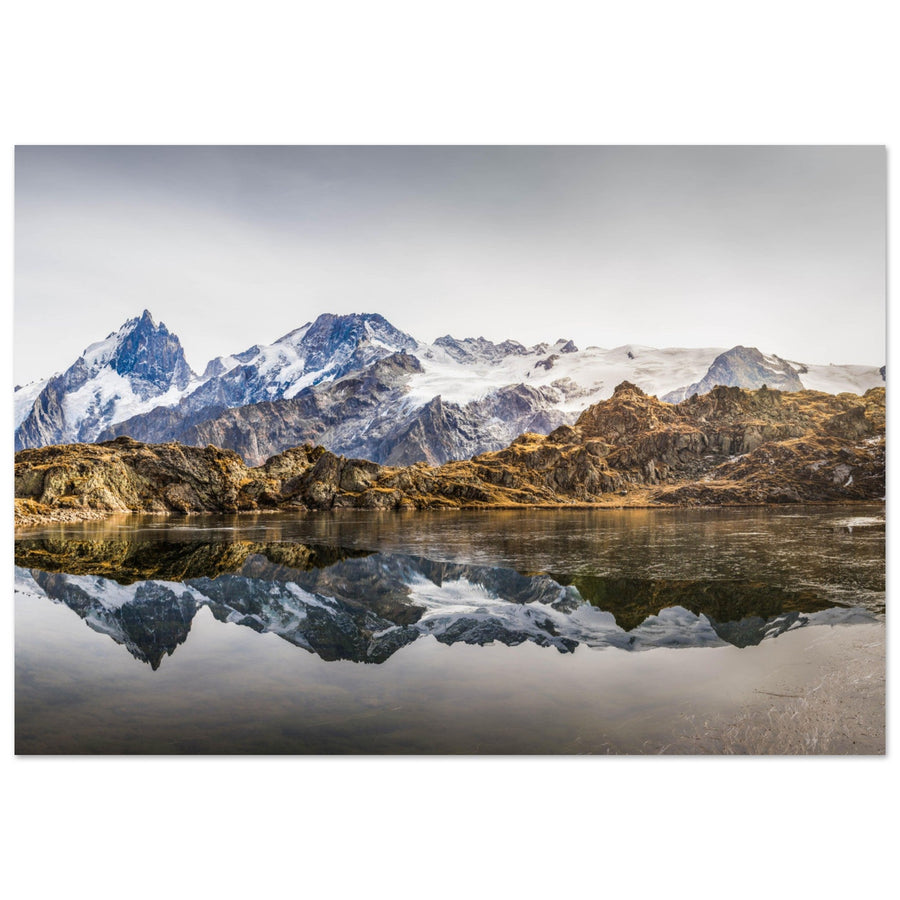
Header photograph: Pierre Thiaville — Reflection of La Meije on Lac du Lérié on the Plateau d’Emparis.
Reading time: 12 min
The essentials in 30 seconds
- The subject is the plateau: openness, alpine pastures, lakes, streams, and the contrast with the high mountains in the background.
- Lac Lérié and Lac Noir are two strong components, not two mandatory checkpoints to be reproduced in the same way.
- A reflection of La Meije is possible when water conditions permit; it should never be considered guaranteed.
- If the water is rippled, the banks, alpine lines, ponds, sheepfolds, or relief layers offer other compositions.
- The Col du Souchet and documented routes allow for a broader understanding of the plateau and its role as a lookout.
- A standard lens easily maintains the relationship between the plateau and the summits; a longer lens helps simplify the background.
- Pastoralism must be integrated as a reality of the territory: do not change your path or that of a herd to construct an image.
- Trail conditions, snow cover, and weather conditions should be checked before heading out.
Read the plateau before the lakes
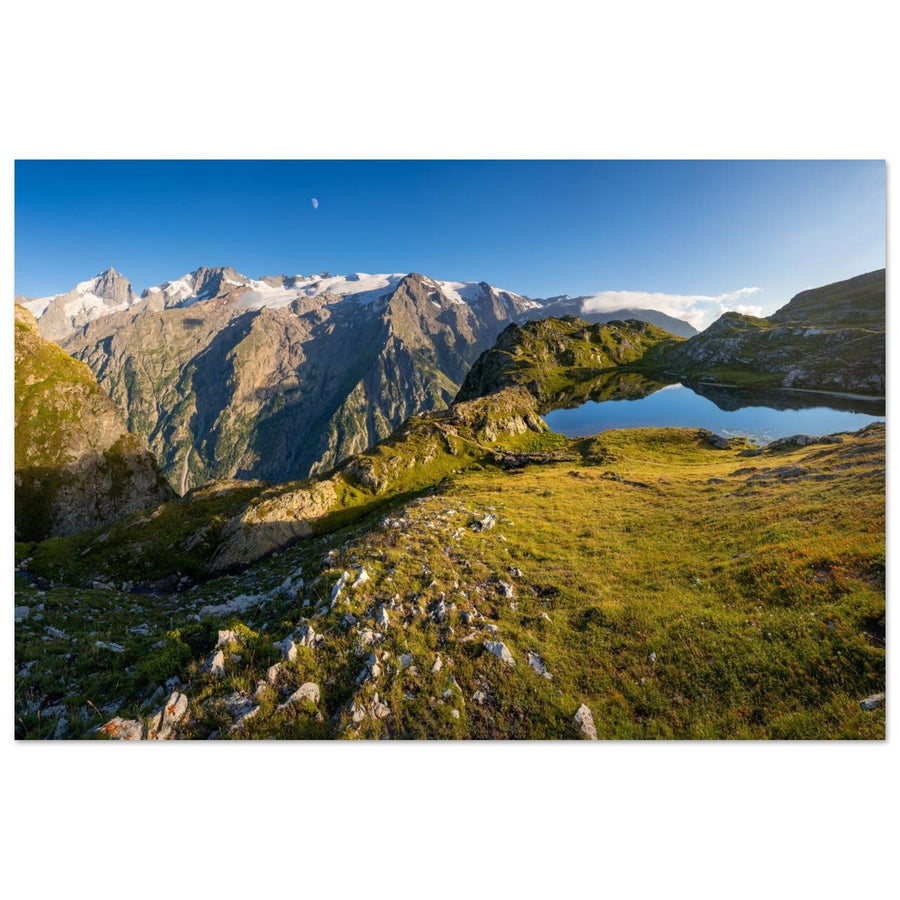
The Natura 2000 site describes Emparis as a vast alpine plateau overlooking the upper Romanche. This relative horizontality is essential for photography: it leaves space between the foreground and the Écrins, which allows for images constructed in layers rather than suffering from an immediately frontal mountain view.
The alpine pastures can form large, simple areas. A curve in the terrain, a path, or a break in the slope is often enough to provide direction. The frame benefits from remaining sober: the openness of the plateau works precisely because it contrasts with the much denser relief of La Meije and the glaciers in the background.
The plunging views toward the Malaval valley, the high-altitude sheepfolds, and the meadow sectors documented by Destination Écrins show that the plateau has its own identity even without a lake in the frame. Water is therefore not a prerequisite for a successful photograph.
To maintain this sensation of space, avoid systematically filling the foreground. A well-drawn strip of alpine pasture can be more effective than a cluttered heap of rocks, grass, and flowers without hierarchy.
Lac Lérié: water as a component of the plateau
Lac Lérié is documented facing La Meije, Le Râteau, and the Girose glacier. This relationship naturally creates a multi-layered composition: bank, water, plateau, then high mountains.
A photograph by Pierre Thiaville shows La Meije reflected in Lac Lérié. This scene does not imply that an identical reflection is frequent, nor that it corresponds to a specific time.
When the water is calm and the reflection is clear, symmetry can become a strong choice. But it is not mandatory. A diagonal bank can provide more depth; a slightly rippled surface can become a texture; a tighter frame can reduce the amount of water and strengthen the relationship between the plateau and the mountain.
Before centering the horizon, ask yourself what is actually carrying the image. If the reflection is precise and balanced, a more symmetrical composition can work. If it is incomplete, place more weight on the bank, the plateau, or the background rather than forcing an absent mirror effect.
Lac Noir: changing your relationship with water
Lac Noir belongs to the same plateau ensemble and is also documented facing the great reliefs of the Écrins. It should not be approached as a second version of Lac Lérié.
Look first at what its bank and basin offer from your actual position: a curve, a darker strip of water, a more mineral foreground, or a different relationship with the relief. The goal is not to produce two identical images a few hundred meters apart, but to let each situation impose its structure.
If no convincing composition presents itself around the lake, the plateau remains the subject. A photograph of Emparis does not need to check a box for water bodies.
Col du Souchet and overall view
The Col du Souchet constitutes a documented landmark for plateau routes. Official courses highlight the relationship between the open spaces of Emparis and the great glacial mountain opposite.
From lookout areas, a standard focal length allows you to preserve the width of the plateau and multiple layers of relief. A longer focal length can reduce the sky, visually bring the ridges closer, and give more presence to La Meije without completely removing the plateau.
The question to ask yourself is simple: what still makes the image feel like Emparis? A strip of alpine pasture, a line of terrain, a bank, or a pastoral element may suffice. If all these elements disappear and only La Meije still matters, the photographic intent has changed.
Photographing Emparis without reflections
Preparing a trip solely around a perfect mirror effect makes photography dependent on a phenomenon that is not guaranteed. Fortunately, Emparis offers many other structures.
Banks can form lines. Streams and small areas of water can separate layers. Alpine pastures create simple surfaces. Paths can lead toward the horizon. Sheepfolds provide a human scale to the plateau when they are integrated without becoming the main subject.
A moody sky can enhance the depth between the plateau and the Écrins. If La Meije is partially obscured, a lower composition, centered on the shapes of Emparis, can remain perfectly coherent.
With a telephoto lens, it is also possible to extract a succession of ridges or a portion of La Meije while keeping a strip of the plateau in the foreground. This strip is often enough to maintain the territorial relationship rather than turning the image into a simple portrait of a summit.
Pastoralism: photographing a living landscape
The Emparis-Ferrand Natura 2000 site presents pastoralism as the primary professional activity in the area. The alpine pastures, herds, shepherds, and herding or protective dogs are not decorative elements added to the landscape: they participate in its shape and its use.
For a photographer, this reality imposes a clear limit. Do not walk through a herd in search of a better foreground. Do not ask a shepherd to move animals for a composition. Keep your distance and follow the instructions found on-site, especially in the presence of livestock guardian dogs.
A herd can provide scale if it is already present in the landscape, but it should never be staged at the expense of pastoral work or animal welfare.
The Natura 2000 site also catalogs grasslands, lakes, springs, brooks, marshes, wet meadows, peat bogs, and rocky habitats. This diversity explains why the plateau changes appearance depending on the sector.
Composing with the softness of the plateau and the power of the Écrins
The visual strength of Emparis comes from the contrast between two families of shapes: the more horizontal and flexible lines of the plateau, and the steep reliefs of the high mountains in the background.
Use this opposition rather than trying to neutralize it. A large alpine pasture area can serve as breathing room before the summits. An almost horizontal bank can accentuate the verticality of La Meije. A distant moraine or a dark ridge can separate the planes.
Wide-angle is relevant when the foreground has a clear structure. Without this structure, it pushes the summits away and gives too much importance to an empty area of the plateau.
A standard 24–70mm focal length generally offers more control over the relationship between the foreground and the mountain. A longer range, like 70–200mm, makes it possible to simplify the landscape, isolate a succession of ridges, or give more presence to La Meije while retaining a sign of the plateau.
These choices are composition tools, not prescriptions linked to an exact point.
Light, clouds, and water conditions
The selected sources do not allow for determining a best sunrise, sunset, or optimal photographic season for the plateau. The choice must start from the visible conditions.
When the water is calm, a reflection can become the center of the composition. If it is rippled, use the texture, the bank, or the planes of the plateau instead. When the summits are partially in the clouds, check whether this atmospheric layer adds depth or completely removes the image's anchor point.
Diffuse light can make the surfaces of the plateau more homogeneous and preserve detail. More contrasting light can create distinct zones between the pasture, water, and mountains. In both cases, observe the scene before choosing the frame rather than starting from a supposedly ideal schedule.
Compositions to prepare
Layered plateau — pasture, intermediate relief, and Écrins follow one another clearly.
Lake and mountain — water serves as a separation between the bank and the background.
Conditional reflection — symmetry is used only if it actually exists.
Diagonal bank — the waterline guides the gaze toward the summits.
Discreet pastoralism — a sheepfold or a herd already present provides scale without taking control of the frame.
Plateau without a lake — paths, grasses, and terrain curves are enough to construct the image.
Territorial telephoto — a portion of the plateau remains visible beneath the great reliefs to preserve context.
When the scene does not match the plan
No reflection: abandon symmetry and work the bank, the texture of the water, or the relief of the plateau.
La Meije disappears: reduce dependence on the background and photograph the lines of Emparis themselves.
Foreground too empty: change your position slightly or use a longer focal length rather than artificially adding elements.
Too much detail in the pasture: simplify with a strong line or tighten the frame.
Herd on your path: adapt your route and respect pastoral operations.
Trail or access degraded: change your plan and consult recent official information.
Access and safety
Destination Écrins documents hiking routes to Lac Noir and Lac Lérié from Le Chazelet. These are real mountain routes with distance and elevation gain, not immediate access to a photo spot.
Besse-en-Oisans also constitutes an official documented starting point toward the plateau lakes: the loop joins Lac Lérié then Lac Noir before returning to Besse. This approach provides another territorial entry into Emparis.
From Mizoën, the official documented courses are more involved: Destination Écrins offers multi-day treks that reach the plateau and its lakes. Oisans also describes the foot access via the GR54C as demanding and sometimes exposed. Mizoën should therefore not be presented as a shortcut equivalent to Le Chazelet.
Traffic rules on the pastoral tracks of Besse and Mizoën can be seasonal. If motorized access is considered, check the regulations in force before setting out rather than relying on outdated information.
Official documents remind us that accessibility varies according to snow cover, winter damage, and weather, and that trail conditions are not checked daily. Therefore, check recent information before leaving.
The plateau is also a pastoral space. Stay on adapted routes, respect instructions related to herds and livestock guardian dogs, and avoid needlessly trampling wetlands or banks to find a framing.
The Natura 2000 designation should not be transformed into a list of supposed prohibitions. Precise rules applicable to a practice or a sector must be verified with the competent authorities when they are necessary for your trip.
Work and collection
This work illustrates the relationship between water, the plateau, and La Meije. It shows a reflection actually photographed at Lac Lérié without allowing its appearance conditions to be generalized.

Photo of La Meije reflected in Lac du Lérié, Plateau d’Emparis
This work shows a real scenario of reflection and the relationship between water, plateau, and high mountains, without guaranteeing this condition.
Photograph: Pierre Thiaville
See the photo of La Meije at Lac du LériéOfficial sources
- Natura 2000 Emparis-Ferrand — site presentation
- Natura 2000 Emparis-Ferrand — human activities
- Destination Parc national des Écrins — Plateau d’Emparis and its lakes
- Destination Parc national des Écrins — Lac Noir and Lac Lérié from Le Chazelet
- Destination Parc national des Écrins — Mules' trail
- Écrins National Park Destination — Plateau d’Emparis lakes from Besse
- Écrins National Park Destination — 4-day tour of the Plateau d’Emparis from Mizoën
- Natura 2000 Emparis-Ferrand — access via the Besse and Mizoën pastoral tracks
Frequently Asked Questions
Is the Plateau d’Emparis limited to just the Lérié and Noir lakes?
No. While the lakes are two important components, the identity of the plateau is also defined by its alpine pastures, open terrain, mountain streams, sheepfolds, and its function as a viewpoint facing the Écrins range.
Can you take an interesting photo without a reflection of La Meije?
Yes. Use a shoreline as a lead-in line, the curves of the plateau, the pastures, paths, or a series of ridges. A reflection is a possibility depending on water conditions, not a requirement for success.
How can I use alpine pastures without cluttering the frame?
Look for a simple shape: a curve, a strip of meadow, a path, or a slope break. A large, simple area can serve as breathing space in front of the much more complex high-mountain scenery.
How much space should I give La Meije in the frame?
It can close off the background or become more prominent with a long lens. To ensure the image remains a story about Emparis, include an element of the plateau—shoreline, pasture, terrain, or pastoral structure—that truly contributes to the composition.
How should I behave near livestock and livestock guardian dogs?
Keep your distance, follow the instructions found on-site, and adapt your route rather than the animals'. A photograph is never worth disrupting pastoral work.
What should I check before choosing an access point to the Plateau d’Emparis?
The condition of the trail, snow coverage, weather, and the difficulty of the chosen route. Le Chazelet, Besse-en-Oisans, and Mizoën offer different types of approaches. For Besse or Mizoën, also check the regulations in effect if you plan to use a pastoral track or motorized access.
Building the Plateau d’Emparis in multiple layers
Pastures, lakes, and distant peaks allow for multiple compositions; a reflection remains a possibility, never a requirement for success.